10.2.1 Formulae and structures of the alkanes
The first four alkanes and their formulae
Alkane
A saturated hydrocarbon with the general formula CnH2n+2.
- Methane is CH4\text{CH}_4CH4, with a single carbon atom.
- Ethane is C2H6\text{C}_2\text{H}_6C2H6.
- Propane is C3H8\text{C}_3\text{H}_8C3H8.
- Butane is C4H10\text{C}_4\text{H}_{10}C4H10.
- Each fits the general formula CnH2n+2\text{C}_n\text{H}_{2n+2}CnH2n+2, so the count of hydrogens follows from the carbons.
Knowing the general formula makes any alkane's molecular formula available without recall.
Drawing the structure means showing every bond
Covalent bond
A shared pair of electrons between two atoms, attracted to the nucleus of each.
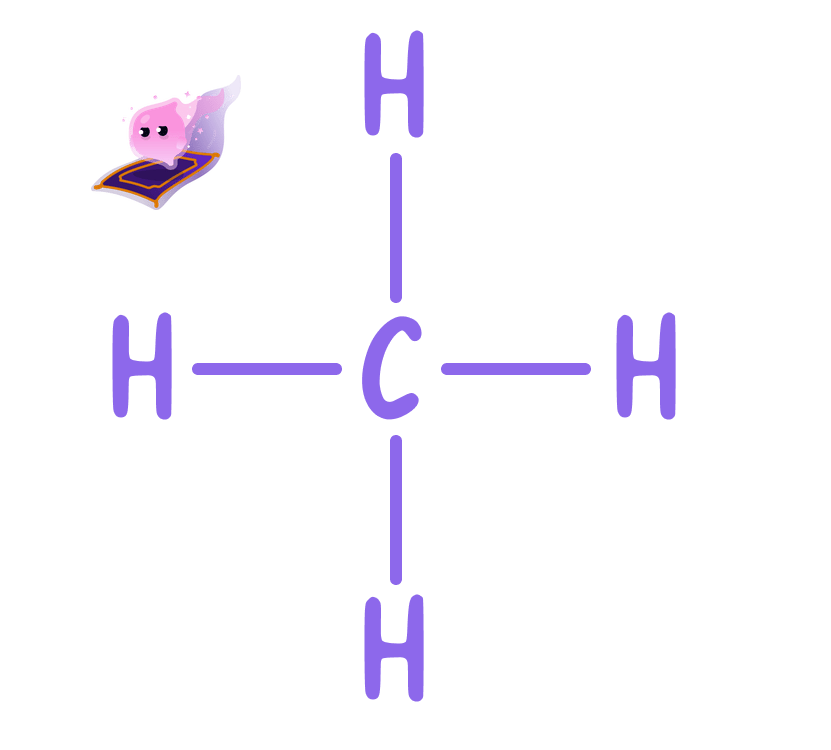
- A structure shows each atom and every covalent bond as a line between two atoms.
- Every carbon atom has four lines drawn to it, because carbon forms four bonds.
- Every hydrogen atom has exactly one line, because hydrogen forms one bond.
- The carbons are drawn in a chain, joined to one another by single lines.
- The remaining bonds on each carbon are filled with hydrogen atoms.
- Methane: one carbon with four hydrogens attached, four lines in all.
- Ethane: two carbons joined by one line, each carrying three hydrogens.
- Propane: three carbons in a row; the middle one carries two hydrogens, the end ones three each.
Counting the bonds as a check
- The number of lines drawn to each carbon must come to four, every time.
- A carbon with only three lines has a missing hydrogen.
- The total number of hydrogen atoms drawn must match the molecular formula.
- Propane has eight hydrogens, arranged three, two and three along the chain.
- Butane has ten, arranged three, two, two and three.
A structure with a carbon showing fewer than four bonds is wrong, however tidy it looks.
Alkanes are saturated
Saturated hydrocarbon
A hydrocarbon whose carbon atoms are joined only by single bonds.
- Every bond between carbon atoms in an alkane is a single bond.
- A molecule whose carbons are joined only by single bonds is saturated.
- Saturated means the molecule holds as many hydrogen atoms as it can.
- No more hydrogen can be added without breaking an existing bond.
- This is what separates the alkanes from the alkenes, which have a double bond.
- Give the molecular formulae of methane, ethane, propane and butane.
- How many bonds does each carbon atom form?
- Describe the structure of ethane, showing where each bond goes.
- What does saturated mean?
- Use the general formula to give the formula of the alkane with five carbons.
10.2.2 Alkenes and the C=C functional group
The alkenes and their formulae
Alkene
An unsaturated hydrocarbon containing a carbon to carbon double bond, with the general formula CnH2n.
- Ethene is C2H4\text{C}_2\text{H}_4C2H4, the smallest alkene.
- Propene is C3H6\text{C}_3\text{H}_6C3H6.
- Butene is C4H8\text{C}_4\text{H}_8C4H8.
- Each fits the general formula CnH2n\text{C}_n\text{H}_{2n}CnH2n.
- An alkene has two fewer hydrogens than the alkane with the same number of carbons.
The two missing hydrogens are the sign that a double bond is present.
The double bond is the functional group
Functional group
The group of atoms in a molecule that gives a homologous series its characteristic reactions.
- Every alkene contains a carbon to carbon double bond, written C=C\text{C}=\text{C}C=C.
- That double bond is the alkene functional group.
- Such a group is what gives a family its characteristic reactions.
- The rest of the molecule is a chain of carbons carrying hydrogen atoms.
- Every alkene reacts in a similar way because every one contains the same group.
The double bond is drawn as two lines between the two carbon atoms.
Drawing the structures
- Each carbon still forms four bonds in total, with the double bond counting as two of them.
- Ethene is two carbons joined by a double bond, each carrying two hydrogens.
- Propene is three carbons, with the double bond between the first and second.
- The carbon at the end of the double bond carries two hydrogens, and the middle one carries a single hydrogen.
- The third carbon in propene is joined by a single bond and carries three hydrogens.
- But-1-ene: four carbons with the double bond between the first and second.
- But-2-ene: four carbons with the double bond between the second and third.
- Same formula: both are C4H8\text{C}_4\text{H}_8C4H8, and only the position of the double bond differs.
Alkenes are unsaturated
Unsaturated hydrocarbon
A hydrocarbon containing at least one carbon to carbon double bond.
- A molecule containing a carbon to carbon double bond is unsaturated.
- Unsaturated means the molecule could hold more hydrogen than it does.
- The double bond can open so that two more atoms join on.
- An alkane cannot do this, since it has no double bond to open.
- This difference is what makes alkenes far more reactive than alkanes.
- Give the molecular formulae of ethene, propene and butene.
- What is the functional group in an alkene?
- Give the general formula of the alkenes.
- How do but-1-ene and but-2-ene differ?
- Why are alkenes described as unsaturated?
10.2.3 Addition reactions of alkenes and testing for unsaturation
An addition reaction opens the double bond
Addition reaction
A reaction in which two molecules join to form a single product, with nothing else formed.
- The double bond between the two carbons opens up.
- Each of those carbons then has a spare bond to use.
- An atom joins onto each of the two carbons.
- A single product is formed, with nothing else made alongside it.
- The product is saturated, since the double bond has gone.
Addition is possible only because the molecule is unsaturated: there is a bond to open.
Ethene reacts with bromine
- Bromine, Br2\text{Br}_2Br2, adds across the double bond of ethene.
- One bromine atom joins to each of the two carbon atoms.
- The equation is: C2H4+Br2→C2H4Br2\text{C}_2\text{H}_4 + \text{Br}_2 \rightarrow \text{C}_2\text{H}_4\text{Br}_2C2H4+Br2→C2H4Br2
- The product is 1,2-dibromoethane, with a bromine on each carbon.
- Its structure is two carbons joined by a single bond, each carrying two hydrogens and one bromine.
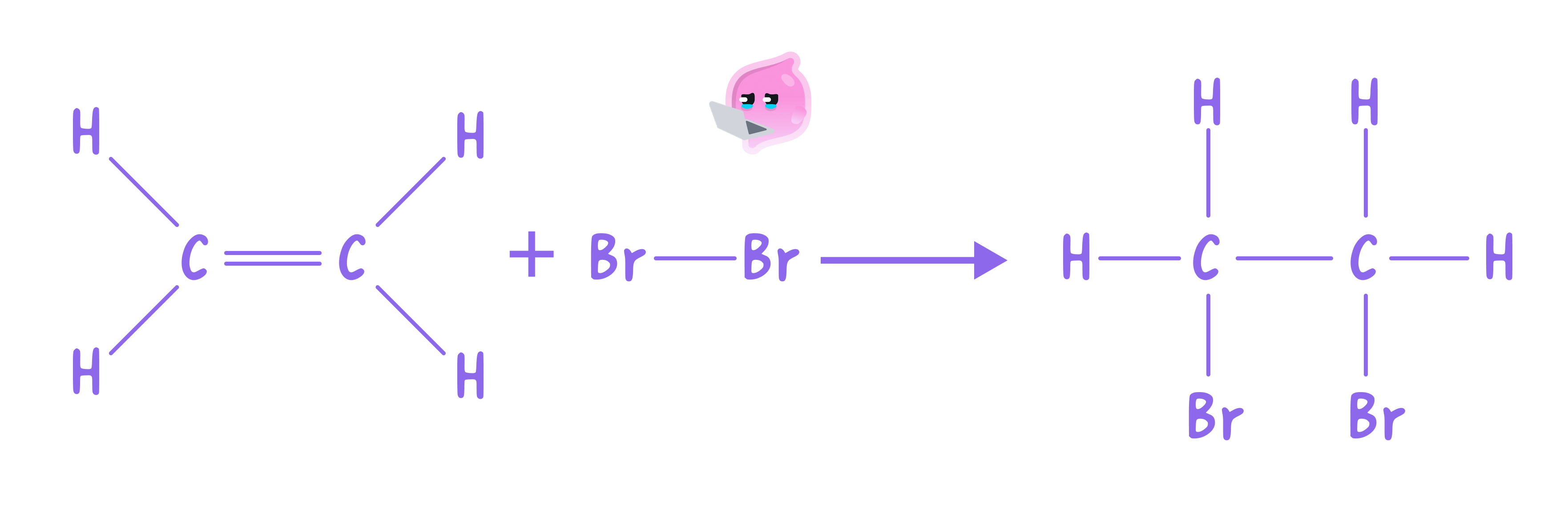
- Before: two carbons joined by a double bond, two hydrogens on each.
- After: two carbons joined by a single bond, each with two hydrogens and one bromine.
The same reaction works for other alkenes
- Every alkene has the same functional group, so every one reacts in the same way.
- Propene adds bromine to give 1,2-dibromopropane.
- The pattern extends directly: C3H6+Br2→C3H6Br2\text{C}_3\text{H}_6 + \text{Br}_2 \rightarrow \text{C}_3\text{H}_6\text{Br}_2C3H6+Br2→C3H6Br2
- The two bromine atoms always end up on the carbons that held the double bond.
- The rest of the molecule is unchanged by the reaction.
Predicting the product means finding the double bond and putting one atom on each of its carbons.
Bromine water distinguishes alkanes from alkenes
- Bromine water is orange.
- It is shaken with the hydrocarbon being tested.
- With an alkene it turns colourless, because the bromine has been used up in addition.
- With an alkane it stays orange, because there is no double bond to react with.
- Orange to colourless is therefore the positive result for an alkene.
Colourless is not the same as white, and describing the result wrongly loses the point.
- What happens to the double bond in an addition reaction?
- Write the equation for ethene reacting with bromine.
- Name the product of that reaction and describe its structure.
- Predict the product when propene reacts with bromine.
- Describe how bromine water distinguishes ethane from ethene.
10.2.4 Combustion of alkanes and alkenes
Complete combustion oxidises the hydrocarbon
Complete combustion
Burning in a plentiful supply of oxygen, which gives carbon dioxide and water.
- Burning an alkane or an alkene in plenty of oxygen is complete combustion.
- Every carbon atom is oxidised to carbon dioxide.
- Every hydrogen atom is oxidised to water.
- The hydrocarbon has gained oxygen, which is what oxidation means here.
- Energy is given out, so the reaction is exothermic.
Alkanes and alkenes burn to the same two products, because both contain only carbon and hydrogen.
Writing the equation for an alkane
- Methane burns completely to give: CH4+2O2→CO2+2H2O\text{CH}_4 + 2\text{O}_2 \rightarrow \text{CO}_2 + 2\text{H}_2\text{O}CH4+2O2→CO2+2H2O
- Ethane needs more oxygen for the same reason: 2C2H6+7O2→4CO2+6H2O2\text{C}_2\text{H}_6 + 7\text{O}_2 \rightarrow 4\text{CO}_2 + 6\text{H}_2\text{O}2C2H6+7O2→4CO2+6H2O
- Each carbon in the formula gives one carbon dioxide molecule.
- Each pair of hydrogens gives one water molecule.
- Oxygen is balanced last, once the products are fixed.
Propane: C3H8\text{C}_3\text{H}_8C3H8 gives three CO2\text{CO}_2CO2 and four H2O\text{H}_2\text{O}H2O.
Writing the equation for an alkene
- Ethene burns completely to give: C2H4+3O2→2CO2+2H2O\text{C}_2\text{H}_4 + 3\text{O}_2 \rightarrow 2\text{CO}_2 + 2\text{H}_2\text{O}C2H4+3O2→2CO2+2H2O
- The products are the same two substances as for an alkane.
- The double bond makes no difference to what is formed.
- An alkene has fewer hydrogens, so it needs less oxygen per carbon than the matching alkane.
- The same three-step balancing works for either family.
Combustion is one reaction where the functional group does not change the products.
Burning in a limited supply
- With too little oxygen the combustion is incomplete.
- Carbon monoxide and soot can form, as with any hydrocarbon.
- Alkenes tend to burn with a smokier flame than alkanes of similar size.
- That smoke is unburnt carbon, released because the molecule has proportionally more of it.
- A clean blue flame indicates that the supply of oxygen is plentiful.
- What are the two products of complete combustion of a hydrocarbon?
- Write the balanced equation for the complete combustion of methane.
- Write the balanced equation for the complete combustion of ethene.
- Why does the double bond not change the products?
- Why does an alkene often burn with a smokier flame?
