8.2.1 Exothermic and endothermic changes
Heat energy changes accompany many reactions
- Nearly every chemical change is accompanied by a transfer of heat energy.
- Energy either leaves the reacting mixture or is taken in from around it.
- When the reaction happens in solution, that transfer shows as a change in temperature.
- A thermometer in the mixture therefore measures the heat change indirectly.
- The four changes named in this topic are dissolving, neutralisation, displacement and precipitation.
A temperature change is the evidence for an energy change, not the energy change itself.
An exothermic change gives heat out
Exothermic reaction
A reaction in which heat energy is given out to the surroundings.
- An exothermic change releases heat energy into the surroundings.
- The surroundings get warmer, so the temperature of the mixture rises.
- Neutralisation of an acid by an alkali is exothermic.
- Displacement reactions, such as magnesium in copper sulfate solution, are exothermic.
- Combustion is the most familiar example, since burning always gives out heat.
- Acid and alkali mixed: the temperature of the solution rises by several degrees.
- Magnesium in copper sulfate: the mixture warms noticeably as copper is displaced.
An endothermic change takes heat in
Endothermic reaction
A reaction in which heat energy is taken in from the surroundings.
- An endothermic change takes heat energy in from the surroundings.
- The surroundings get colder, so the temperature of the mixture falls.
- Some salts dissolving in water is endothermic, and the beaker feels cold.
- Ammonium nitrate dissolving is the usual example, which is how a cold pack works.
- Thermal decomposition is endothermic, since a compound is broken apart by heating it.
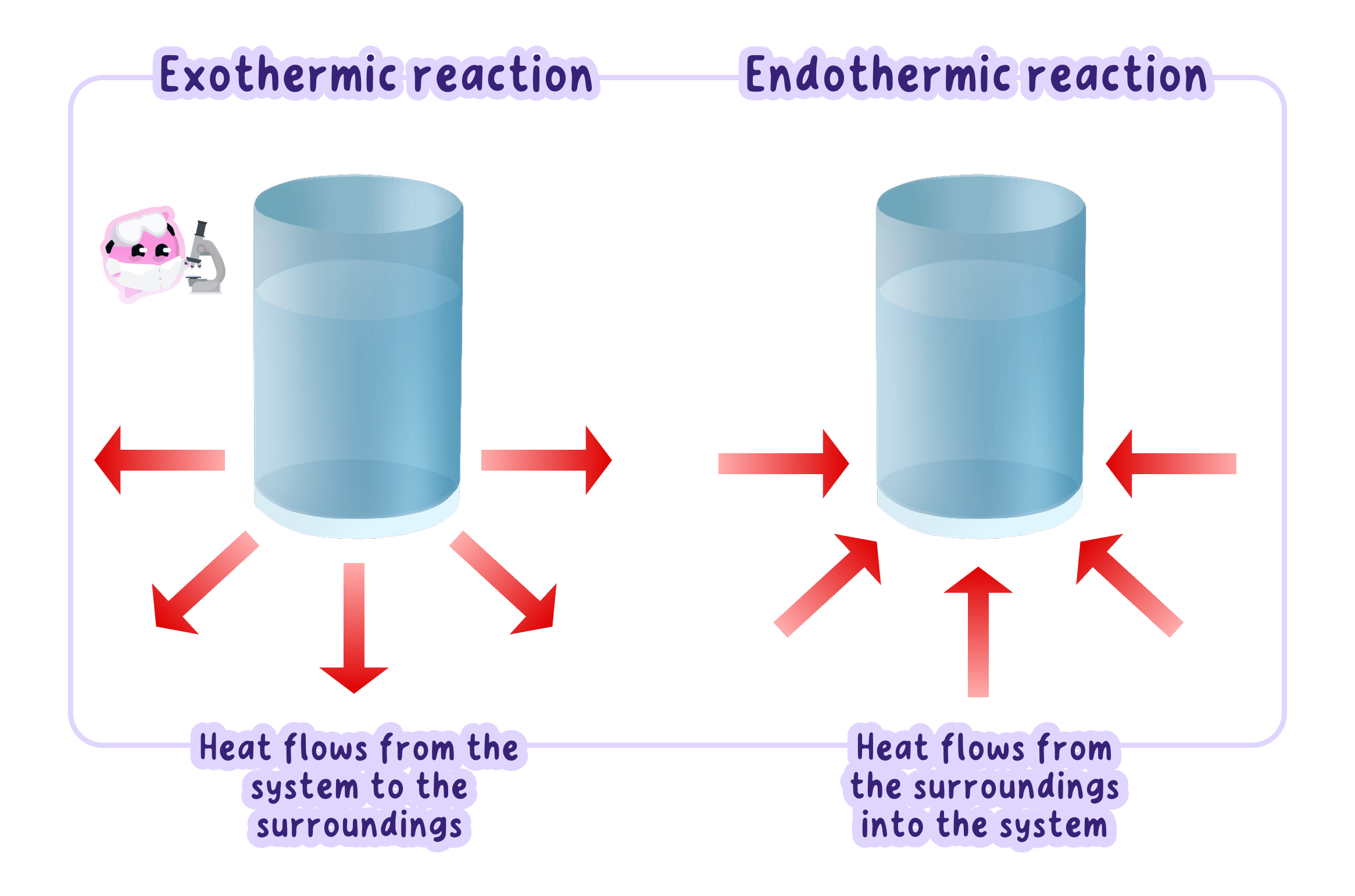
Not every dissolving is endothermic: some salts warm the water instead.
Measuring the change with a thermometer
- The starting temperature of the solution is recorded before anything is added.
- The reactants are mixed and the temperature is followed until it stops changing.
- The highest reading is taken for an exothermic change and the lowest for an endothermic one.
- The temperature change is the difference between that reading and the start.
- A polystyrene cup with a lid reduces the heat lost to the room, which makes the reading more accurate.
Stirring before each reading keeps the temperature even throughout the mixture.
Reading the direction from the data
- A rise in temperature means heat was given out, so the change is exothermic.
- A fall means heat was taken in, so the change is endothermic.
- The size of the change says how much energy moved, not which direction.
- A change of only a fraction of a degree may be within the uncertainty of the thermometer.
- Stating the direction and the evidence is what turns a reading into a conclusion.
- Name the four kinds of change listed in this topic as having heat energy changes.
- What happens to the temperature in an exothermic reaction?
- Give one example of an endothermic change.
- Why is a polystyrene cup used rather than a glass beaker?
- A mixture cools by 4 degrees when two solutions are mixed. What does that show?
8.2.2 Bond breaking, bond making and overall energy change
Breaking bonds takes energy in
- A chemical reaction begins by breaking the bonds in the reactants.
- Pulling bonded atoms apart needs energy to be supplied.
- Bond breaking is therefore endothermic, whatever the reaction as a whole turns out to be.
- A stronger bond needs more energy to break it.
- The energy for this comes from the surroundings or from the energy already in the mixture.
Bond breaking is always endothermic and bond making is always exothermic, in every reaction.
Making bonds gives energy out
- The reaction finishes by forming the bonds in the products.
- Atoms coming together into a bond release energy as they do so.
- Bond making is therefore exothermic, whatever the reaction as a whole turns out to be.
- Forming a stronger bond releases more energy.
- That energy passes out into the surroundings.
The same bond takes exactly as much energy to break as it releases when it forms.
The overall change is the balance of the two
Exothermic reaction
A reaction in which heat energy is given out to the surroundings.
Endothermic reaction
A reaction in which heat energy is taken in from the surroundings.
- Every reaction involves bonds being broken and bonds being made.
- The overall heat change depends on which of the two involves more energy.
- The comparison is between the energy required to break and the energy released in making.
- Whichever is larger decides the direction of the overall change.
- The two quantities are compared, not added, so the answer is a difference.
An exothermic reaction still breaks bonds, so energy is taken in at that stage.
Exothermic: more released than required
- If forming the products' bonds releases more energy than breaking the reactants' bonds requires, the reaction is exothermic.
- The surplus energy passes into the surroundings, so the temperature rises.
- This means the products hold less energy than the reactants did.
- Combustion is exothermic, because the bonds in the products are stronger overall.
- Most reactions met in this course are exothermic.
Burning methane: the bonds formed in carbon dioxide and water release more than the methane and oxygen bonds required.
Endothermic: less released than required
- If forming the products' bonds releases less energy than breaking the reactants' bonds requires, the reaction is endothermic.
- The shortfall is drawn from the surroundings, so the temperature falls.
- This means the products hold more energy than the reactants did.
- Thermal decomposition is endothermic, since the compound must be broken apart.
- Deciding the direction always means the same comparison, whichever reaction is being considered.
- Is bond breaking exothermic or endothermic?
- Is bond making exothermic or endothermic?
- What decides whether a reaction is exothermic overall?
- In an exothermic reaction, do the products hold more or less energy than the reactants?
- Why does an endothermic reaction make its surroundings colder?
8.2.3 Calculating energy change from bond energies
Bond energy is the energy to break one mole of a bond
Bond energy
The energy needed to break one mole of a particular bond, measured in kJ mol-1.
- Each type of bond has its own value, measured in kJ mol−1\text{kJ mol}^{-1}kJ mol−1.
- A larger value means a stronger bond that takes more energy to break.
- The same value is released when that bond is formed.
- Values are always supplied in a question, since they are measured quantities.
- Every bond in the molecule counts, so CH4\text{CH}_4CH4 contains four carbon to hydrogen bonds.
One value serves both directions: energy in to break the bond, the same energy out to make it.
The calculation is bonds broken minus bonds made
- Count every bond in the reactants and add their bond energies together.
- Count every bond in the products and add their bond energies together.
- The energy change is the difference between the two totals: energy change=energy in to break bonds−energy out in making bonds\text{energy change} = \text{energy in to break bonds} - \text{energy out in making bonds}energy change=energy in to break bonds−energy out in making bonds
- The balanced equation fixes how many of each molecule to count.
- The answer carries the unit kJ mol−1\text{kJ mol}^{-1}kJ mol−1.
The subtraction runs broken minus made, and reversing it reverses the sign of the answer.
A worked example: hydrogen and chlorine
- The equation is: H2+Cl2→2HCl\text{H}_2 + \text{Cl}_2 \rightarrow 2\text{HCl}H2+Cl2→2HCl
- The bond energies given are 436436436 for H−H\text{H}-\text{H}H−H, 242242242 for Cl−Cl\text{Cl}-\text{Cl}Cl−Cl and 431431431 for H−Cl\text{H}-\text{Cl}H−Cl.
- The bonds broken are one of each in the reactants: 436+242=678 kJ mol−1436 + 242 = 678\ \text{kJ mol}^{-1}436+242=678 kJ mol−1
- The bonds made are two H−Cl\text{H}-\text{Cl}H−Cl bonds: 2×431=862 kJ mol−12 \times 431 = 862\ \text{kJ mol}^{-1}2×431=862 kJ mol−1
- Subtracting gives the energy change: 678−862=−184 kJ mol−1678 - 862 = -184\ \text{kJ mol}^{-1}678−862=−184 kJ mol−1
The balancing number matters: 2HCl2\text{HCl}2HCl means the H−Cl\text{H}-\text{Cl}H−Cl value is counted twice.
Reading the sign of the answer
- A negative answer means more energy was released than taken in, so the reaction is exothermic.
- A positive answer means more energy was taken in than released, so it is endothermic.
- The example above gives −184 kJ mol−1-184\ \text{kJ mol}^{-1}−184 kJ mol−1, so that reaction is exothermic.
- The size of the number says how much energy moved, and the sign says which way.
- A conclusion states the direction as well as the figure.
The sign is part of the answer, so an exothermic value is written with its minus sign.
Where these calculations go wrong
- Forgetting a balancing number undercounts the bonds on one side.
- Missing a bond inside a molecule, such as the four bonds in methane, does the same.
- Subtracting the wrong way round gives an answer with the wrong sign.
- Leaving the unit off, or leaving the sign off, loses part of the answer.
- Checking that an exothermic reaction came out negative catches most of these.
- Listing the bonds on each side before any arithmetic makes a miscount easy to spot.
- The two totals are written down separately, so the subtraction can be checked.
- A final answer carries a number, a sign and a unit.
- What does a bond energy of 436 kJ mol−1436\ \text{kJ mol}^{-1}436 kJ mol−1 mean?
- Write the expression used to calculate the energy change of a reaction.
- How many carbon to hydrogen bonds are broken in one molecule of methane?
- An energy change comes out as +92 kJ mol−1+92\ \text{kJ mol}^{-1}+92 kJ mol−1. Is the reaction exothermic or endothermic?
- Using 436436436, 242242242 and 431431431, calculate the energy change for H2+Cl2→2HCl\text{H}_2 + \text{Cl}_2 \rightarrow 2\text{HCl}H2+Cl2→2HCl.
8.2.4 Activation energy and reaction profiles
Activation energy is the minimum a collision must carry
Activation energy
The minimum energy that colliding particles must have for a reaction to happen.
- Colliding particles react only if they bring at least a certain minimum energy.
- That minimum is the activation energy for the reaction.
- A collision with less than it leaves the particles unchanged.
- Energy is needed because the bonds in the reactants have to be broken first.
- A high activation energy makes a reaction slow, because few collisions clear the bar.
Activation energy is a property of the reaction, not of how much reactant is present.
A reaction profile plots energy against progress
Reaction profile
A diagram showing the energy of the reactants and products during a reaction, and the activation energy between them.
- The horizontal axis shows the progress of the reaction, from reactants to products.
- The vertical axis shows the energy of the substances.
- The reactants sit at the left of the diagram and the products at the right.
- Between them the line rises to a peak and then falls.
- The peak is the point at which the old bonds have broken and the new ones have not yet formed.
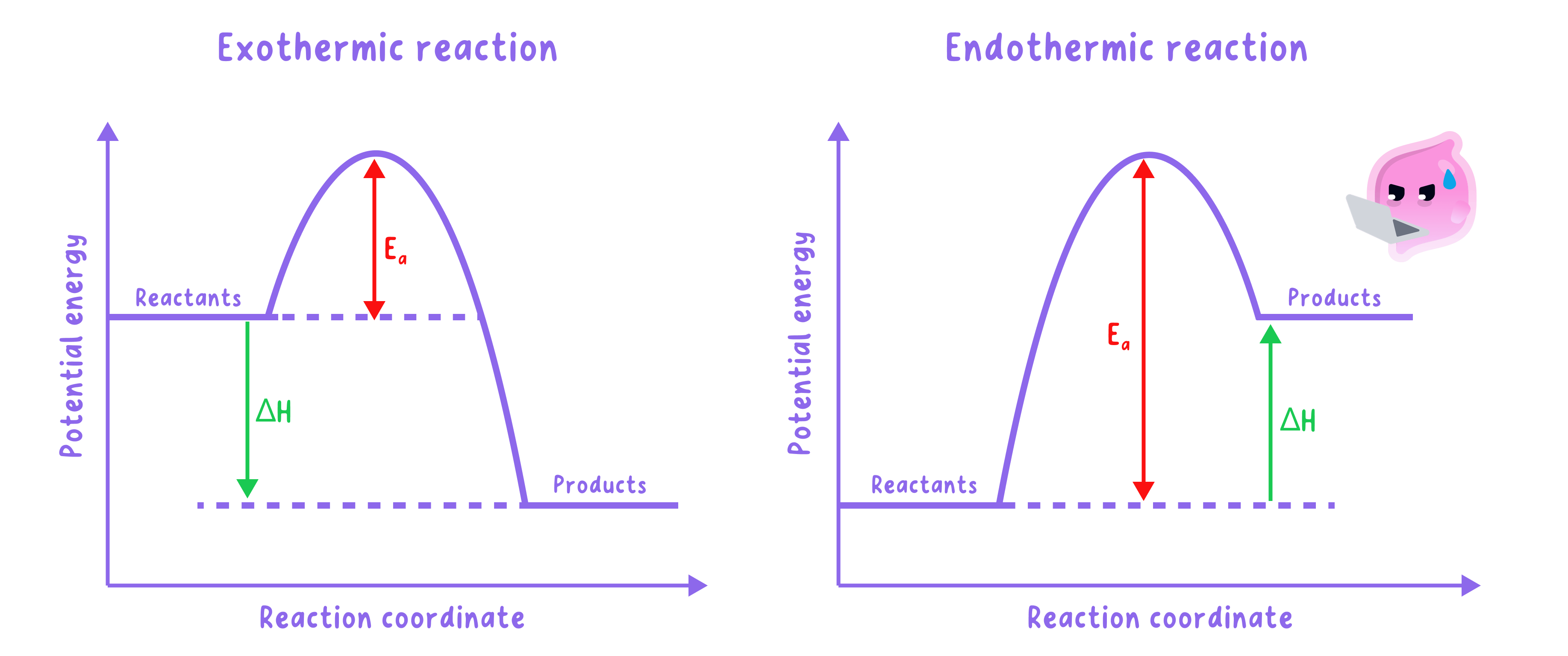
The height of the peak above the reactants is the activation energy, whichever type of reaction is drawn.
An exothermic profile ends lower than it starts
- In an exothermic reaction the products hold less energy than the reactants.
- The product line is therefore drawn below the reactant line.
- The line still rises to a peak first, because bonds must be broken to get started.
- The drop from reactants to products is the overall energy change.
- That difference is the energy given out to the surroundings.
Combustion: the products sit well below the reactants, and the drop is the energy released.
An endothermic profile ends higher than it starts
- In an endothermic reaction the products hold more energy than the reactants.
- The product line is therefore drawn above the reactant line.
- The peak sits above both, so the activation energy is still measured from the reactants up.
- The rise from reactants to products is the overall energy change.
- That difference is the energy taken in from the surroundings.
The activation energy is measured from the reactants to the peak, never from the products.
Labelling a reaction profile
- Both axes are labelled, energy on the vertical and progress of reaction on the horizontal.
- The reactants and the products are each labelled on their own level.
- An arrow from the reactant level to the peak is labelled activation energy.
- An arrow between the reactant and product levels is labelled the overall energy change.
- The direction of that second arrow shows whether the reaction is exothermic or endothermic.
- What is meant by the activation energy of a reaction?
- What do the two axes of a reaction profile show?
- Where are the products drawn on an exothermic profile?
- From which level is the activation energy measured?
- Which two arrows are labelled on a complete reaction profile?
