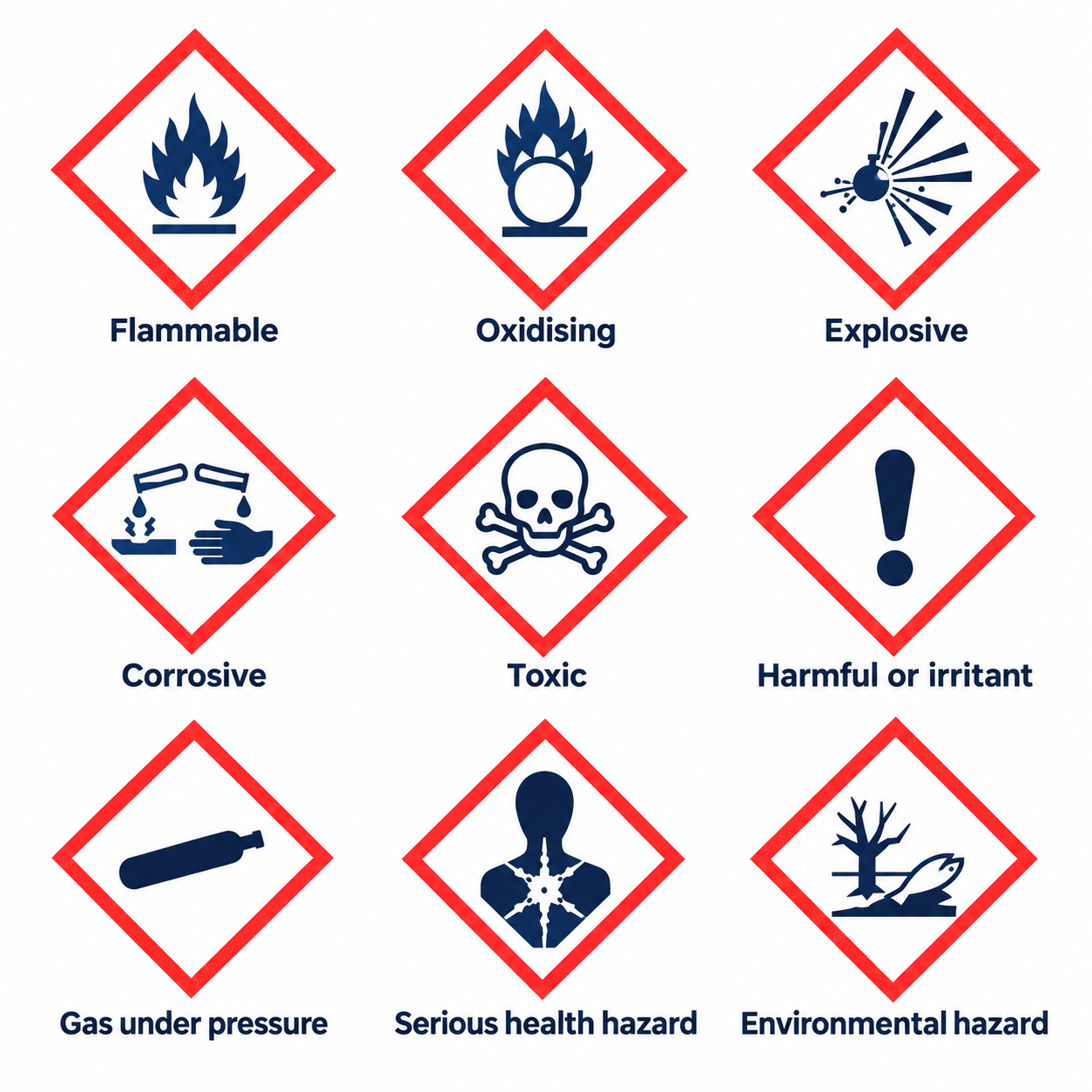
Hazard symbols: the label names the kind of danger
Definition
Hazard symbol
A pictogram printed on a container to show the type of danger presented by the substance inside.
- Read the symbol and the rest of the label before you open or use a substance.
- The symbol tells you what could go wrong, so it points you towards precautions that keep the substance off your skin, away from flames and out of the drains.
- The symbol names the type of danger but not the amount of danger, which depends on the concentration and on what you are doing with the substance.
- Two substances can carry the same symbol and still need different precautions, so the full label and the practical instructions still apply.
Key Idea
- A hazard symbol identifies a type of danger, while the procedure decides which precautions are suitable.
- The pictogram alone does not give every handling, spill and disposal instruction, so use the whole label.
The nine pictograms: what each one warns you about
- Flammable, shown by a flame: the substance catches fire easily. Keep it away from naked flames, sparks and hot equipment.
- Oxidising, shown by a flame over a circle: the substance makes other materials burn more readily. Keep it away from flammable materials and use only the quantity stated in the method.
- Corrosive, shown by liquid damaging a hand and a metal surface: the substance can cause serious burns and attack materials. Wear eye protection, avoid skin contact and clear up spills using the stated procedure.
- Toxic, shown by a skull and crossbones: a small exposure can cause serious illness or death. Prevent swallowing, inhalation and skin contact, and use a fume cupboard when the method says so.
- Harmful or irritant, shown by an exclamation mark: the substance can irritate the skin, eyes or airways. Avoid direct contact and wear the eye protection or other personal protective equipment the method specifies.
- Explosive, shown by an exploding object: the substance may explode if it is heated, struck or rubbed. Keep it away from heat and handle it only as instructed.
- Gas under pressure, shown by a gas cylinder: the container holds compressed gas and may burst if heated. Keep the container secured and away from any heat source.
- Serious health hazard, shown by a person with a star shape on the chest: the substance may cause serious or long-term damage to health. Avoid exposure and follow the special handling instructions on the label.
- Environmental hazard, shown by a dead tree and fish: the substance may harm aquatic organisms. Prevent spills and dispose of the substance as instructed rather than pouring it down the sink.
Common Mistake
- Do not work out a chemical's hazard from its name, because the classification changes with concentration.
- Dilute hydrochloric acid can be an irritant while concentrated hydrochloric acid is corrosive, so check the bottle in front of you.
Hazard and risk: the same chemical, a different risk in each procedure
Definition
Hazard
Something with the potential to cause harm, such as a corrosive chemical, a naked flame or hot glassware.
Definition
Risk
How likely a hazard is to cause harm during a particular procedure, together with how serious that harm would be.
- The hazard belongs to the substance or the equipment, so it does not change when you change the method.
- The risk does change with the method, because it depends on the concentration, the volume, the temperature and how long you are exposed.
- Concentrated sulfuric acid in an open beaker is a far higher risk than the same acid sealed in a bottle on a shelf, although the hazard is identical.
- A precaution reduces the risk, and it never removes the hazard.
- Evaluating a risk means weighing how likely the harm is against how serious it would be.
Note
- A question asking for a hazard wants the substance or equipment named.
- A question asking you to evaluate the risk wants both the likelihood and the severity of the harm.
Risk assessment: identify, judge, control, then check again
Definition
Risk assessment
Identifying the hazards in a procedure, judging the risk each one presents, and choosing precautions that reduce it.
Definition
Control measure
A precaution taken during practical work that reduces the likelihood of harm, the severity of the harm, or both.
- Identify the hazards: read every chemical label and look for hot equipment, sharp edges, electricity, pressure and any gas the reaction produces. Include the substances made during the practical, not only the ones you start with.
- Work out how harm could happen: decide whether a substance could be swallowed, inhaled, splashed into the eyes or brought onto the skin.
- Judge the likelihood: think about the concentration, the volume, the temperature, the length of exposure and the chance of a spill.
- Judge the severity: think about the injury, illness, fire, explosion or environmental damage that could follow.
- Choose control measures: each one should cut the likelihood of harm, its severity, or both.
- Check the remaining risk: start the practical only once the risk that is left is low enough to work safely, and reassess if the method changes.
Example
- In a rate experiment, magnesium ribbon is added to dilute hydrochloric acid and the hydrogen given off is collected in a gas syringe.
- The acid is an irritant at this concentration, and a splash could reach your eyes while you measure it out.
- Eye protection and a small measured volume cut both the chance of a splash reaching your eyes and the harm it would do.
- The reaction gives off flammable hydrogen, so every naked flame in the room is put out before the magnesium goes in.
- Loose tubing or a sticking syringe plunger lets pressure build, so the joints are checked and the plunger is freed before starting.
Risks in common chemistry practicals
- Using acids and alkalis: these can irritate or burn the skin and eyes, depending on their concentration. Check the label, wear eye protection, use small volumes and rinse any splash as the method instructs.
- Making crystals from an acid: the method brings together chemical splashes, hot solutions and hot glassware. Heat gently, keep the container stable, wear eye protection and let the apparatus cool before you move it.
- Heating a substance in a test tube: hot glass burns, and the contents can spit from the open end. Use a test-tube holder, point the opening away from people and stand hot equipment on a heatproof mat.
- Collecting a gas: acid can splash, connections can work loose, and pressure rises if the gas path is blocked. Clamp the apparatus, check that the syringe plunger moves freely and keep the gas path clear.
- Carrying out electrolysis: liquids sit close to electrical connections, and the products can include flammable or toxic gases. Use the low-voltage supply stated, keep the connections dry and switch off before you adjust anything. Keep flames away if hydrogen may form, and work in a fume cupboard if the method warns that chlorine may be produced.
- Using a chromatography solvent: some solvents are flammable or harmful, and their vapour can be inhaled. Use a small volume, replace the lid on the container and keep the solvent away from naked flames.
Common Mistake
- Do not leave a gas syringe or delivery tube blocked, because the pressure can force the apparatus apart.
- Do not improvise after a spill, because the stated spill, first-aid and disposal instructions are chosen for that chemical.
Answering a risk question: tie each precaution to a named hazard
- Name the specific hazard, including the chemical, the equipment or the product that could cause harm.
- Describe the accident that could happen and the harm it would do, such as acid splashing into an eye or solvent vapour catching fire.
- Judge the risk from the likelihood of that accident and the severity of the harm together.
- Give a precaution that acts on that risk, such as removing the flames, using a smaller volume or putting a barrier between your eyes and a splash.
- Say what the precaution does, so a fume cupboard draws harmful vapour away before you can breathe it in.
- Give more than one precaution when a procedure carries separate hazards, such as a corrosive acid and a flammable gas.
- Personal protective equipment is one control measure among several, and it does not replace careful handling, secure apparatus or removing an ignition source.
Self review
- What does a hazard symbol tell you, and what does it not tell you?
- What is the difference between a hazard and a risk?
- Which factors decide the likelihood of harm in a practical?
- Why must a precaution be linked to a specific hazard in the procedure?
- Which precautions would reduce the risks when a practical gives off hydrogen?