Chemical formulae: symbols and subscripts fix what a substance is
Definition
Chemical formula
A combination of element symbols and numbers that shows which elements are present in a substance and the ratio of their atoms.
Definition
Subscript
The small lower number written after a symbol in a formula, showing how many atoms of the element before it are present.
- A symbol with no subscript means one atom of that element in the particle.
- Most elements are written as the bare symbol, such as carbon C\text{C}C, sulfur S\text{S}S, iron Fe\text{Fe}Fe and copper Cu\text{Cu}Cu.
- Seven non-metal elements exist as diatomic molecules, so their formulae are H2,N2,O2,F2,Cl2,Br2\text{H}_2, \text{N}_2, \text{O}_2, \text{F}_2, \text{Cl}_2, \text{Br}_2H2,N2,O2,F2,Cl2,Br2 and I2\text{I}_2I2.
- A compound contains atoms of two or more different elements chemically bonded together.
- Common compound formulae include water H2O\text{H}_2\text{O}H2O, carbon dioxide CO2\text{CO}_2CO2, carbon monoxide CO\text{CO}CO, methane CH4\text{CH}_4CH4 and ammonia NH3\text{NH}_3NH3.
- Common acid and salt formulae include HCl\text{HCl}HCl, H2SO4\text{H}_2\text{SO}_4H2SO4, HNO3\text{HNO}_3HNO3, NaOH\text{NaOH}NaOH, NaCl\text{NaCl}NaCl, CuSO4\text{CuSO}_4CuSO4 and CaCO3\text{CaCO}_3CaCO3.
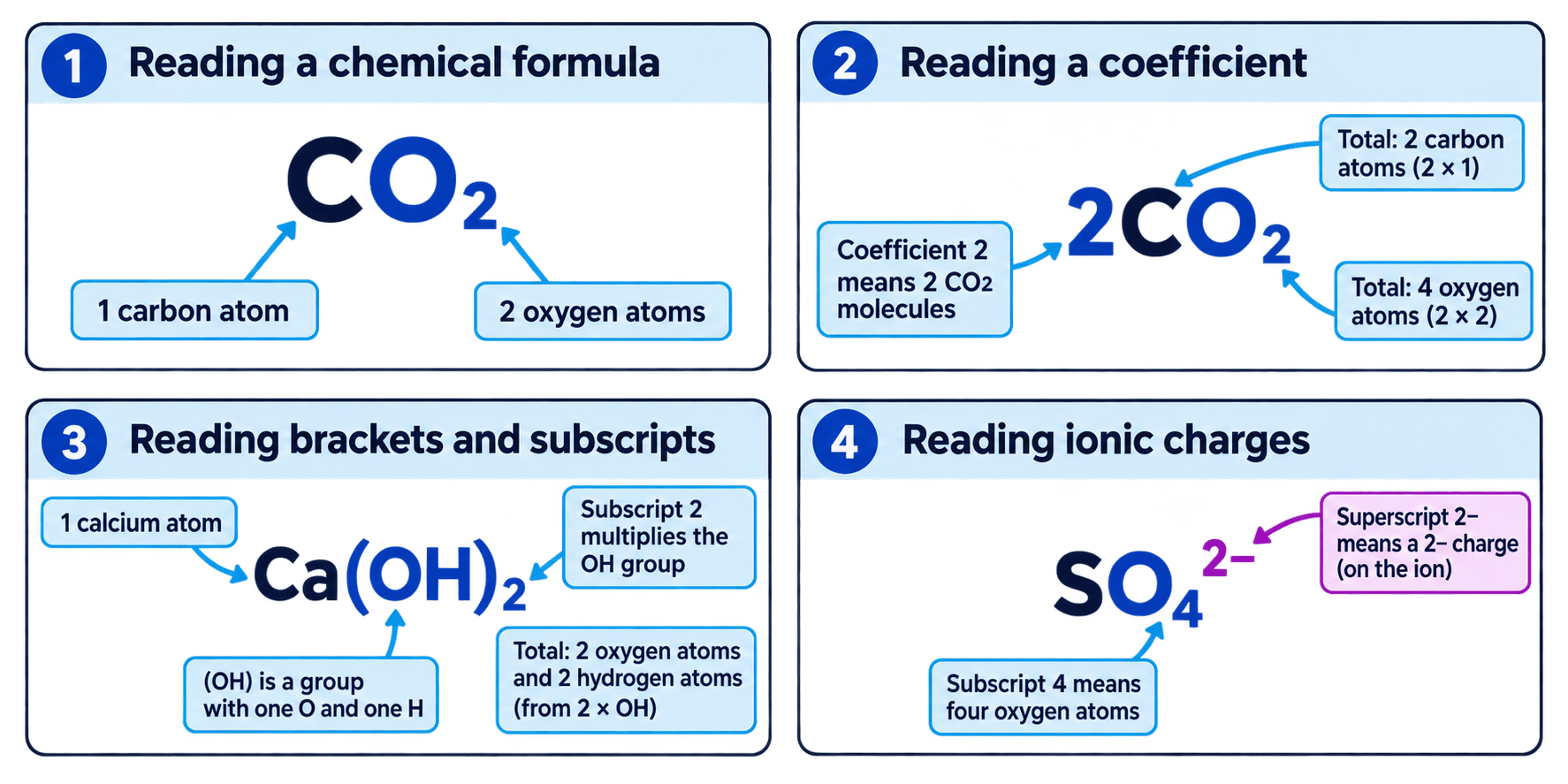
- Brackets group a set of atoms, and the subscript outside them multiplies everything inside, so Ca(OH)2\text{Ca(OH)}_2Ca(OH)2 has one calcium atom, two oxygen atoms and two hydrogen atoms.
Example
- CO2\text{CO}_2CO2 is one carbon atom and two oxygen atoms in a single molecule.
- 2CO22\text{CO}_22CO2 is two molecules, giving two carbon atoms and four oxygen atoms in total.
Ions: atoms and groups of atoms that carry a charge
Definition
Ion
An atom, or a group of atoms, with an overall electrical charge because it has lost or gained electrons.
- Losing electrons leaves a positive ion, and gaining electrons makes a negative ion.
- Common positive ions include H+,Na+,K+,Ag+,NH4+,Mg2+,Ca2+,Cu2+,Zn2+\text{H}^{+}, \text{Na}^{+}, \text{K}^{+}, \text{Ag}^{+}, \text{NH}_4^{+}, \text{Mg}^{2+}, \text{Ca}^{2+}, \text{Cu}^{2+}, \text{Zn}^{2+}H+,Na+,K+,Ag+,NH4+,Mg2+,Ca2+,Cu2+,Zn2+ and Al3+\text{Al}^{3+}Al3+.
- Common negative ions include Cl−,Br−,I−,O2−,OH−,NO3−,SO42−\text{Cl}^{-}, \text{Br}^{-}, \text{I}^{-}, \text{O}^{2-}, \text{OH}^{-}, \text{NO}_3^{-}, \text{SO}_4^{2-}Cl−,Br−,I−,O2−,OH−,NO3−,SO42− and CO32−\text{CO}_3^{2-}CO32−.
- The ammonium, hydroxide, nitrate, sulfate and carbonate ions are groups of atoms that share one charge between them.
- The charge is written as a superscript after the formula, and it is part of what identifies the ion.
Common Mistake
- Do not confuse the superscript charge with a subscript, because SO42−\text{SO}_4^{2-}SO42− has four oxygen atoms and a 2−2-2− charge.
- Do not put a charge on a neutral atom or molecule, so chlorine gas stays as Cl2\text{Cl}_2Cl2.
Formulae of ionic compounds: the charges have to cancel
Definition
Ionic compound
A compound made of positive and negative ions, whose formula shows the smallest whole-number ratio of ions that gives no overall charge.
- Write the symbol and charge of each ion, then find the smallest whole-number ratio of ions that cancels the charges.
- Na+\text{Na}^{+}Na+ and Cl−\text{Cl}^{-}Cl− balance in a 1:11:11:1 ratio, giving sodium chloride NaCl\text{NaCl}NaCl.
- Mg2+\text{Mg}^{2+}Mg2+ needs two Cl−\text{Cl}^{-}Cl− ions to cancel its charge, giving magnesium chloride MgCl2\text{MgCl}_2MgCl2.
- Two Al3+\text{Al}^{3+}Al3+ ions balance three O2−\text{O}^{2-}O2− ions, giving aluminium oxide Al2O3\text{Al}_2\text{O}_3Al2O3.
- Put brackets round a group of atoms whenever more than one of that group is needed, as in Ca(OH)2\text{Ca(OH)}_2Ca(OH)2 and Al(NO3)3\text{Al(NO}_3\text{)}_3Al(NO3)3.
- The charges are not written in the finished formula, because the compound as a whole is neutral.
Example
- Calcium nitrate: Ca2+\text{Ca}^{2+}Ca2+ needs two NO3−\text{NO}_3^{-}NO3− ions, so the formula is Ca(NO3)2\text{Ca(NO}_3\text{)}_2Ca(NO3)2.
- Sodium sulfate: SO42−\text{SO}_4^{2-}SO42− needs two Na+\text{Na}^{+}Na+ ions, so the formula is Na2SO4\text{Na}_2\text{SO}_4Na2SO4.
Word equations: names on each side of the arrow
- A word equation shows a reaction using the names of the substances rather than their formulae.
- The reactants are the substances present at the start, and they go on the left of the arrow.
- The products are the new substances formed, and they go on the right of the arrow.
- A plus sign separates two or more substances on the same side of the arrow.
- The arrow means “reacts to form”, so it is never replaced by an equals sign.
- Magnesium burning in oxygen is written as: magnesium+oxygen→magnesium oxide\text{magnesium} + \text{oxygen} \rightarrow \text{magnesium oxide}magnesium+oxygen→magnesium oxide
- A word equation names the substances but shows nothing about the numbers of atoms involved.
Common Mistake
- Do not swap in formulae when the question asks for a word equation.
- Do not put a product on the reactant side, or a reactant on the product side.
Balanced symbol equations: change the coefficients, never the formulae
Definition
Coefficient
A whole number written in front of a formula in an equation, which multiplies every atom in that formula.
- A symbol equation shows the same reaction using the formulae of the substances.
- An equation is balanced when each element has the same number of atoms on both sides of the arrow.
- Balancing matters because atoms are only rearranged in a reaction, so none are created or destroyed.
- Balance by changing coefficients only, because changing a subscript changes the substance itself, turning water H2O\text{H}_2\text{O}H2O into hydrogen peroxide H2O2\text{H}_2\text{O}_2H2O2.
- Write the correct formulae first, count each element on both sides, adjust the coefficients, then count again.
- Balance an element that appears in one formula on each side before one that appears in several formulae.
Example
- Balance the equation for magnesium burning in oxygen.
- Write the correct formulae:
- Mg+O2→MgO\text{Mg} + \text{O}_2 \rightarrow \text{MgO}Mg+O2→MgO
- Count the atoms: one magnesium on each side, two oxygen on the left and one on the right.
- Put a 2 in front of MgO\text{MgO}MgO to give two oxygen atoms on the right:
- Mg+O2→2MgO\text{Mg} + \text{O}_2 \rightarrow 2\text{MgO}Mg+O2→2MgO
- Put a 2 in front of Mg\text{Mg}Mg to match the two magnesium atoms:
- 2Mg+O2→2MgO2\text{Mg} + \text{O}_2 \rightarrow 2\text{MgO}2Mg+O2→2MgO
- Count again: two magnesium atoms and two oxygen atoms on each side.
State symbols: showing the physical state of every substance
- A state symbol is written straight after a formula to show that substance's physical state.
- (s)\text{(s)}(s) means solid, (l)\text{(l)}(l) means liquid and (g)\text{(g)}(g) means gas.
- (aq)\text{(aq)}(aq) means aqueous, so the substance is dissolved in water.
- The state symbol goes immediately after the formula, with any coefficient in front of the whole formula.
- Magnesium burning in oxygen, written with state symbols, is: 2Mg(s)+O2(g)→2MgO(s)2\text{Mg(s)} + \text{O}_2\text{(g)} \rightarrow 2\text{MgO(s)}2Mg(s)+O2(g)→2MgO(s)
- Hydrochloric acid neutralising sodium hydroxide, written with state symbols, is: HCl(aq)+NaOH(aq)→NaCl(aq)+H2O(l)\text{HCl(aq)} + \text{NaOH(aq)} \rightarrow \text{NaCl(aq)} + \text{H}_2\text{O(l)}HCl(aq)+NaOH(aq)→NaCl(aq)+H2O(l)
- Water made in a reaction is H2O(l)\text{H}_2\text{O(l)}H2O(l) rather than H2O(aq)\text{H}_2\text{O(aq)}H2O(aq), because the water is the liquid itself and not something dissolved in water.
Self review
- What does a subscript tell you in a chemical formula?
- Give the formulae of the seven elements that exist as diatomic molecules.
- What is an ion?
- Deduce the formula of the compound made from Mg2+\text{Mg}^{2+}Mg2+ and NO3−\text{NO}_3^{-}NO3−.
- Balance H2+O2→H2O\text{H}_2 + \text{O}_2 \rightarrow \text{H}_2\text{O}H2+O2→H2O and add state symbols.