2.1.1 Development of the atomic model
Dalton's atom: a solid sphere with nothing inside it
Atom
The smallest particle of an element that can exist, made of a central nucleus surrounded by electrons in shells.
Subatomic particle
A particle smaller than an atom, such as a proton, a neutron or an electron.
- An atomic model is a scientific description of what an atom contains and how its parts are arranged.
- In the early 1800s John Dalton described each atom as a tiny solid sphere that could not be split.
- Dalton's model treated atoms as indivisible, so it allowed nothing smaller to exist inside them.
- It fitted the evidence of the time, because elements combined in fixed ratios as though built from identical unsplittable units.
- Every later change to the model came from finding a subatomic particle that Dalton's solid sphere had no room for.
- A model is replaced when new experimental evidence appears that the old model cannot explain.
- The atom went from a solid sphere to a nucleus of protons and neutrons with electrons in shells.
Thomson: the electron turns the sphere into a plum pudding
- In 1897 J. J. Thomson used cathode-ray experiments to show that atoms contain electrons, which carry a negative charge.
- An electron is far smaller than an atom, so atoms could no longer be described as indivisible.
- Thomson proposed the plum pudding model, with electrons embedded in a ball of positive charge.
- The positive charge balanced the negative electrons, so the atom as a whole stayed electrically neutral.
- Do not give Thomson's model a central nucleus, because its positive charge was spread through the whole atom.
- Do not say Thomson discovered the atom, because what he discovered was a particle inside it.
Rutherford: alpha scattering puts the positive charge in a nucleus
Nucleus
The tiny, dense, positively charged centre of an atom, containing the protons and neutrons and almost all of the atom's mass.
- In the alpha-scattering experiment, positively charged alpha particles were fired at a very thin sheet of gold foil.
- Most alpha particles passed straight through, which showed that most of the atom is empty space.
- A small number were deflected through large angles, which showed a concentrated region of positive charge.
- A very small number bounced almost straight back, which showed that this region is both tiny and dense.
- Rutherford concluded that nearly all the positive charge and nearly all the mass sit in a tiny central nucleus.
- That replaced the spread-out positive charge of the plum pudding model and left the electrons somewhere outside the nucleus.
- If the plum pudding model were right, spread-out positive charge would deflect every alpha particle only slightly.
- The handful that bounced back could only have struck something small, dense and positively charged.
- Because almost none were deflected, that dense region must take up a tiny fraction of the atom's volume.
Bohr and Chadwick: shells for the electrons, neutrons in the nucleus
Electron shell
A fixed energy level around the nucleus in which electrons are found.
- Niels Bohr showed that electrons orbit at fixed distances from the nucleus rather than anywhere outside it.
- Calculations based on fixed energy levels matched the experimental observations, which Rutherford's model could not explain.
- Later work identified the positively charged particles inside the nucleus as protons.
- James Chadwick provided evidence for the neutron in 1932, explaining why nuclei are heavier than their protons alone can account for.
- The current model therefore has a tiny nucleus of protons and neutrons, with electrons in shells around it.
- The order to learn is Dalton, Thomson, Rutherford, Bohr, then Chadwick.
- A question about how the model changed wants the evidence that forced each change, not only the names.
Why the model changed: each discovery exposed a limit in the one before
- Dalton's solid sphere became Thomson's plum pudding once the electron was found inside the atom.
- The plum pudding became Rutherford's nuclear model once alpha scattering showed the positive charge was concentrated.
- The nuclear model became Bohr's shell model once fixed energy levels were needed to match what was observed.
- Bohr's model gained neutrons once Chadwick accounted for the missing nuclear mass.
- A model survives only while it explains every observation, so new evidence is what forces each change.
- What did Dalton's model say about the inside of an atom?
- How did the discovery of the electron change Dalton's model?
- Which observation in the alpha-scattering experiment showed that the nucleus is tiny?
- How did Bohr's model change Rutherford's model?
- What did Chadwick's discovery add to the model of the atom?
2.1.2 Structure of the atom and subatomic particles
Inside the atom: a nucleus of protons and neutrons, electrons in shells
Nucleus
The tiny, dense, positively charged centre of an atom, containing the protons and neutrons and almost all of the atom's mass.
Electron shell
A fixed energy level around the nucleus in which electrons are found.
- The nucleus sits at the centre of the atom and holds the protons and the neutrons.
- The electrons move around the nucleus, occupying shells at fixed distances from it.
- Protons, neutrons and electrons are the three subatomic particles that make up an atom.
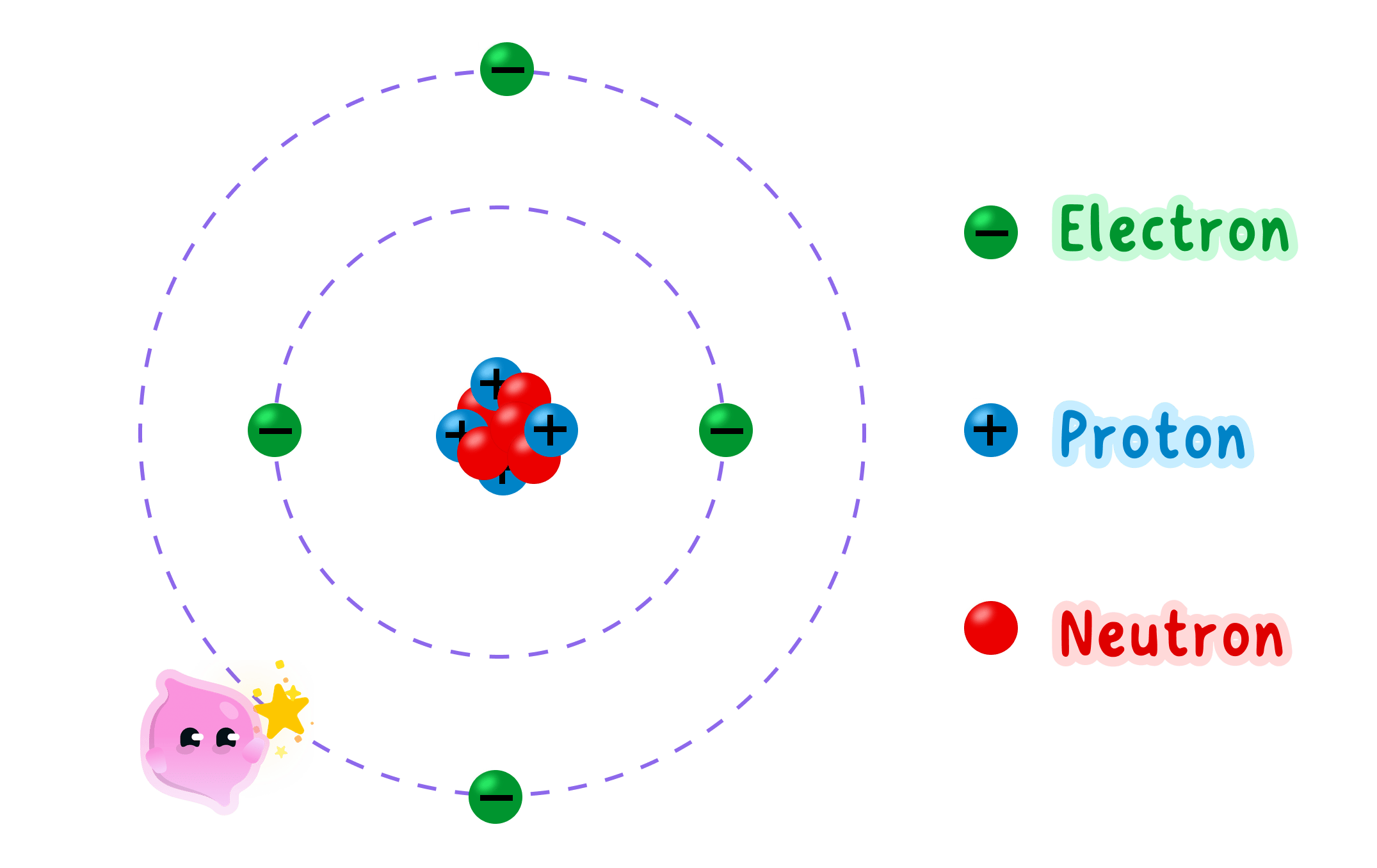
- An atom carries no overall charge, so it holds as many electrons as protons.
- All the positive charge and nearly all the mass sit in the nucleus.
- All the negative charge sits outside it, in the electron shells.
Relative charge and relative mass of each particle
- Relative charge compares a particle's charge with the charge on a proton, which is set at +1+1+1.
- Relative mass compares a particle's mass with the mass of a proton, which is set at 111.
- Proton: relative charge +1+1+1, relative mass 111, found in the nucleus.
- Neutron: relative charge 000, relative mass 111, found in the nucleus.
- Electron: relative charge −1-1−1, relative mass 11840\frac{1}{1840}18401, found in a shell around the nucleus.
- A proton and a neutron therefore contribute about the same mass, while an electron contributes almost none.
- The neutron is the only one of the three with no charge, so it never affects the atom's overall charge.
- Relative charge and relative mass have no units, because each one compares a particle with a proton.
Why an atom is neutral: protons and electrons cancel exactly
- A proton carries +1+1+1 and an electron carries −1-1−1, so one of each cancels to zero.
- Equal numbers of protons and electrons give equal amounts of positive and negative charge.
- Those charges cancel, so the atom has an overall charge of zero.
- Neutrons carry no charge, so they take no part in this balance.
- A particle whose protons and electrons are unequal is an ion, not an atom.
- Do not confuse equal protons and electrons with equal protons and neutrons, which is not generally true.
- Do not use neutrons to explain why an atom is neutral, because they have no charge to cancel.
Size and mass: a tiny nucleus that carries nearly all the mass
- The nucleus has a radius of roughly 110000\frac{1}{10000}100001 that of the whole atom.
- Almost all of the atom is therefore empty space through which the electrons move.
- Each proton and each neutron has relative mass 111, while each electron has relative mass 11840\frac{1}{1840}18401.
- Adding in the electrons changes the total mass by an amount too small to matter.
- Nearly all of the atom's mass therefore sits in the nucleus, even though the nucleus occupies almost none of its volume.
- The electrons fix the size of the atom while the nucleus fixes its mass.
- Which particles are found in the nucleus of an atom?
- Give the relative charge and relative mass of a proton, a neutron and an electron.
- Why must an atom contain equal numbers of protons and electrons?
- How does the radius of the nucleus compare with the radius of the atom?
- Why is nearly all of an atom's mass concentrated in the nucleus?
2.1.3 Mass number, isotopes and relative atomic mass
Atomic number and mass number: counting the particles in an atom
Atomic number
The number of protons in the nucleus of an atom, which is unique to each element.
Mass number
The total number of protons and neutrons in the nucleus of an atom.
- Every atom of a given element has the same number of protons, and no other element shares that number.
- Carbon always has 6 protons, so carbon's atomic number is 6.
- A neutral atom holds as many electrons as protons, so the atomic number also gives the electron count.
- The mass number counts the protons and neutrons together, because those two particles carry essentially all the mass.
- On a periodic table entry the larger number is the relative atomic mass, not the mass number, and the smaller is the atomic number.
- The atomic number identifies which element the atom is.
- The mass number belongs to one particular isotope, and is written in nuclide notation rather than printed on the table.
Isotopes: same element, different numbers of neutrons
Isotope
Atoms of the same element with the same number of protons but different numbers of neutrons.
- Isotopes of one element share an atomic number, because they contain the same number of protons.
- They have different mass numbers, because they contain different numbers of neutrons.
- Chlorine-35 and chlorine-37 are both chlorine, so each atom has 17 protons.
- A chlorine-35 atom has 35−17=1835 - 17 = 1835−17=18 neutrons.
- A chlorine-37 atom has 37−17=2037 - 17 = 2037−17=20 neutrons.
- Extra neutrons change the mass but not the chemical reactions, because the electron arrangement is unchanged.
- Do not change the number of protons to make an isotope, because that changes the element.
- Do not read the mass number as the number of protons, because it counts protons and neutrons together.
Counting the particles from the two numbers
- The number of protons is equal to the atomic number.
- The number of electrons in a neutral atom is also equal to the atomic number.
- The number of neutrons is the mass number minus the atomic number: neutrons=mass number−atomic number\text{neutrons} = \text{mass number} - \text{atomic number}neutrons=mass number−atomic number
- Sodium with atomic number 11 and mass number 23 has 11 protons, 11 electrons and 23−11=1223 - 11 = 1223−11=12 neutrons.
- Chlorine-37 with atomic number 17 has 17 protons, 17 electrons and 37−17=2037 - 17 = 2037−17=20 neutrons.
- Check that your proton count matches the element named in the question before you accept the answer.
- An atom has atomic number 8 and mass number 16.
- Protons =8= 8=8, so the element is oxygen.
- Electrons =8= 8=8, because the atom is neutral.
- Neutrons =16−8=8= 16 - 8 = 8=16−8=8.
Why relative atomic mass is often not a whole number
Relative atomic mass
The weighted mean mass of an element's atoms, taking the abundance of each isotope into account, compared with one-twelfth of the mass of a carbon-12 atom.
- Every individual atom has a whole-number mass number, because an atom cannot hold part of a neutron.
- A real sample of an element contains a mixture of isotopes in fixed proportions.
- Relative atomic mass averages those isotopes, weighting each one by how common it is.
- Chlorine is about three-quarters chlorine-35 and one-quarter chlorine-37, which averages to 35.535.535.5.
- The value sits closer to 353535 than to 373737 because chlorine-35 is the more abundant isotope.
- A value such as 35.535.535.5 describes the sample, never any single atom in it.
- What does the mass number tell you?
- Why do all atoms of one element have the same atomic number?
- How do isotopes of the same element differ?
- How many protons, neutrons and electrons are in an atom with atomic number 8 and mass number 16?
- Why can the relative atomic mass of chlorine be 35.535.535.5 when each chlorine atom has a whole-number mass number?
2.1.4 Calculating relative atomic mass from isotopic abundance
The two numbers a question gives you
Relative atomic mass
The weighted mean mass of an element's atoms, taking the abundance of each isotope into account, compared with one-twelfth of the mass of a carbon-12 atom.
Relative isotopic mass
The mass of one isotope compared with one-twelfth of the mass of a carbon-12 atom, which is equal to that isotope's mass number.
Isotopic abundance
The proportion of the atoms in a sample of an element that are a particular isotope, given as a percentage or a fraction.
- A question supplies the mass of each isotope and how common that isotope is.
- An isotope's relative isotopic mass is the same number as its mass number.
- Abundance may be given as a percentage, as a decimal fraction, or as a count of atoms detected.
- The more abundant isotope pulls the average towards its own mass.
- Relative atomic mass has no unit, because it compares one mass with another.
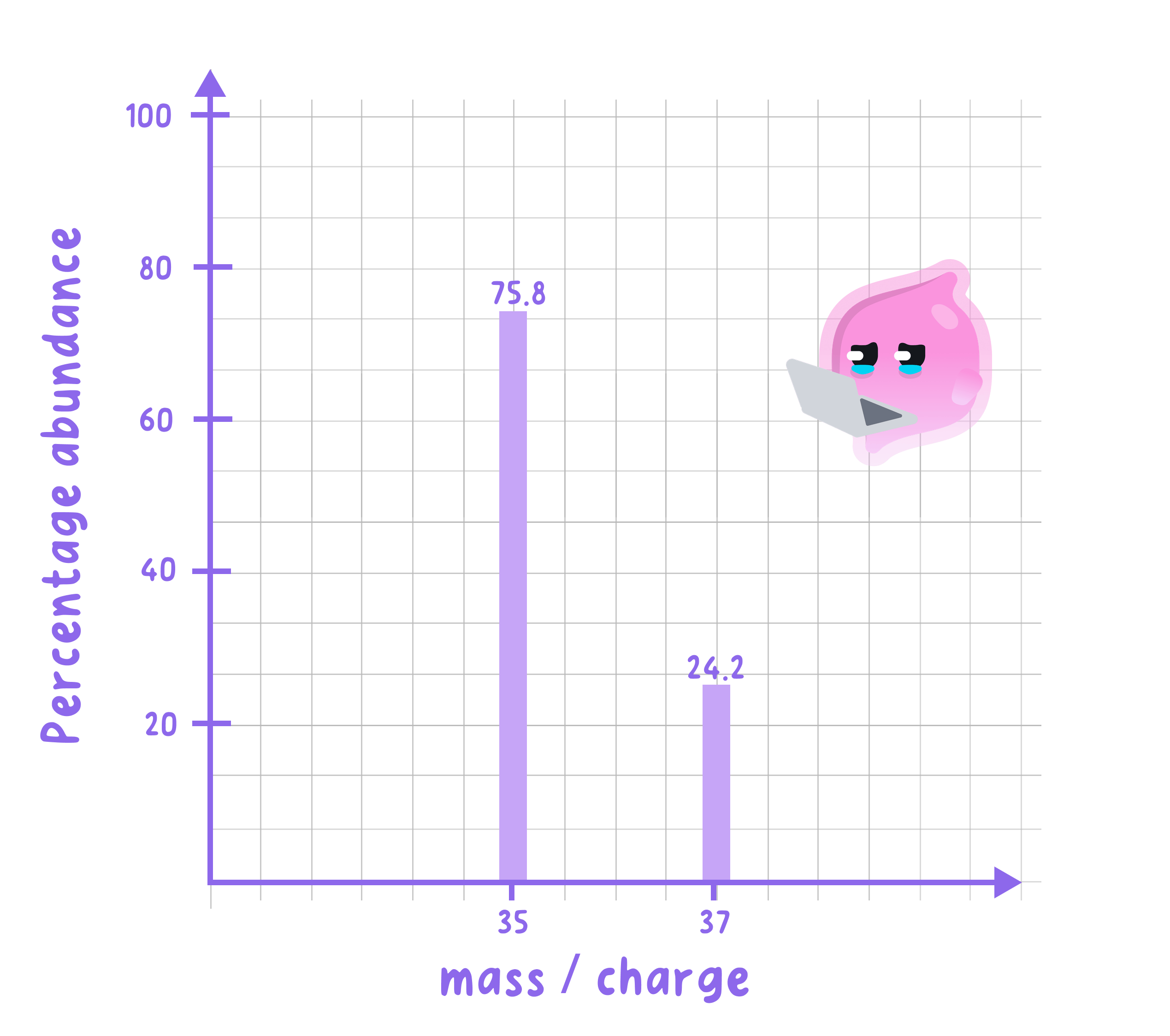
- The answer always lies between the smallest and the largest isotopic mass.
- It lands nearer the mass of the most abundant isotope.
The method: multiply, add, then divide by the total abundance
- Write each isotopic mass and its abundance side by side before calculating anything.
- Multiply each isotopic mass by its own abundance.
- Add all of those products together.
- Divide by the total abundance: Ar=(m1×a1)+(m2×a2)a1+a2A_r = \frac{(m_1 \times a_1) + (m_2 \times a_2)}{a_1 + a_2}Ar=a1+a2(m1×a1)+(m2×a2)
- The denominator is 100100100 when the abundances are percentages that add to 100100100.
- Extend the same pattern for three or more isotopes by adding one product per isotope.
- Use the total abundance as the denominator even when the percentages do not add to exactly 100100100.
- Keep one format throughout, so use percentages everywhere or decimals everywhere.
Worked example: weighting three isotopes
- An element has isotopes of mass 242424, 252525 and 262626, with abundances of 79%79\%79%, 10%10\%10% and 11%11\%11%.
- The abundances add to 100100100, so the denominator is 100100100.
- Work out the three products separately before adding, so that a slip in one does not hide inside the total.
- Find the relative atomic mass of the element.
- Multiply each isotopic mass by its abundance:
- 24×79=189624 \times 79 = 189624×79=1896
- 25×10=25025 \times 10 = 25025×10=250
- 26×11=28626 \times 11 = 28626×11=286
- Add the three products:
- 1896+250+286=24321896 + 250 + 286 = 24321896+250+286=2432
- Divide by the total abundance:
- Ar=2432100=24.32A_r = \dfrac{2432}{100} = 24.32Ar=1002432=24.32
Checking your answer
- Your answer must lie between the lowest and the highest isotopic mass in the data.
- It must sit nearer the mass of the most abundant isotope.
- Do not round the intermediate products, because rounding early shifts the final value.
- Do not take a plain average of the masses, because the isotopes are not equally abundant.
- Give ArA_rAr with no unit, and to the precision the question asks for.
- What is an isotope?
- How does isotopic abundance affect the value of the relative atomic mass?
- Why do you divide by 100100100 when the percentage abundances add to 100100100?
- Why is relative atomic mass written without a unit?
- An element is 60%60\%60% mass 696969 and 40%40\%40% mass 717171; what is its relative atomic mass?
