10.4.1 Alcohols and the -OH functional group
The first four alcohols and their formulae
Alcohol
A member of the homologous series whose functional group is -OH.
- Methanol is CH3OH\text{CH}_3\text{OH}CH3OH.
- Ethanol is C2H5OH\text{C}_2\text{H}_5\text{OH}C2H5OH.
- Propan-1-ol is C3H7OH\text{C}_3\text{H}_7\text{OH}C3H7OH.
- Butan-1-ol is C4H9OH\text{C}_4\text{H}_9\text{OH}C4H9OH.
- Each has one more CH2\text{CH}_2CH2 than the one before, so they form a homologous series.
Writing the formula as CnH2n+1OH\text{C}_n\text{H}_{2n+1}\text{OH}CnH2n+1OH keeps the −OH-\text{OH}−OH group visible.
The functional group is -OH
Functional group
The group of atoms in a molecule that gives a homologous series its characteristic reactions.
- Every alcohol contains an oxygen joined to a hydrogen, written −OH-\text{OH}−OH.
- That group is attached to a carbon atom in the chain.
- It is what gives every alcohol its characteristic reactions.
- The 1 in propan-1-ol says the group sits on the first carbon of the chain.
- The rest of the molecule is an ordinary hydrocarbon chain.
The −OH-\text{OH}−OH in an alcohol is covalently bonded, and is not the hydroxide ion of an alkali.
Drawing the structures
- Each carbon still shows four bonds and each hydrogen one.
- The oxygen shows two bonds, one to a carbon and one to a hydrogen.
- Methanol is one carbon carrying three hydrogens and one −OH-\text{OH}−OH.
- Ethanol is two carbons joined by a single bond, with the −OH-\text{OH}−OH on the end carbon.
- Counting the bonds on the oxygen as well as the carbons checks the structure.
- Method: weigh a capped spirit burner, burn the alcohol under a metal can holding a measured mass of water, then cap it, let it cool and reweigh it.
- The four alcohols used are ethanol, propanol, butanol and pentanol, with the mass of water, the wick length and the distance to the flame kept the same.
- Compare them by the energy transferred per gram of fuel burned, found from the temperature rise and the mass of alcohol used up.
- Heat loss to the surroundings is the largest source of error, so a draught shield and a lid help.
- Soot on the can shows incomplete combustion, which lowers the energy released.
Alcohols can be dehydrated to alkenes
Alkene
An unsaturated hydrocarbon containing a carbon to carbon double bond, with the general formula CnH2n.
- Dehydration removes a molecule of water from the alcohol.
- The water comes from the −OH-\text{OH}−OH group and a hydrogen from the next carbon.
- The two carbons left behind form a double bond.
- Ethanol is dehydrated to ethene: C2H5OH→C2H4+H2O\text{C}_2\text{H}_5\text{OH} \rightarrow \text{C}_2\text{H}_4 + \text{H}_2\text{O}C2H5OH→C2H4+H2O
- The product is an alkene, so a saturated molecule has become unsaturated.
- Give the formulae of methanol, ethanol, propan-1-ol and butan-1-ol.
- What is the functional group in an alcohol?
- Describe the structure of ethanol.
- What is formed when ethanol is dehydrated?
- Why are the alcohols a homologous series?
10.4.2 Carboxylic acids and the -COOH functional group
The first four carboxylic acids
Carboxylic acid
A member of the homologous series whose functional group is -COOH.
- Methanoic acid is HCOOH\text{HCOOH}HCOOH.
- Ethanoic acid is CH3COOH\text{CH}_3\text{COOH}CH3COOH.
- Propanoic acid is C2H5COOH\text{C}_2\text{H}_5\text{COOH}C2H5COOH.
- Butanoic acid is C3H7COOH\text{C}_3\text{H}_7\text{COOH}C3H7COOH.
- Each differs from the next by CH2\text{CH}_2CH2, so they are a homologous series.
Ethanoic acid is the acid in vinegar, which is the one met most often.
The functional group is -COOH
Functional group
The group of atoms in a molecule that gives a homologous series its characteristic reactions.
- Every carboxylic acid contains the group −COOH-\text{COOH}−COOH.
- That group is a carbon joined to an oxygen by a double bond and to an −OH-\text{OH}−OH group.
- It always sits at the end of the carbon chain.
- It is what gives the family its characteristic reactions.
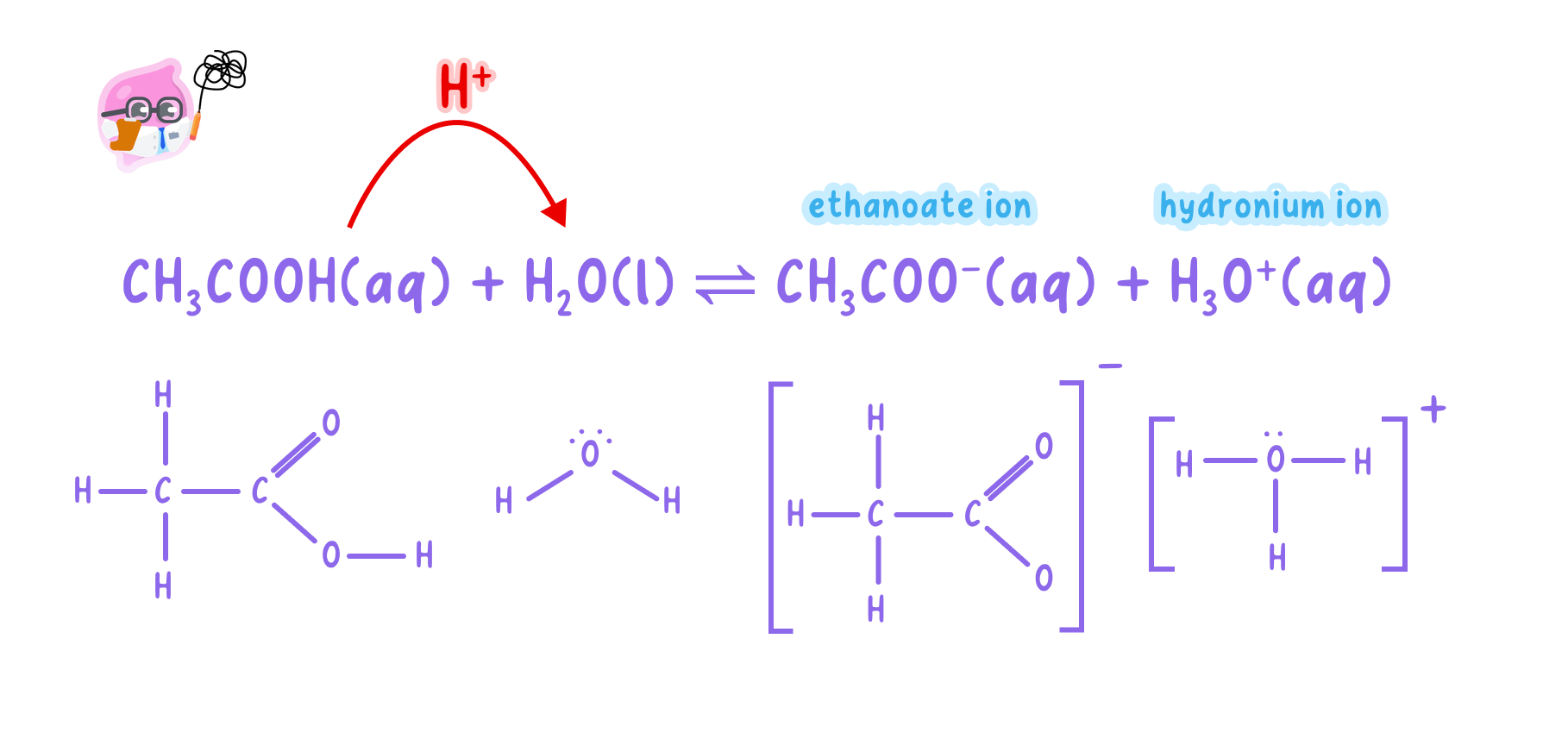
- The −OH-\text{OH}−OH inside it is what releases the hydrogen ion in solution.
Writing the formula as −COOH-\text{COOH}−COOH rather than −CO2H-\text{CO}_2\text{H}−CO2H keeps the two oxygens distinct.
Drawing the structures
- The end carbon shows four bonds: two to one oxygen, one to the other oxygen, and one to the chain.
- The second oxygen carries a hydrogen, completing the −OH-\text{OH}−OH.
- Methanoic acid has a hydrogen in place of the carbon chain.
- Ethanoic acid has a CH3\text{CH}_3CH3 group attached to the −COOH-\text{COOH}−COOH.
- Counting two oxygens in the group is the usual check on the structure.
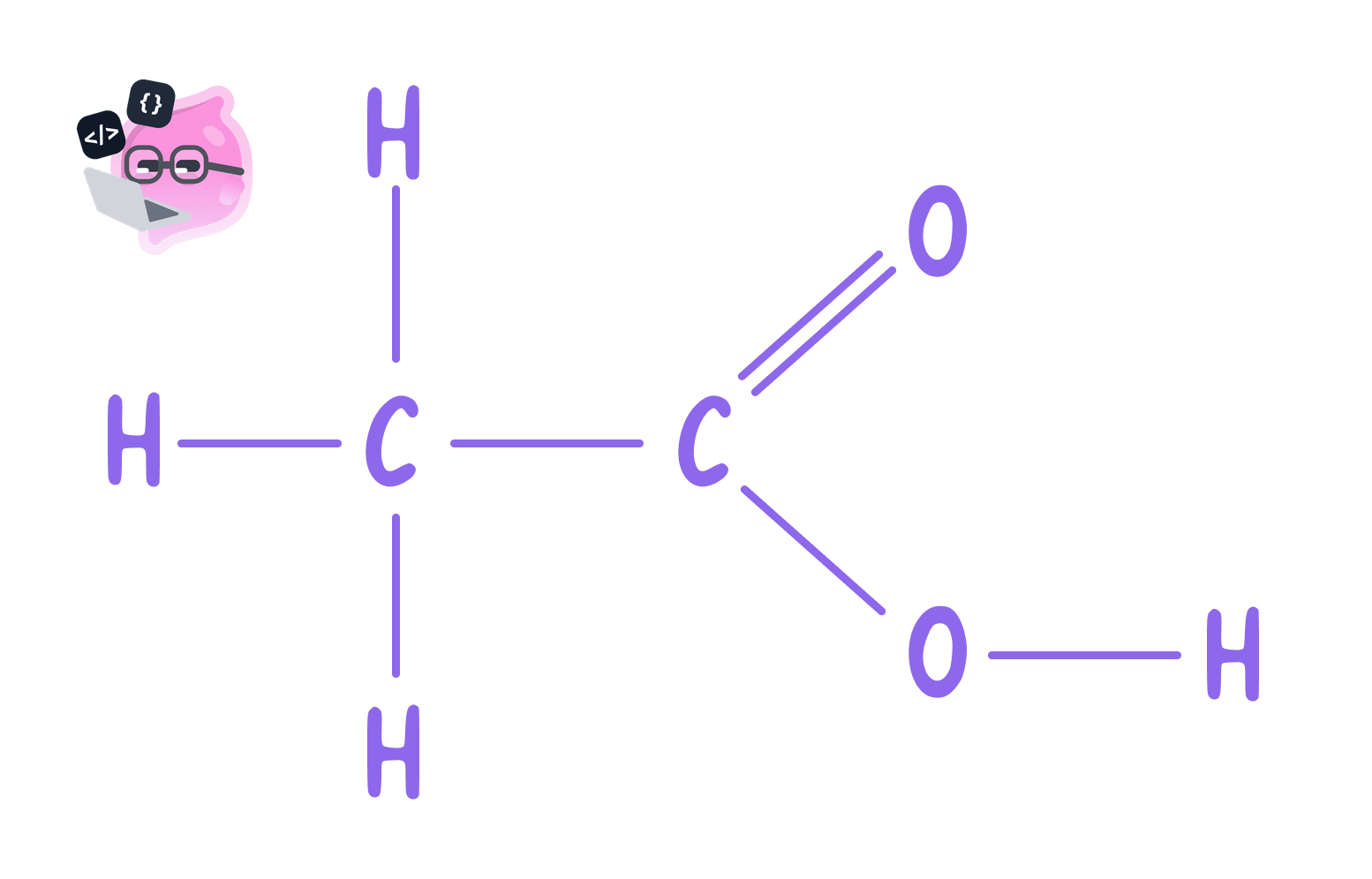
- Methanoic acid: HCOOH\text{HCOOH}HCOOH, one carbon in all.
- Ethanoic acid: CH3COOH\text{CH}_3\text{COOH}CH3COOH, two carbons in all.
Their solutions show typical acidic properties
Acid
A substance that is a source of hydrogen ions when it dissolves in water.
- A carboxylic acid dissolves in water and releases hydrogen ions.
- Its solution therefore has a pH below 7 and turns litmus red.
- It reacts with a metal to give a salt and hydrogen: ethanoic acid+magnesium→magnesium ethanoate+hydrogen\text{ethanoic acid} + \text{magnesium} \rightarrow \text{magnesium ethanoate} + \text{hydrogen}ethanoic acid+magnesium→magnesium ethanoate+hydrogen
- It reacts with a carbonate to give a salt, water and carbon dioxide.
- It reacts with an alkali to give a salt and water, which is neutralisation.
- Give the formulae of methanoic, ethanoic, propanoic and butanoic acids.
- What is the functional group in a carboxylic acid?
- Describe the structure of ethanoic acid.
- Name the products when ethanoic acid reacts with magnesium.
- What would you see if ethanoic acid were added to a carbonate?
10.4.3 Oxidation of alcohols and homologous series
Ethanol can be oxidised to ethanoic acid
Oxidation
The loss of electrons by a substance.
- Ethanol can be converted into ethanoic acid.
- The change is an oxidation: ethanol+oxygen→ethanoic acid+water\text{ethanol} + \text{oxygen} \rightarrow \text{ethanoic acid} + \text{water}ethanol+oxygen→ethanoic acid+water
- The −OH-\text{OH}−OH group of the alcohol becomes the −COOH-\text{COOH}−COOH group of the acid.
- The number of carbon atoms in the molecule does not change.
- The reagents used to bring this about are not required here.
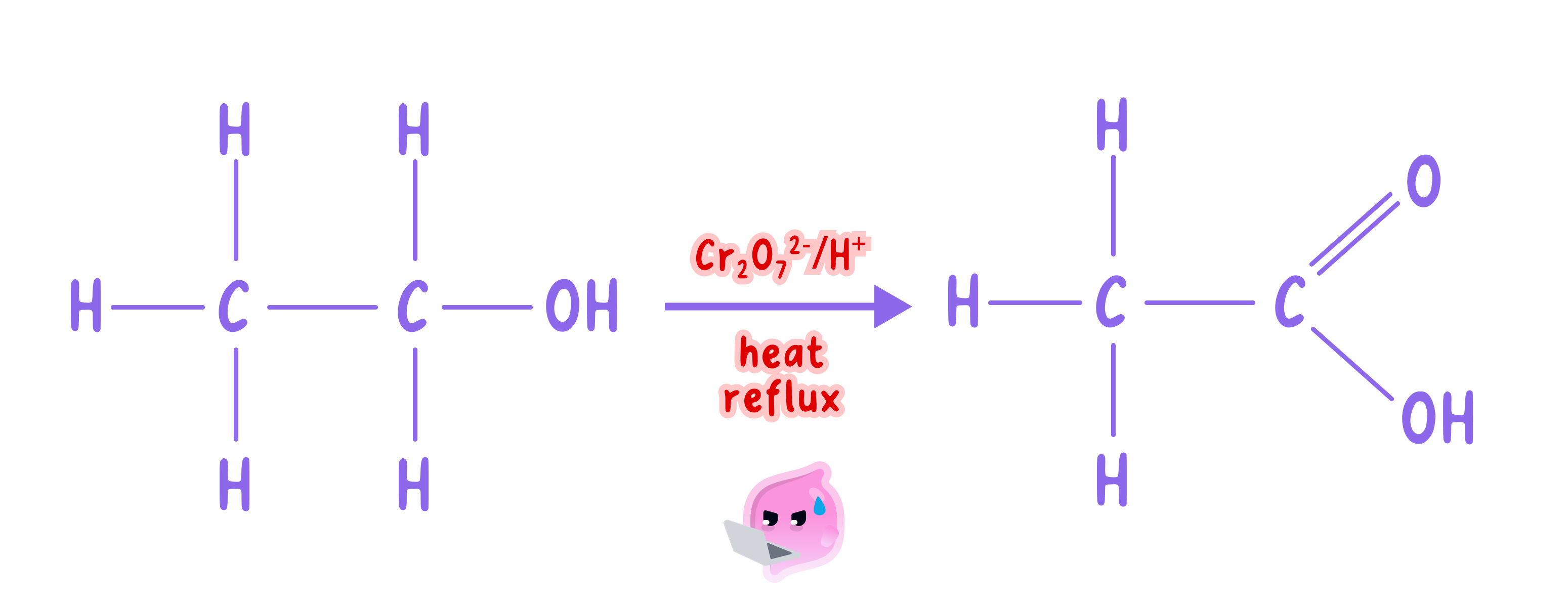
The carbon chain is untouched: only the functional group changes.
The same change happens to other alcohols
- Methanol is oxidised to methanoic acid.
- Propan-1-ol is oxidised to propanoic acid.
- Butan-1-ol is oxidised to butanoic acid.
- In each case the acid has the same number of carbons as the alcohol.
- The name changes from -ol to -oic acid, keeping the same stem.
- Ethanol gives ethanoic acid, and propan-1-ol gives propanoic acid.
- The stem stays: eth- stays eth-, prop- stays prop-.
A homologous series reacts the same way throughout
Homologous series
A family of compounds with the same general formula, differing by CH2 from one member to the next, with similar chemical properties and a gradual change in physical properties.
- Members of a series all contain the same functional group.
- Reactions happen at that group, so they are the same for every member.
- The carbon chain attached to it changes the physical properties, not the chemistry.
- A reaction shown for one member can therefore be extended to the others.
- This is what makes a homologous series worth learning as a family.
Similar does not mean identical: a longer chain often reacts a little more slowly.
Predicting the product for another member
- Identify the functional group in the molecule given.
- Recall what that group does in the reaction being asked about.
- Apply the same change to the molecule in front of you.
- Keep the carbon chain the same unless the reaction is one that breaks it.
- Name the product using the stem of the starting material.
- A prediction quotes the functional group as the reason, not the specific example learned.
- Counting the carbons before and after catches a miscounted product name.
- An answer that changes the chain length is almost always wrong for these reactions.
- What is ethanol oxidised to?
- Which functional group becomes which in that change?
- What is propan-1-ol oxidised to?
- Why do all the members of a homologous series react similarly?
- Predict the product when pentan-1-ol is oxidised.
10.4.4 Fermentation and fractional distillation of ethanol
Fermentation converts carbohydrates into ethanol
Fermentation
The conversion of sugars into ethanol and carbon dioxide by the enzymes in yeast.
Enzyme
A biological catalyst that speeds up a reaction in a living organism.
- Yeast is added to a solution of carbohydrate in water.
- The yeast supplies the enzymes that bring the reaction about.
- The sugar is converted into ethanol and carbon dioxide: glucose→ethanol+carbon dioxide\text{glucose} \rightarrow \text{ethanol} + \text{carbon dioxide}glucose→ethanol+carbon dioxide
- The carbon dioxide escapes, so the mixture bubbles as the reaction runs.
- The carbohydrate must be in aqueous solution, since the enzymes work in water.
The enzymes in yeast are the catalyst, which is why the conditions suit a living organism.
The conditions fermentation needs
- A warm temperature is used, around body temperature.
- Too cold and the enzymes work too slowly to be useful.
- Too hot and the enzymes are damaged and stop working altogether.
- Air is kept out, because with oxygen the yeast respires aerobically and produces very little ethanol.
- Fermentation stops on its own once the ethanol concentration gets high enough to harm the yeast.
- Fermentation alone cannot give concentrated ethanol, because the yeast dies first.
- Ethanol left standing in air later sours to ethanoic acid, but that is the work of other microorganisms.
Fractional distillation concentrates the ethanol
Fractional distillation
A method that separates miscible liquids with close boiling points, using a fractionating column in which vapours repeatedly condense and evaporate.
- The fermented mixture is mostly water, with ethanol dissolved in it.
- Ethanol boils at about 78 ∘C78\ ^{\circ}\text{C}78 ∘C and water at 100 ∘C100\ ^{\circ}\text{C}100 ∘C.
- Heating the mixture makes the ethanol evaporate first.
- The vapour passes up a fractionating column and through a condenser.
- The liquid collected is a far more concentrated solution of ethanol.
The separation works because the two liquids have different boiling points.
Following the temperature during the distillation
- The thermometer bulb is placed level with the side arm, where the vapour leaves.
- The temperature steadies near 78 ∘C78\ ^{\circ}\text{C}78 ∘C while ethanol is distilling over.
- The liquid collected at that temperature is the ethanol-rich fraction.
- A rise towards 100 ∘C100\ ^{\circ}\text{C}100 ∘C shows that water is now coming over.
- Collection is stopped at that point, so that the product stays concentrated.
- What does yeast supply in fermentation?
- Write the word equation for the fermentation of glucose.
- Why must air be kept out during fermentation?
- Why does fermentation stop on its own?
- Why does ethanol distil over before water?
