4.1.1 Acids, alkalis and the pH scale
Acids supply hydrogen ions and alkalis supply hydroxide ions
Acid
A substance that is a source of hydrogen ions when it dissolves in water.
Alkali
A soluble base, which is a source of hydroxide ions when it dissolves in water.
- An acid dissolved in water is a source of hydrogen ions, H+\text{H}^{+}H+.
- An alkali dissolved in water is a source of hydroxide ions, OH−\text{OH}^{-}OH−.
- Those ions are present because the acid or alkali has dissolved and separated into ions.
- Hydrogen ions make a solution acidic, and hydroxide ions make it alkaline.
- Hydrochloric, sulfuric and nitric acid are the three acids met most often.
- Sodium hydroxide, potassium hydroxide and calcium hydroxide are common alkalis.
- Acids supply H+\text{H}^{+}H+, which is what makes a solution acidic.
- Alkalis supply OH−\text{OH}^{-}OH−, which is what makes a solution alkaline.
The pH scale runs from acidic through neutral to alkaline
pH scale
A numerical scale that measures how acidic or alkaline a solution is, with 7 as neutral, lower values acidic and higher values alkaline.
- The pH scale runs from 000 to 141414 and shows how acidic or alkaline a solution is.
- A neutral solution has a pH of exactly 777.
- An acidic solution has a pH below 777, and the lower the value the more acidic it is.
- An alkaline solution has a pH above 777, and the higher the value the more alkaline it is.
- So pH 222 is more acidic than pH 555, and pH 121212 is more alkaline than pH 999.
- Universal indicator gives an approximate pH from its colour, while a pH probe gives a number.
- A pH probe is the more precise of the two, because it does not depend on judging a shade by eye.
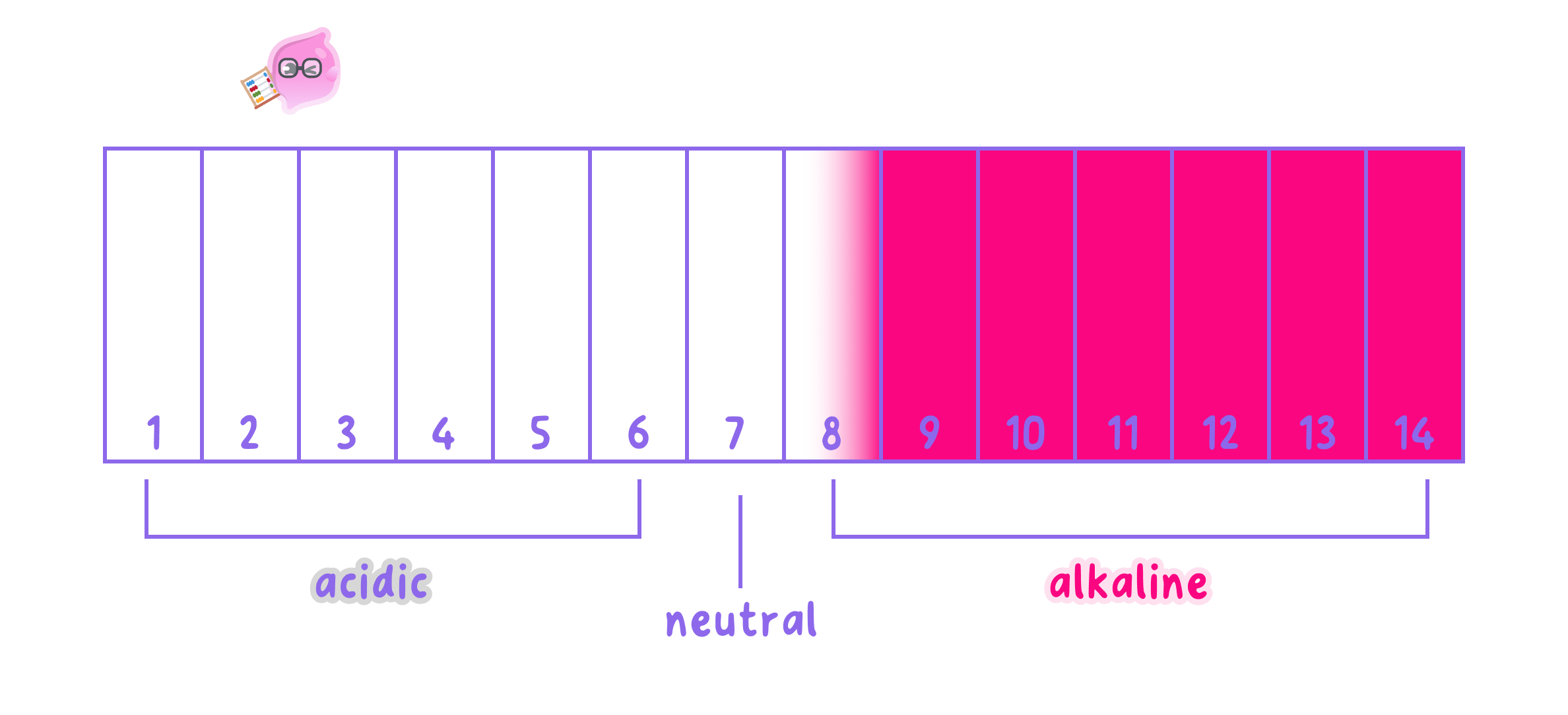
- pH 444: acidic, because it lies below 777.
- pH 777: neutral.
- pH 101010: alkaline, because it lies above 777.
Each indicator has its own set of colours
Indicator
A substance that changes colour to show whether a solution is acidic, neutral or alkaline.
- An indicator changes colour according to whether a solution is acidic, neutral or alkaline.
- Litmus is red in acid, purple in neutral solution and blue in alkali.
- Methyl orange is red in acid, orange in neutral solution and yellow in alkali.
- Phenolphthalein is colourless in acid, colourless in neutral solution and pink in alkali.
- Phenolphthalein therefore cannot tell an acidic solution from a neutral one.
- A colour only means something once the indicator that produced it has been named.
- Colours do not carry across indicators, so red litmus and red methyl orange agree only by coincidence.
- Colourless phenolphthalein leaves two options, acidic or neutral, and cannot separate them.
- Method: measure the pH of a fixed volume of dilute hydrochloric acid, then add powdered calcium hydroxide in small, equal portions, stirring and measuring the pH after each one.
- Result: the pH climbs as the acid is used up, quickly at first and then more slowly, and barely moves once all the acid has reacted.
- Plotting pH against the mass added shows that rise and then the levelling off.
- Stir before each reading, because an unstirred mixture gives a pH that depends on where the probe sits.
- Equal portions matter, since the shape of the graph depends on the additions being comparable.
Reading an indicator or a pH result
- Name the indicator before reading anything into its colour.
- Match that colour against the set of colours belonging to that indicator.
- With a pH value, compare it with 777: below is acidic and above is alkaline.
- A pH of exactly 777 is neutral, not almost acidic.
- Two indicators pointing the same way is a check on the result rather than a contradiction.
- A colour on its own is not an answer, so the indicator has to be named alongside it.
- Comparing a pH with 777 and saying which side it falls on is what turns a number into a conclusion.
- Phenolphthalein cannot separate acidic from neutral, so a second indicator is needed when that distinction matters.
- Which ions is an acid in solution a source of?
- Which ions is an alkali in solution a source of?
- What is the pH of a neutral solution?
- What colour is methyl orange in an acidic solution and in an alkaline one?
- Why can phenolphthalein not distinguish an acidic solution from a neutral one?
4.1.2 Hydrogen ion concentration and pH
Hydrogen ion concentration sets the pH
pH scale
A numerical scale that measures how acidic or alkaline a solution is, with 7 as neutral, lower values acidic and higher values alkaline.
Concentration
The mass or amount of a solute dissolved in a given volume of solution.
- pH measures the concentration of hydrogen ions, H+\text{H}^{+}H+, in a solution.
- The scale is not a straight one: each step of 111 in pH stands for a tenfold change in that concentration.
- A higher H+\text{H}^{+}H+ concentration gives a lower pH.
- A higher OH−\text{OH}^{-}OH− concentration gives a higher pH.
- A neutral solution at pH 777 holds the two ions in equal concentrations.
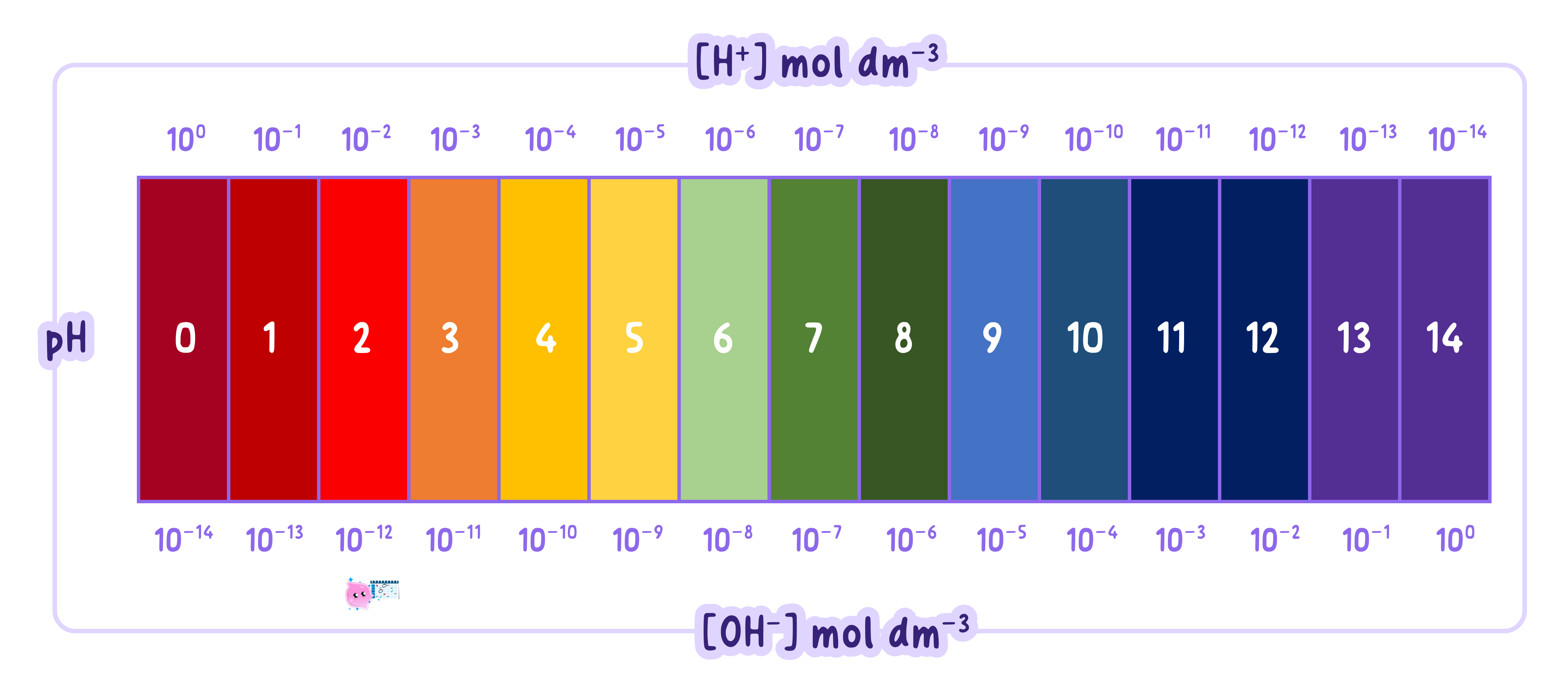
- More H+\text{H}^{+}H+ means a lower pH.
- More OH−\text{OH}^{-}OH− means a higher pH.
Each step of one on the scale is a factor of ten
- Multiplying the H+\text{H}^{+}H+ concentration by 101010 lowers the pH by 111.
- Dividing the H+\text{H}^{+}H+ concentration by 101010 raises the pH by 111.
- So a solution at pH 555 moves to pH 444 when its H+\text{H}^{+}H+ concentration is multiplied by 101010.
- A change from pH 444 to pH 333 therefore means the concentration rose ten times.
- A change from pH 333 to pH 111 means it rose 100100100 times, because that is two steps.
- The steps work the same way in reverse, so pH 222 to pH 555 is a thousandfold fall.
- pH 666 to pH 555: the H+\text{H}^{+}H+ concentration has been multiplied by 101010.
- pH 333 to pH 444: the H+\text{H}^{+}H+ concentration has been divided by 101010.
- pH 222 to pH 555: three steps, so the concentration has fallen by a factor of 100010001000.
Hydroxide ions push the pH the other way
- Adding alkali raises the hydroxide ion concentration in the solution.
- A higher OH−\text{OH}^{-}OH− concentration gives a higher pH.
- The two concentrations move in opposite directions, because H+\text{H}^{+}H+ and OH−\text{OH}^{-}OH− react together to form water.
- Multiplying the OH−\text{OH}^{-}OH− concentration by 101010 raises the pH by 111, mirroring the acid case.
- Diluting an alkali lowers its OH−\text{OH}^{-}OH− concentration, so its pH falls back towards 777.
- Higher OH−\text{OH}^{-}OH− raises the pH, so the direction is the opposite of the acid case.
- Identify which ion changed before applying any factor of ten.
Working out a pH change
- Decide which ion the question changes, H+\text{H}^{+}H+ or OH−\text{OH}^{-}OH−.
- Count how many factors of ten the concentration changes by.
- Each factor of ten is one unit of pH.
- Set the direction: more H+\text{H}^{+}H+ lowers the pH, more OH−\text{OH}^{-}OH− raises it.
- Give the new pH, or the factor, according to what the question asks for.
- Counting the factors of ten first, and fixing the direction afterwards, keeps the two decisions apart.
- A pH change of 222 is a hundredfold change in concentration, not a doubling.
- Saying which ion changed is what makes the direction of the answer defensible.
- What happens to the pH when the hydrogen ion concentration increases?
- By how much does the pH change when the H+\text{H}^{+}H+ concentration is multiplied by 101010?
- What happens to the pH when the hydroxide ion concentration increases?
- What does a change from pH 555 to pH 444 tell you about the H+\text{H}^{+}H+ concentration?
- By what factor has the concentration changed between pH 222 and pH 555?
4.1.3 Dilute and concentrated, weak and strong acids
Concentration and strength describe different things
Concentration
The mass or amount of a solute dissolved in a given volume of solution.
Dissociation
The separation of a substance into ions when it dissolves in water.
- Concentration describes how much acid is dissolved in a given volume of solution.
- Strength describes what proportion of the dissolved acid molecules split up into ions.
- The two are independent, so an acid can be dilute and strong, or concentrated and weak.
- Adding water changes the concentration but never the strength.
- Strength is a property of the acid itself, fixed by which acid it is.
- Concentration is how much acid there is in a given volume.
- Strength is what proportion of it dissociates, and that is fixed by which acid it is rather than by how much water is present.
Dilute and concentrated describe how much acid is present
Dilute solution
A solution containing a relatively small amount of solute in a given volume.
Concentrated solution
A solution containing a relatively large amount of solute in a given volume.
- A dilute acid holds a relatively small amount of acid in a given volume of solution.
- A concentrated acid holds a relatively large amount in the same volume.
- Adding water increases the volume without changing the amount of acid, so the solution becomes more dilute.
- Removing water reduces the volume, so the solution becomes more concentrated.
- Diluting an acid raises its pH, because the H+\text{H}^{+}H+ concentration falls.
- Diluting tenfold: the H+\text{H}^{+}H+ concentration falls by a factor of 101010, so the pH rises by 111.
- Two bottles of one acid: one labelled dilute and one concentrated hold the same acid at different concentrations.
Strong and weak describe how far the acid dissociates
Strong acid
An acid whose molecules dissociate completely into ions in aqueous solution.
Weak acid
An acid whose molecules dissociate only partially into ions in aqueous solution.
- A strong acid dissociates completely, so every molecule splits into ions in solution.
- Hydrochloric acid is strong: HCl(aq)→H+(aq)+Cl−(aq)\text{HCl}(aq) \rightarrow \text{H}^{+}(aq) + \text{Cl}^{-}(aq)HCl(aq)→H+(aq)+Cl−(aq).
- A weak acid dissociates only partially, so most of it stays as whole molecules.
- Ethanoic acid is weak: CH3COOH(aq)⇌H+(aq)+CH3COO−(aq)\text{CH}_3\text{COOH}(aq) \rightleftharpoons \text{H}^{+}(aq) + \text{CH}_3\text{COO}^{-}(aq)CH3COOH(aq)⇌H+(aq)+CH3COO−(aq).
- The reversible arrow shows that ions and undissociated molecules are both present at once.
- At the same concentration a strong acid gives a higher H+\text{H}^{+}H+ concentration than a weak one.
- The strong acid therefore has the lower pH of the two at equal concentration.
- Strong is not concentrated, because strength is about dissociation and concentration about amount.
- Weak is not dilute, for exactly the same reason.
Describing an acid needs both words
- Dilute and strong: little acid present, but all of it dissociated.
- Concentrated and strong: a lot of acid present, all of it dissociated.
- Dilute and weak: little acid present, and only some of it dissociated.
- Concentrated and weak: a lot of acid present, but only some of it dissociated.
- Give the two descriptions separately, because they answer different questions.
- A concentrated weak acid can hold a higher H+\text{H}^{+}H+ concentration than a dilute strong one.
- Keeping concentration for amount and strength for dissociation stops the two ideas blurring together.
- A comparison of pH only holds at the same concentration, so that condition is worth stating.
- The reversible arrow is the mark of a weak acid, and it belongs in the equation.
- What does the concentration of an acid describe?
- What happens to the concentration, and to the strength, when water is added?
- What is the difference between complete and partial dissociation?
- Why is hydrochloric acid described as a strong acid?
- Can an acid be both concentrated and weak?
4.1.4 Bases, alkalis and the reactions of acids
A base reacts with an acid to give a salt and water
Base
A substance that reacts with an acid to form a salt and water only.
Alkali
A soluble base, which is a source of hydroxide ions when it dissolves in water.
Salt
The compound formed when the hydrogen ion of an acid is replaced by a metal ion or an ammonium ion.
- A base reacts with an acid to form a salt and water, and nothing else.
- Metal oxides and metal hydroxides are bases, because those are their only products with an acid.
- A base that dissolves in water is also called an alkali.
- Every alkali is therefore a base, but a base that will not dissolve is not an alkali.
- Metal carbonates also react with acids, but they give carbon dioxide as well, so they fall outside that definition.
- In every case the metal gives the first part of the salt's name and the acid gives the ending.
- Every alkali is a base, though not every base is an alkali.
- Only a salt and water come from an acid and a base, which is what the definition demands.
The acid fixes the ending of the salt's name
Word equation
A way of showing a reaction that uses the names of the reactants and products, with an arrow pointing from reactants to products.
- Hydrochloric acid makes chloride salts.
- Sulfuric acid makes sulfate salts.
- Nitric acid makes nitrate salts.
- The metal supplies the first word, so magnesium with hydrochloric acid gives magnesium chloride.
- A word equation names the substances without formulae, which is enough to get the salt right.
- Copper oxide with sulfuric acid gives copper sulfate and water.
- Zinc and hydrochloric acid: zinc chloride.
- Sodium hydroxide and nitric acid: sodium nitrate.
- Calcium carbonate and sulfuric acid: calcium sulfate.
Acids with metals give a salt and hydrogen
- A suitable metal reacts with a dilute acid to give a salt and hydrogen: acid+metal→salt+hydrogen\text{acid} + \text{metal} \rightarrow \text{salt} + \text{hydrogen}acid+metal→salt+hydrogen
- Magnesium with hydrochloric acid: Mg(s)+2HCl(aq)→MgCl2(aq)+H2(g)\text{Mg}(s) + 2\text{HCl}(aq) \rightarrow \text{MgCl}_2(aq) + \text{H}_2(g)Mg(s)+2HCl(aq)→MgCl2(aq)+H2(g)
- Magnesium with sulfuric acid: Mg(s)+H2SO4(aq)→MgSO4(aq)+H2(g)\text{Mg}(s) + \text{H}_2\text{SO}_4(aq) \rightarrow \text{MgSO}_4(aq) + \text{H}_2(g)Mg(s)+H2SO4(aq)→MgSO4(aq)+H2(g)
- The bubbles seen during the reaction are hydrogen leaving the solution.
- This is not a neutralisation, because hydrogen is a product alongside the salt.
- A metal is not a base, because the reaction gives hydrogen as well as a salt.
- Not every metal reacts, since copper and the metals below hydrogen leave dilute acids alone.
Acids with metal oxides and hydroxides give a salt and water
Neutralisation
The reaction in which hydrogen ions from an acid join with hydroxide ions from an alkali to form water.
-
Both a metal oxide and a metal hydroxide give only a salt and water with an acid:
acid+metal oxide→salt+water\text{acid} + \text{metal oxide} \rightarrow \text{salt} + \text{water}acid+metal oxide→salt+water acid+metal hydroxide→salt+water\text{acid} + \text{metal hydroxide} \rightarrow \text{salt} + \text{water}acid+metal hydroxide→salt+water -
Copper oxide with sulfuric acid: CuO(s)+H2SO4(aq)→CuSO4(aq)+H2O(l)\text{CuO}(s) + \text{H}_2\text{SO}_4(aq) \rightarrow \text{CuSO}_4(aq) + \text{H}_2\text{O}(l)CuO(s)+H2SO4(aq)→CuSO4(aq)+H2O(l).
-
Sodium hydroxide with hydrochloric acid: NaOH(aq)+HCl(aq)→NaCl(aq)+H2O(l)\text{NaOH}(aq) + \text{HCl}(aq) \rightarrow \text{NaCl}(aq) + \text{H}_2\text{O}(l)NaOH(aq)+HCl(aq)→NaCl(aq)+H2O(l).
-
Calcium hydroxide needs two acid molecules: Ca(OH)2(aq)+2HNO3(aq)→Ca(NO3)2(aq)+2H2O(l)\text{Ca(OH)}_2(aq) + 2\text{HNO}_3(aq) \rightarrow \text{Ca(NO}_3)_2(aq) + 2\text{H}_2\text{O}(l)Ca(OH)2(aq)+2HNO3(aq)→Ca(NO3)2(aq)+2H2O(l).
-
Both of these are neutralisations, because a salt and water are the only products.
- A soluble hydroxide is an alkali, so sodium hydroxide counts as both a base and an alkali.
- An insoluble oxide is still a base, even though it cannot make an alkaline solution.
Acids with metal carbonates also give carbon dioxide
- A metal carbonate gives three products with an acid: acid+metal carbonate→salt+water+carbon dioxide\text{acid} + \text{metal carbonate} \rightarrow \text{salt} + \text{water} + \text{carbon dioxide}acid+metal carbonate→salt+water+carbon dioxide
- Calcium carbonate with hydrochloric acid: CaCO3(s)+2HCl(aq)→CaCl2(aq)+H2O(l)+CO2(g)\text{CaCO}_3(s) + 2\text{HCl}(aq) \rightarrow \text{CaCl}_2(aq) + \text{H}_2\text{O}(l) + \text{CO}_2(g)CaCO3(s)+2HCl(aq)→CaCl2(aq)+H2O(l)+CO2(g).
- Sodium carbonate with sulfuric acid: Na2CO3(aq)+H2SO4(aq)→Na2SO4(aq)+H2O(l)+CO2(g)\text{Na}_2\text{CO}_3(aq) + \text{H}_2\text{SO}_4(aq) \rightarrow \text{Na}_2\text{SO}_4(aq) + \text{H}_2\text{O}(l) + \text{CO}_2(g)Na2CO3(aq)+H2SO4(aq)→Na2SO4(aq)+H2O(l)+CO2(g).
- The fizzing is carbon dioxide escaping, and it is the quickest sign that a carbonate is present.
- Hydrogen comes from a metal and carbon dioxide from a carbonate, so the gas identifies which one reacted.
- Naming the gas identifies the reactant, so hydrogen points to a metal and carbon dioxide to a carbonate.
- A salt name is built from two places at once: the metal for the first word and the acid for the second.
- State symbols belong in these equations, and they are the detail most often left out.
- What is a base, in terms of what it produces with an acid?
- What makes a base an alkali?
- What are the products when a metal reacts with a dilute acid?
- What are the products when a metal carbonate reacts with an acid?
- Which salt forms from zinc oxide and sulfuric acid?
4.1.5 Chemical tests for hydrogen and carbon dioxide
Two gases, two tests
- A chemical test is a stated method together with the observation that counts as a positive result.
- Hydrogen is tested with a burning splint.
- Carbon dioxide is tested with limewater.
- A test is only complete when both the method and the observation have been given.
- Hydrogen gives a squeaky pop with a burning splint.
- Carbon dioxide turns limewater milky, which is a white precipitate forming.
Hydrogen: a burning splint gives a squeaky pop
- Collect the gas in a test tube and keep it stoppered until the moment of the test.
- Hold a burning splint at the open mouth of the tube.
- Hydrogen burns rapidly in the air inside the tube.
- That rapid burning makes a squeaky pop, and the sound is the positive result.
- A splint that simply goes out has identified nothing, because no pop was heard.
- The pop is the result, so describing the splint going out identifies no gas at all.
- Hydrogen burns rather than relighting a glowing splint, which is the test for oxygen instead.
Carbon dioxide: limewater turns milky
Precipitate
An insoluble solid that forms when two solutions are mixed.
- Limewater is a solution of calcium hydroxide, Ca(OH)2\text{Ca(OH)}_2Ca(OH)2.
- Bubble the gas being tested through the limewater.
- Carbon dioxide reacts with that calcium hydroxide to give insoluble calcium carbonate: Ca(OH)2(aq)+CO2(g)→CaCO3(s)+H2O(l)\text{Ca(OH)}_2(aq) + \text{CO}_2(g) \rightarrow \text{CaCO}_3(s) + \text{H}_2\text{O}(l)Ca(OH)2(aq)+CO2(g)→CaCO3(s)+H2O(l)
- The tiny solid particles make the limewater look milky, and that is the positive result.
- Limewater that stays clear has not shown carbon dioxide.
- Positive: the limewater turns milky as a white precipitate of calcium carbonate forms.
- Negative: the limewater stays clear, so the gas is not carbon dioxide.
Giving a complete test answer
- Name the reagent or apparatus first.
- Then give the observation that counts as a positive result.
- Hydrogen: burning splint, squeaky pop.
- Carbon dioxide: bubble through limewater, limewater turns milky.
- Do not swap the two observations, because each belongs to one gas only.
- What is used to test for hydrogen?
- Which observation confirms that a gas is hydrogen?
- How do you test a gas for carbon dioxide?
- Why does limewater turn milky with carbon dioxide?
- What substance is limewater a solution of?
4.1.6 Neutralisation as a reaction of acids with bases
Neutralisation is an acid reacting with a base
Neutralisation
The reaction in which hydrogen ions from an acid join with hydroxide ions from an alkali to form water.
Base
A substance that reacts with an acid to form a salt and water only.
- In a neutralisation an acid and a base react together to give a salt and water.
- Both starting substances lose their acidic and basic character as the reaction proceeds.
- An alkali is a soluble base, so an acid and an alkali neutralise each other in solution.
- The general pattern is acid plus base giving salt plus water.
- That pattern holds whichever acid and whichever base are used.
- Acid plus base gives a salt and water, and nothing else.
- An alkali is the soluble kind of base, which is why this reaction happens in solution.
Hydrogen ions and hydroxide ions combine to make water
Aqueous solution
A solution made by dissolving a substance in water, shown in an equation by the state symbol (aq).
- An acid in solution supplies hydrogen ions, H+(aq)\text{H}^{+}(aq)H+(aq).
- An alkali in solution supplies hydroxide ions, OH−(aq)\text{OH}^{-}(aq)OH−(aq).
- One of each holds exactly the atoms of one water molecule, so they react in a 1:11:11:1 ratio: H+(aq)+OH−(aq)→H2O(l)\text{H}^{+}(aq) + \text{OH}^{-}(aq) \rightarrow \text{H}_2\text{O}(l)H+(aq)+OH−(aq)→H2O(l)
- Removing those ions from the solution is what neutralisation means at the particle level.
- The equation is the same for every acid and alkali, because each supplies one of the two ions.
- Hydrochloric acid and sodium hydroxide: HCl(aq)+NaOH(aq)→NaCl(aq)+H2O(l)\text{HCl}(aq) + \text{NaOH}(aq) \rightarrow \text{NaCl}(aq) + \text{H}_2\text{O}(l)HCl(aq)+NaOH(aq)→NaCl(aq)+H2O(l).
- The part that reacts: the H+\text{H}^{+}H+ from the acid and the OH−\text{OH}^{-}OH− from the alkali form the water.
The other ions are spectators
Spectator ion
An ion that is unchanged by the reaction and appears on both sides of the full ionic equation, so it is cancelled out.
Ionic equation
An equation that shows only the ions and substances that change during a reaction, with the spectator ions left out.
- Sodium ions and chloride ions are present before the reaction and afterwards, unchanged.
- Ions that do not change are left out of the ionic equation.
- What remains is the change that actually happens, between H+\text{H}^{+}H+ and OH−\text{OH}^{-}OH−.
- Those spectator ions stay in solution and become the salt once the water is evaporated.
- The full equation shows the salt, while the ionic equation shows the change.
- The salt still forms, even though the ionic equation does not show it.
- State symbols matter here, because the water forms as a liquid among aqueous ions.
Writing about neutralisation
- Identify the acid and say that it supplies H+\text{H}^{+}H+.
- Identify the base or alkali and say that it supplies OH−\text{OH}^{-}OH−.
- State that those two ions react together to form water.
- Name the salt, which takes its name from the metal and from the acid.
- Give the ionic equation with state symbols whenever the question asks for the particle-level change.
- What is meant by a neutralisation reaction?
- What is the difference between a base and an alkali?
- Which ion comes from the acid and which from the alkali?
- What is the ionic equation for the neutralisation of an acid by an alkali?
- Why are sodium and chloride ions called spectator ions?
4.1.7 Preparing soluble salts
The method depends on whether the other reactant dissolves
Soluble
Able to dissolve in a particular solvent.
Insoluble
Unable to dissolve in a particular solvent.
- A soluble salt stays in solution until the water is removed, so everything else has to be got rid of first.
- When the other reactant is insoluble, it can be added in excess and filtered off afterwards.
- When the other reactant is soluble, excess cannot be filtered off, so the volumes are matched by titration.
- Choosing between the two routes starts with asking whether that reactant dissolves.
- Either route finishes with crystallisation to obtain the dry salt.
- Insoluble reactant: add it in excess, then filter the excess off.
- Soluble reactant: match the volumes by titration, so nothing is left over.
- Method: warm dilute sulfuric acid gently, then add black copper(II) oxide a little at a time, stirring, until some solid stays undissolved.
- The excess is what shows all the acid has reacted: CuO(s)+H2SO4(aq)→CuSO4(aq)+H2O(l)\text{CuO}(s) + \text{H}_2\text{SO}_4(aq) \rightarrow \text{CuSO}_4(aq) + \text{H}_2\text{O}(l)CuO(s)+H2SO4(aq)→CuSO4(aq)+H2O(l)
- Filter off the excess copper oxide, leaving blue copper sulfate solution as the filtrate.
- Crystallise: heat the filtrate over a water bath, stop well before dryness, and leave it to cool so that crystals form.
- Not to dryness, because the hydrated crystals would lose their water of crystallisation.
Metals and carbonates reach the same salt by the same route
- A metal added in excess gives the salt and hydrogen, and the leftover metal is filtered off.
- A metal carbonate added in excess gives the salt, water and carbon dioxide, and the leftover solid is filtered off.
- Zinc with sulfuric acid: Zn(s)+H2SO4(aq)→ZnSO4(aq)+H2(g)\text{Zn}(s) + \text{H}_2\text{SO}_4(aq) \rightarrow \text{ZnSO}_4(aq) + \text{H}_2(g)Zn(s)+H2SO4(aq)→ZnSO4(aq)+H2(g)
- Copper carbonate with hydrochloric acid: CuCO3(s)+2HCl(aq)→CuCl2(aq)+H2O(l)+CO2(g)\text{CuCO}_3(s) + 2\text{HCl}(aq) \rightarrow \text{CuCl}_2(aq) + \text{H}_2\text{O}(l) + \text{CO}_2(g)CuCO3(s)+2HCl(aq)→CuCl2(aq)+H2O(l)+CO2(g)
- Fizzing that stops is the sign that the carbonate route has finished.
- Insoluble oxides, hydroxides, metals and carbonates can all be used this way.
- The signal to stop: solid remains undissolved, or the fizzing dies away.
- The separation: filtration removes the excess solid and leaves the salt in solution.
Titration is used when both reactants dissolve
Titration
A method that finds the exact volume of one solution that reacts with a measured volume of another.
Indicator
A substance that changes colour to show whether a solution is acidic, neutral or alkaline.
- Rinse the pipette with the alkali and the burette with the acid, then discard both rinses.
- Pipette a measured volume of the alkali into a conical flask.
- Add a few drops of a single indicator such as methyl orange or phenolphthalein.
- Fill the burette with acid, remove the funnel, and read the level at eye level to 0.05 cm30.05\ \text{cm}^30.05 cm3.
- Run acid in while swirling the flask, adding it dropwise as the colour begins to change.
- Stop at the first permanent colour change and record the final reading.
- The titre is the final reading minus the initial one.
- Repeat until the titres agree within 0.10 cm30.10\ \text{cm}^30.10 cm3, and average only those concordant results.
- The first run is a rough one, and it is left out of the mean.
- A single indicator is used, because universal indicator passes through too many colours to show one endpoint.
Getting a pure, dry salt from a titration
Crystallisation
A method that obtains a dissolved solid from its solution by evaporating some of the solvent and letting crystals form as the solution cools.
- Repeat the titration with the mean volume of acid and no indicator in the flask.
- The solution then holds only the salt and water, with no dye in it.
- Transfer it to an evaporating basin and heat gently to concentrate it.
- Leave the concentrated solution to cool so that crystals form.
- Filter off the crystals and dry them between filter papers.
- The salt is pure because the reactants were matched exactly and no indicator was present.
- Leaving the indicator out matters because it would otherwise end up in the crystals, and that reason is the part worth writing.
- Excess and titration answer different situations, so naming which reactant dissolves comes first.
- A method answer is judged on its order, so heating, cooling, filtering and drying belong in sequence.
- Why is an insoluble reactant added in excess?
- How is that excess removed from the mixture?
- Why is titration used when both reactants are soluble?
- How do you know when the endpoint of a titration has been reached?
- Why is the final preparation carried out without an indicator?
4.1.8 Solubility rules and preparing insoluble salts
The solubility rules, and the exceptions that matter
Solubility
A measure of how much of a substance will dissolve in a given amount of solvent.
Salt
The compound formed when the hydrogen ion of an acid is replaced by a metal ion or an ammonium ion.
- All common sodium, potassium and ammonium salts are soluble.
- All nitrates are soluble.
- Common chlorides are soluble, except silver chloride and lead chloride.
- Common sulfates are soluble, except lead sulfate, barium sulfate and calcium sulfate.
- Common carbonates are insoluble, except those of sodium, potassium and ammonium.
- Common hydroxides are insoluble, except those of sodium, potassium and calcium, and calcium hydroxide is only slightly soluble.
- The exceptions are the part worth learning, because the general rules follow a pattern.
- Silver and lead break the chloride rule, and lead, barium and calcium break the sulfate rule.
- Calcium hydroxide is the awkward one, because it is only slightly soluble rather than fully soluble.
Predicting whether a precipitate forms
Precipitate
An insoluble solid that forms when two solutions are mixed.
- Write down the ions present in each of the two solutions.
- Pair each positive ion with the negative ion that came from the other solution.
- Check both of those possible products against the solubility rules.
- If one of them is insoluble it forms a precipitate, and it should be named.
- If both are soluble, no precipitate forms and no reaction takes place.
- Silver nitrate and sodium chloride: AgNO3(aq)+NaCl(aq)→AgCl(s)+NaNO3(aq)\text{AgNO}_3(aq) + \text{NaCl}(aq) \rightarrow \text{AgCl}(s) + \text{NaNO}_3(aq)AgNO3(aq)+NaCl(aq)→AgCl(s)+NaNO3(aq)
- Barium chloride and sodium sulfate: BaCl2(aq)+Na2SO4(aq)→BaSO4(s)+2NaCl(aq)\text{BaCl}_2(aq) + \text{Na}_2\text{SO}_4(aq) \rightarrow \text{BaSO}_4(s) + 2\text{NaCl}(aq)BaCl2(aq)+Na2SO4(aq)→BaSO4(s)+2NaCl(aq)
- Potassium nitrate and sodium chloride give no reaction, because every possible product is soluble and all the ions simply stay in solution.
- A precipitate: AgCl\text{AgCl}AgCl is the exception to the chloride rule, so it drops out as a white solid.
- No precipitate: mixing potassium nitrate with sodium chloride leaves every ion dissolved.
Ionic equations show only the ions that react
Ionic equation
An equation that shows only the ions and substances that change during a reaction, with the spectator ions left out.
Spectator ion
An ion that is unchanged by the reaction and appears on both sides of the full ionic equation, so it is cancelled out.
- Only the ions that form the precipitate actually change.
- The rest stay in solution throughout and are spectator ions.
- For silver chloride the ionic equation is: Ag+(aq)+Cl−(aq)→AgCl(s)\text{Ag}^{+}(aq) + \text{Cl}^{-}(aq) \rightarrow \text{AgCl}(s)Ag+(aq)+Cl−(aq)→AgCl(s)
- For barium sulfate it is: Ba2+(aq)+SO42−(aq)→BaSO4(s)\text{Ba}^{2+}(aq) + \text{SO}_4^{2-}(aq) \rightarrow \text{BaSO}_4(s)Ba2+(aq)+SO42−(aq)→BaSO4(s)
- The state symbols carry the meaning here, because (aq)(aq)(aq) and (s)(s)(s) are what show the precipitation.
- Cancel the spectator ions, which are the ones appearing unchanged on both sides.
- Balance charge as well as atoms, because an ionic equation has to balance both.
Preparing a pure, dry insoluble salt
- Choose two soluble solutions that between them contain the ions you want.
- Mix them and stir, so that the insoluble salt precipitates out.
- Filter the mixture, keeping the residue on the filter paper.
- Wash that residue with distilled water, which rinses away the soluble substances clinging to it.
- Dry the washed solid between filter papers or in a warm oven.
- The product is pure because everything else was soluble and has been washed away.
- Naming both starting solutions is part of the answer, because choosing them is what the question asks.
- Washing is the step most often missed, and without it soluble salt is left on the crystals.
- Check the rules in both directions, since one soluble product is not enough to settle the question.
- Which salts of sodium, potassium and ammonium are soluble?
- Which chlorides and which sulfates are the insoluble exceptions?
- What precipitate forms when silver nitrate is mixed with sodium chloride?
- Why is the residue washed with distilled water?
- What is the ionic equation for the formation of barium sulfate?

