Skip to content

Course home

10.1 Using the Earth's resources and obtaining potable water

10.1 Using the Earth's resources and obtaining potable water

EasyMedium
1234567
Question 7

An environmental monitoring station is analysing local river water downstream of an industrial plant following a suspected leakage of copper(II) chloride (CuCl2\text{CuCl}_2CuCl2​).

a.

Draw one line from each water treatment step to its correct purpose.

  • Step:

    • Filtration
    • Sedimentation
  • Purpose:

    • Allow heavier suspended solids to settle to the bottom of a tank
    • Remove small insoluble particles like sand and silt by passing through gravel beds
    • Kill pathogenic microbes and bacteria
    • Neutralise dissolved acidic compounds
[2]
b.

Which two of the following options are commonly used to sterilise fresh water to make it potable? Choose two options.

  • Chlorine gas
  • Argon gas
  • Ultraviolet (UV) light
  • Methane
  • Sulfur dioxide
[2]
c.

Which two methods can demonstrate the presence of dissolved solids in a sample of river water?

  • Test if the boiling point of the water is significantly higher than 100∘C100^\circ\text{C}100∘C at standard pressure.
  • Check if the liquid turns anhydrous copper(II) sulfate from white to blue.
  • Evaporate all the liquid to see if a solid residue remains.
  • Add a universal indicator solution to check if the pH is neutral.
[2]
d.

Separate samples are tested to confirm the presence of the ions from the copper(II) chloride contaminant. Draw one line from each ion to the correct chemical reagent needed to identify it.

  • Ion:

    • Copper(II) ion (Cu2+\text{Cu}^{2+}Cu2+)
    • Chloride ion (Cl−\text{Cl}^-Cl−)
  • Reagent:

    • Dilute sulfuric acid
    • Barium chloride solution (acidified)
    • Sodium hydroxide solution
    • Silver nitrate solution (acidified)
[2]
e.

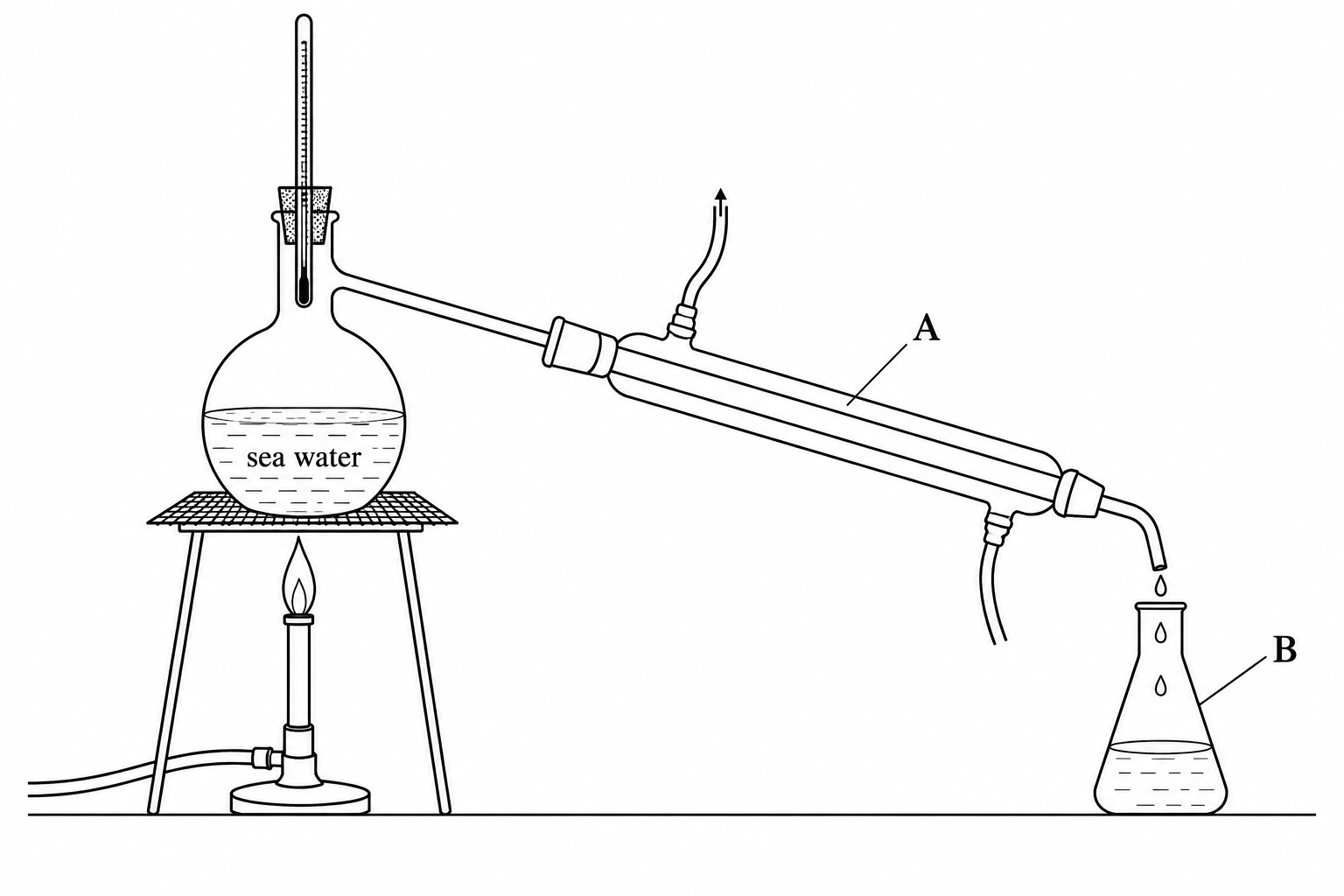
How can pure water be produced from a sample of river water containing dissolved solids?

  • Simple distillation
  • Decanting
  • Paper chromatography
  • Gravity filtration
[1]
Markscheme

10.1 Using the Earth's resources and obtaining potable water Questions

  1. GCSE
  2. /Chemistry
  3. /10.1 Using the Earth's resources and obtaining potable water

11 exam-style questions on AQA GCSE Chemistry 10.1 Using the Earth's resources and obtaining potable water, covering 10.1.1 Using the Earth's resources and sustainable development, 10.1.2 Potable water, 10.1.3 Waste water treatment, and 10.1.4 Alternative methods of extracting metals (HT only). Each one has a worked solution and a mark scheme showing where the marks go.

Question bank