Question 3
HA student heated calcium carbonate strongly until it had completely decomposed.
CaCO3→CaO+CO2\text{CaCO}_3 \rightarrow \text{CaO} + \text{CO}_2CaCO3→CaO+CO2
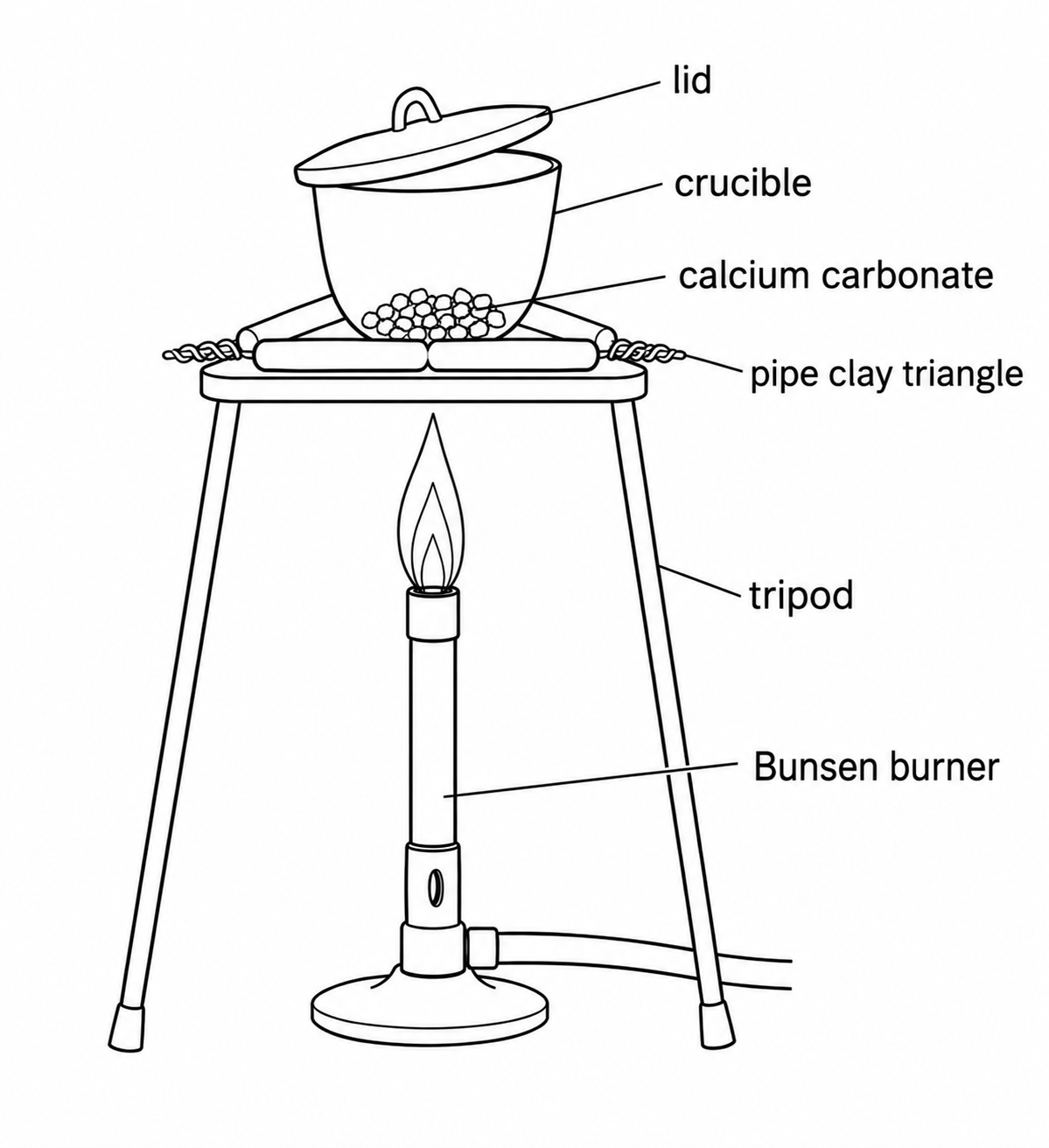
Figure shows the apparatus the student used.
Figure: Apparatus used to heat calcium carbonate to constant mass
Relative formula masses (MrM_rMr): CaCO3=100\text{CaCO}_3 = 100CaCO3=100, CaO=56\text{CaO} = 56CaO=56
The student heated 50 g of calcium carbonate.
a.[2]
Calculate the amount, in moles, of calcium carbonate the student heated.
b.[2]
Calculate the mass of calcium oxide produced.
3.2 Use of amount of substance in relation to masses of pure substances Questions
40 exam-style questions on AQA GCSE Chemistry 3.2 Use of amount of substance in relation to masses of pure substances, covering 3.2.1 Moles, 3.2.2 Amounts of substances in equations, 3.2.3 Using moles to balance equations, 3.2.4 Limiting reactants, 3.2.5a Concentration of solutions, and 3.2.5b Relating mass, volume and concentration. Each one has a worked solution and a mark scheme showing where the marks go.