The pH scale measures how acidic or alkaline a solution is
Definition
pH scale
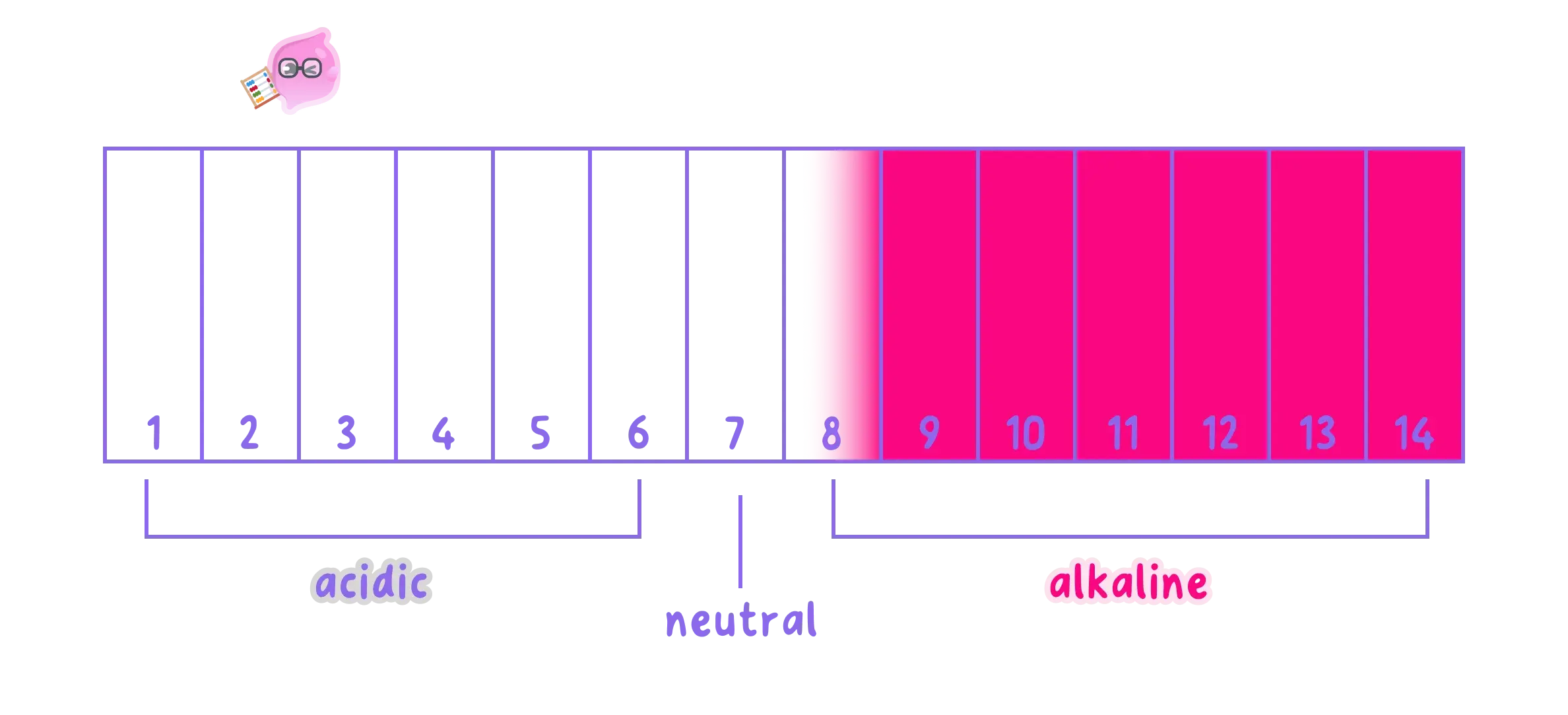
A scale running from 0 to 14 that shows how acidic or alkaline a solution is.
Definition
Hydrogen ion
A positively charged ion, H+\text{H}^{+}H+, produced by acids in aqueous solution.
- The pH scale runs from 0 to 14 and measures acidity.
- A solution with pH below 7 is acidic, pH 7 is neutral, and pH above 7 is alkaline.
- Acids produce hydrogen ions, H+\text{H}^{+}H+, in solution; the more hydrogen ions, the lower the pH.
- Alkalis produce hydroxide ions, OH−\text{OH}^{-}OH−, in solution; the more hydroxide ions, the higher the pH.
Key Idea
- Lower pH means a higher hydrogen ion concentration and a stronger acidity.
- Higher pH means a higher hydroxide ion concentration and a stronger alkalinity.
Measuring pH: universal indicator or a pH probe
Definition
Universal indicator
A mixture of indicators that changes colour across the pH scale and allows the approximate pH of a solution to be estimated.
- Universal indicator changes through a range of colours and is matched to a chart to estimate pH.
- It gives only an approximate whole-number pH, red for strong acid through green for neutral to purple for strong alkali.
- A pH probe connected to a meter gives a precise numerical pH.
- A probe is more accurate than an indicator and avoids judging colours by eye.
Exam technique
- If a question wants a precise pH, choose a pH probe; if it wants a quick estimate, choose universal indicator.
- Universal indicator is unsuitable for accurate work because its colour change is gradual and hard to judge.
Neutralisation makes water from hydrogen and hydroxide ions
Definition
Hydroxide ion
A negatively charged group of atoms with the formula OH−\text{OH}^-OH− that is present in metal hydroxides.
Definition
Neutralisation
The reaction of an acid with a base in which hydrogen ions and hydroxide ions combine to form water.
- In neutralisation, hydrogen ions from the acid react with hydroxide ions from the alkali.
- H+(aq)+OH−(aq)→H2O(l)\text{H}^{+}(aq) + \text{OH}^{-}(aq) \rightarrow \text{H}_2\text{O}(l)H+(aq)+OH−(aq)→H2O(l)
- As the ions combine, the pH moves towards 7 and the solution becomes neutral at the end point.
- This ionic equation is the same for any strong acid neutralised by any strong alkali.
Self review
- What is the pH of a neutral solution?
- Which ion do acids produce in solution, and which ion do alkalis produce?
- Why is a pH probe more accurate than universal indicator?
- Write the ionic equation for neutralisation.
- What happens to the pH as an acid is neutralised by an alkali?
