x

Revision notes for AQA GCSE Chemistry The Haber process. Open the guide for explanations and worked examples. Written against the AQA GCSE Chemistry (8462) specification, so the content matches what's examinable rather than general Chemistry background.

The Haber process

What you'll learn

  • What ammonia is used for, especially in nitrogen-based fertilisers.
  • The raw materials for the Haber process and where they come from.
  • The reversible reaction that makes ammonia.
  • Why industry uses about 450°C, about 200 atmospheres, and an iron catalyst.

Why make ammonia?

Ammonia is an important industrial chemical. Its formula is NH₃, meaning each ammonia molecule contains one nitrogen atom bonded to three hydrogen atoms.

Ammonia is used to make nitrogen-based fertilisers, which add nitrogen compounds to soil. Plants need nitrogen to make proteins and grow well, so ammonia is a key starting point for many fertilisers, including some used in NPK fertilisers.

Definition

Ammonia

Ammonia is a compound with the formula NH₃. In the Haber process, ammonia is manufactured from nitrogen and hydrogen gases.

The raw materials

The Haber process uses two raw materials:

  • Nitrogen, obtained from the air.
  • Hydrogen, usually obtained from natural gas, mainly methane, CH₄.

Air is a convenient source of nitrogen because it contains a lot of nitrogen gas. Hydrogen is more expensive because it has to be produced from methane or other sources. Before the reaction, the gases are purified, meaning impurities are removed.

Key Idea

Sources to remember

For GCSE, remember: nitrogen comes from air, and hydrogen comes from natural gas / methane.

The reaction

Nitrogen and hydrogen react to form ammonia:

N₂(g) + 3H₂(g) ⇌ 2NH₃(g)

The state symbol (g) means the substance is a gas.

The equation is balanced: one nitrogen molecule reacts with three hydrogen molecules to form two ammonia molecules. So the reacting ratio is 1 volume of nitrogen to 3 volumes of hydrogen, or 1 mole of nitrogen to 3 moles of hydrogen.

Definition

Reversible reaction

A reversible reaction can happen in both directions. In the Haber process, nitrogen and hydrogen can react to form ammonia, but ammonia can also break down again into nitrogen and hydrogen.

Example

Using the balanced equation ratio

If 60 mol of hydrogen reacts with excess nitrogen, calculate the maximum amount of ammonia that could form.

  1. From the equation, 3 mol of H₂ forms 2 mol of NH₃.

  2. Work out how many “sets” of 3 mol of H₂ are present:

60 mol÷3=20 60\ \text{mol} \div 3 = 20 60 mol÷3=20
  1. Each set forms 2 mol of NH₃, so:
20×2 mol=40 mol 20 \times 2\ \text{mol} = 40\ \text{mol} 20×2 mol=40 mol

So the maximum amount of ammonia is 40 mol.

What happens in the factory?

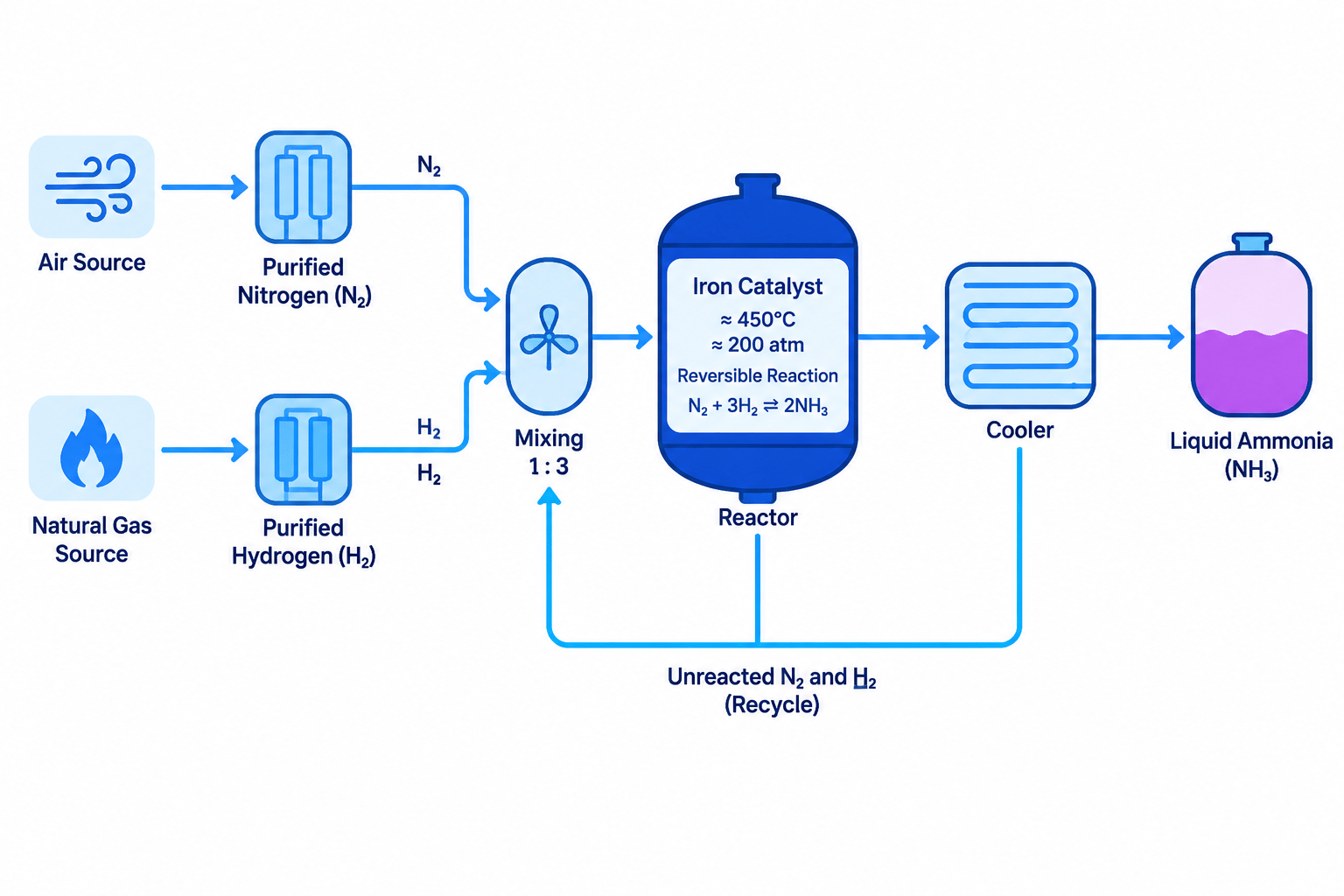
In the Haber process, purified nitrogen and hydrogen gases are passed over an iron catalyst at a high temperature and a high pressure.

The usual industrial conditions are:

  • About 450°C
  • About 200 atmospheres, roughly 2×10⁷ Pa2 \times 10^7\ \text{Pa}2×10⁷ Pa
  • Iron catalyst

Some nitrogen and hydrogen react to form ammonia. The mixture is then cooled, so the ammonia liquefies and can be removed. The unreacted nitrogen and hydrogen gases are recycled back into the reactor.

Flow diagram of the Haber process showing nitrogen and hydrogen sources, compressor, reactor, cooler, ammonia removal, and gas recycling

Common Mistake

Not all the gases react in one pass

Because the reaction is reversible, only some of the nitrogen and hydrogen become ammonia each time through the reactor. The unreacted gases are recycled instead of being wasted.

Dynamic equilibrium

In the reactor, the forward reaction makes ammonia:

N₂(g) + 3H₂(g) ⇌ 2NH₃(g)

The reverse reaction breaks ammonia back down into nitrogen and hydrogen.

Definition

Dynamic equilibrium

A dynamic equilibrium is reached in a closed system when the forward and reverse reactions happen at the same rate, so the amounts of reactants and products stay constant overall.

The word dynamic matters: the reactions have not stopped. Particles are still reacting both ways, but the overall amounts do not change.

In the Haber process, the industrial setup helps improve the overall amount of ammonia collected by cooling and removing ammonia, then recycling unreacted nitrogen and hydrogen.

Example

Predicting the effect of removing ammonia

Explain what happens when ammonia is removed from the reaction mixture.

  1. Ammonia is a product, so removing it decreases the amount of product present.

  2. The system is no longer balanced at equilibrium, so more nitrogen and hydrogen react in the forward direction.

  3. More ammonia is produced, and the unreacted gases can be recycled to improve the overall yield.

Choosing the conditions: a compromise

Industry does not simply choose the conditions that give the highest possible yield. It chooses conditions that give a good yield fast enough and at a reasonable cost.

Definition

Rate and yield

The rate is how fast ammonia is made. The yield is the amount of ammonia produced, often compared with the maximum possible amount.

Temperature: about 450°C

The forward reaction in the Haber process is exothermic, meaning it releases energy to the surroundings.

For an exothermic reversible reaction:

  • A lower temperature gives a higher equilibrium yield of ammonia.
  • But a lower temperature makes the reaction too slow.
  • A higher temperature makes the reaction faster.
  • But a higher temperature gives a lower equilibrium yield of ammonia.

So about 450°C is used as a compromise: hot enough for a good rate, but not so hot that the yield becomes too low.

Graphs showing the Haber process trade-off: lower temperature gives higher ammonia yield, but higher temperature gives faster rate

Pressure: about 200 atmospheres

Pressure affects reversible reactions involving gases.

On the reactant side, there are 4 gas molecules in total:

  • 1 N₂ molecule
  • 3 H₂ molecules

On the product side, there are 2 gas molecules:

  • 2 NH₃ molecules

Increasing the pressure favours the side with fewer gas molecules, so it increases the equilibrium yield of ammonia.

Higher pressure also increases the rate because gas particles are closer together and collide more often. However, very high pressures are expensive because they need strong pipes, strong reactors, and more energy to compress the gases. They are also more dangerous.

So about 200 atmospheres is another compromise.

Example

Predicting the effect of increasing pressure

Explain why increasing pressure increases the ammonia yield.

  1. Count the gas molecules in the balanced equation: the reactant side has 4 gas molecules, while the product side has 2 gas molecules.

  2. Increasing pressure favours the side with fewer gas molecules because this reduces the pressure.

  3. The equilibrium shifts towards ammonia, so the yield of NH₃ increases.

Catalyst: iron

A catalyst increases the rate of reaction without being used up.

In the Haber process, iron is used as the catalyst. It makes the reaction reach equilibrium faster, so ammonia can be produced more quickly.

However, the catalyst does not change the position of equilibrium. It speeds up both the forward and reverse reactions.

Common Mistake

Catalysts do not increase equilibrium yield

A catalyst makes ammonia form faster, but it does not change the final equilibrium mixture. Do not say the iron catalyst increases the yield.

Why these conditions are used commercially

The Haber process is designed around cost, availability, rate, and yield.

  • Nitrogen is cheap and readily available from air.
  • Hydrogen is usually made from methane, so it costs more and depends on natural gas supplies.
  • High temperature increases rate but reduces equilibrium yield.
  • High pressure increases yield and rate, but costs more and has safety risks.
  • Iron is a relatively cheap and effective catalyst.
  • Recycling unreacted gases reduces waste and improves overall production.
Key Idea

The commercial compromise

The Haber conditions are not chosen for maximum yield. They are chosen to give a profitable balance between rate, equilibrium yield, energy cost, equipment cost, and safety.

For Higher Tier, you should also be able to interpret graphs of reaction conditions against rate. In general, if temperature or pressure increases, the rate increases. But for the Haber process, equilibrium yield must also be considered.

Example

Choosing a compromise from data

A factory compares two conditions at the same pressure:

  • 350°C gives 55% equilibrium yield and produces 2 tonnes of ammonia per hour.
  • 450°C gives 35% equilibrium yield and produces 8 tonnes of ammonia per hour.

Explain why the factory might choose 450°C.

  1. Compare the yields: 350°C gives the higher equilibrium yield, so more ammonia is present at equilibrium.

  2. Compare the rates: 450°C produces ammonia faster. It produces:

8÷2=4 8 \div 2 = 4 8÷2=4

times as much ammonia per hour.

  1. For a continuous industrial process, a faster rate can be more profitable, especially because unreacted nitrogen and hydrogen are recycled.
Exam technique

In the exam

  1. Always quote the key conditions accurately: about 450°C, about 200 atmospheres, and an iron catalyst.

  2. When explaining pressure, count the gas molecules: 4 on the left and 2 on the right, so higher pressure favours ammonia.

  3. For compromise questions, mention both sides: what improves the yield or rate, and what makes the condition expensive, unsafe, or too slow.

Self review

Check yourself

  • What are the sources of nitrogen and hydrogen for the Haber process?
  • Why does increasing pressure increase the equilibrium yield of ammonia?
  • Why is 450°C used instead of a much lower temperature?
You've reached the end

Test yourself on this topic, or move on to the next guide.

FlashcardsSelf-test with active recall
Production and uses of NPK fertilisersUp next

How was this guide?

The Haber process Revision Guide

  1. GCSE
  2. /Chemistry
  3. /The Haber process