The effect of changing conditions on equilibrium (HT only)
What you'll learn
- What dynamic equilibrium means in a reversible reaction.
- How to use Le Chatelier’s Principle to predict changes at equilibrium.
- How changes in concentration, pressure and temperature affect the relative amounts of reactants and products.
- Why a catalyst speeds up reaching equilibrium but does not change the equilibrium position.
Reversible reactions: the starting point
A reversible reaction is a reaction where the products can react to form the original reactants again. We show this using the equilibrium arrow, ⇌, instead of the one-way arrow, →.
For example, in the Haber process:
N₂(g) + 3H₂(g) ⇌ 2NH₃(g)
The forward reaction makes ammonia. The reverse reaction breaks ammonia back down into nitrogen and hydrogen.
Reversible reaction
A reversible reaction is a reaction that can happen in both directions: reactants can form products, and products can form reactants again.
Dynamic equilibrium
For a reversible reaction to reach equilibrium, it must be in a closed system. This means no substances can enter or leave the reaction mixture.
Closed system
A closed system is a system where no reactants or products can escape and no extra substances can enter.
At first, the forward reaction may be faster than the reverse reaction. As more products form, the reverse reaction speeds up. Eventually, the forward and reverse reactions happen at the same rate.
At this point, the reaction has reached dynamic equilibrium.
Dynamic equilibrium
Dynamic equilibrium is reached in a closed system when the forward and reverse reactions happen at the same rate, so the concentrations of reactants and products stay constant.
“Dynamic” means the reactions are still happening. Equilibrium does not mean everything has stopped.
A concentration-time graph at equilibrium has flat lines because the concentrations are constant. If a condition changes, the system may shift and then settle at a new equilibrium.

Equal rates, not equal amounts
At equilibrium, the rates of the forward and reverse reactions are equal. The amounts of reactants and products do not have to be equal.
Equilibrium position
The equilibrium position describes the relative amounts of reactants and products in the equilibrium mixture.
If there is a lot of product compared with reactant, we say the equilibrium lies to the right. If there is a lot of reactant compared with product, we say it lies to the left.
Equilibrium position
The equilibrium position is the balance of reactants and products present in a reaction mixture at equilibrium.
The key idea for this Higher Tier topic is that the equilibrium position depends on the conditions of the reaction.
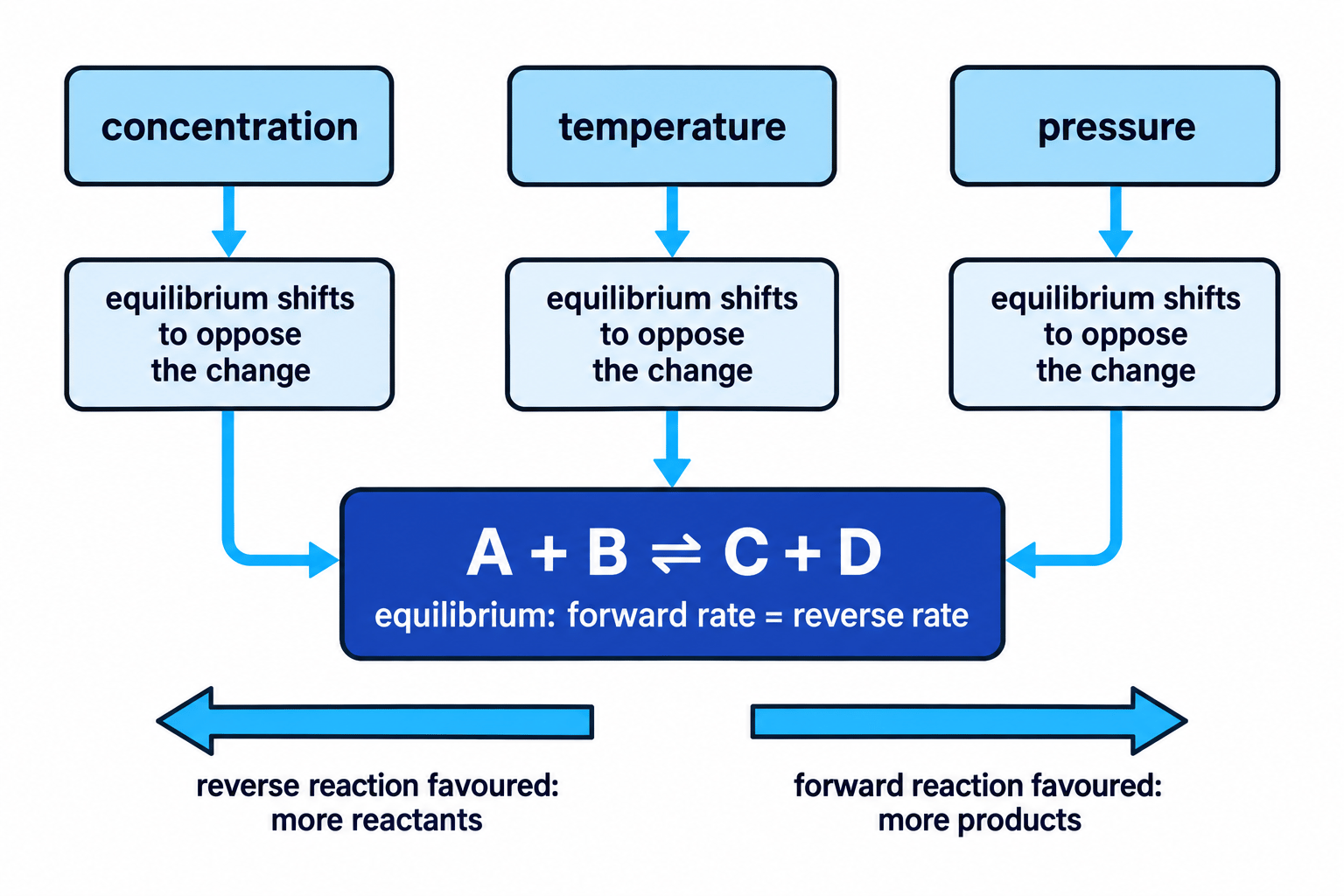
Le Chatelier’s Principle
Le Chatelier’s Principle helps you predict what happens when conditions are changed.
Le Chatelier’s Principle
If a system is at equilibrium and a change is made to the conditions, the system responds to counteract that change.
“Counteract” means the equilibrium shifts in the direction that reduces the effect of the change. You are usually asked for a qualitative prediction: the direction of shift and whether the amount of a product increases or decreases, not an exact calculation.

The big rule
When conditions change, the equilibrium shifts in the direction that opposes the change: it tries to use up added substances, replace removed substances, reduce pressure changes, or reduce temperature changes.
Changing concentration
A concentration is the amount of a substance dissolved or present in a certain volume. In GCSE Chemistry, solution concentration is often measured in moles per cubic decimetre, written as mol/dm³.
For an equilibrium mixture:
- Increasing the concentration of a reactant shifts equilibrium towards the products.
- Increasing the concentration of a product shifts equilibrium towards the reactants.
- Decreasing the concentration of a reactant shifts equilibrium towards the reactants, to replace it.
- Decreasing the concentration of a product shifts equilibrium towards the products, to replace it.
The system does not “know” what you want. It simply shifts to counteract the concentration change.
Predicting a concentration change
For the equilibrium:
N₂(g) + 3H₂(g) ⇌ 2NH₃(g)
More nitrogen gas is added. Predict the effect on the amount of ammonia.
- The concentration of a reactant, nitrogen, has been increased.
- To counteract this, the system shifts to use up some of the added nitrogen, so the forward reaction is favoured.
- The equilibrium shifts to the right, so the amount of ammonia increases and some hydrogen is used up.
Use up does not mean completely remove
If you add more reactant, the system uses up some of it. The final concentration of that reactant may still be higher than before you added it.
Changing pressure
Pressure changes matter for equilibria involving gases. They have little or no effect on equilibria with only solids or liquids.
For gas equilibria, count the number of gas molecules on each side using the big numbers in front of the formulae.
- Increasing pressure shifts equilibrium to the side with fewer gas molecules.
- Decreasing pressure shifts equilibrium to the side with more gas molecules.
- If both sides have the same number of gas molecules, changing pressure does not change the equilibrium position.
This happens because fewer gas molecules take up less space, so shifting that way helps reduce pressure.
Counting gas molecules
Only count substances with the state symbol (g). Ignore solids, liquids and aqueous substances when deciding the pressure effect.
Predicting a pressure change
For the equilibrium:
2SO₂(g) + O₂(g) ⇌ 2SO₃(g)
Predict the effect of increasing the pressure.
- Count the gas molecules on each side: the left has 3 gas molecules in total, while the right has 2 gas molecules.
- Increasing pressure is counteracted by shifting to the side with fewer gas molecules.
- The equilibrium shifts to the right, so the amount of SO₃ increases.
Forgetting to count all gases
In N₂(g) + 3H₂(g) ⇌ 2NH₃(g), the left side has 4 gas molecules in total, not 2 substances. Use the coefficients, not just the number of different chemicals.
Changing temperature
Every reversible reaction is exothermic in one direction and endothermic in the other direction.
Exothermic and endothermic
An exothermic reaction transfers energy to the surroundings. An endothermic reaction takes in energy from the surroundings.
Changing temperature affects equilibrium like this:
- Increasing temperature shifts equilibrium in the endothermic direction.
- Decreasing temperature shifts equilibrium in the exothermic direction.
Think of heat as something the system can “use up” or “replace”. If temperature increases, the system shifts in the direction that takes in energy. If temperature decreases, the system shifts in the direction that releases energy.
Predicting a temperature change
For the equilibrium:
N₂(g) + 3H₂(g) ⇌ 2NH₃(g)
The forward reaction is exothermic. Predict the effect of increasing the temperature.
- The forward reaction is exothermic, so the reverse reaction must be endothermic.
- Increasing temperature is counteracted by favouring the direction that takes in energy.
- The equilibrium shifts to the left, so the amount of ammonia decreases at the new equilibrium.
Mixing up rate and equilibrium
Increasing temperature usually makes reactions happen faster, but for equilibrium questions you must also decide which direction is favoured. A higher temperature can make equilibrium reached faster while producing less of the desired product.
Catalysts and equilibrium
A catalyst is a substance that increases the rate of a reaction without being used up.
For a reversible reaction, a catalyst speeds up both the forward and reverse reactions. This means equilibrium is reached more quickly, but the equilibrium position does not change.
Catalysts do not shift equilibrium
A catalyst changes how fast equilibrium is reached. It does not change the relative amounts of reactants and products at equilibrium.
The full prediction technique
When you are given an equilibrium question, use this method:
- Identify the condition changed: concentration, pressure or temperature.
- Decide what the system must do to counteract the change.
- Work out which direction that means: left or right.
- State the effect on the amount of the named product or reactant.
Combining pressure and temperature ideas
For the equilibrium:
N₂O₄(g) ⇌ 2NO₂(g)
The forward reaction is endothermic. Predict the effect of increasing the temperature and increasing the pressure.
- For temperature: the forward reaction is endothermic, so increasing temperature favours the forward reaction.
- Therefore, increasing temperature shifts equilibrium to the right and increases the amount of NO₂.
- For pressure: the left side has 1 gas molecule, while the right side has 2 gas molecules.
- Increasing pressure favours the side with fewer gas molecules, so pressure shifts equilibrium to the left and decreases the amount of NO₂.
Notice that different changes can push equilibrium in different directions. In real industrial processes, chemists choose conditions that balance product amount, rate, cost and safety.
In the exam
- Always use the word counteract or explain the idea clearly: the system shifts to oppose the change.
- For pressure questions, count only gaseous particles using the coefficients in the balanced equation.
- For temperature questions, first decide which direction is exothermic and which is endothermic, then apply the temperature rule.
Check yourself
- If more product is added to a reaction at equilibrium, which way does the equilibrium shift?
- Why does increasing pressure favour the side with fewer gas molecules?
- If the forward reaction is exothermic, what happens to the amount of product when temperature is increased?