Equilibrium
What you'll learn
- What a reversible reaction is and how to write one using
⇌. - Why equilibrium only happens properly in a closed system.
- What dynamic equilibrium means in terms of reaction rates.
- How to avoid the common exam mistake that “equilibrium means equal amounts”.
The starting point: reactions can go forwards
In most early GCSE chemistry, reactions are written with a single arrow:
magnesium(s) + hydrochloric acid(aq) → magnesium chloride(aq) + hydrogen(g)
The substances you start with are called reactants. The substances made are called products.
A single arrow → means we are treating the reaction as going mainly in one direction: reactants become products.
Reactants and products
Reactants are the substances present at the start of a reaction. Products are the substances made by the reaction.
Reversible reactions
Some reactions can go in both directions. The products can react to make the original reactants again. These are called reversible reactions.
We show this using the reversible arrow ⇌.
For example:
NH4Cl(s) ⇌ NH3(g) + HCl(g)
This means:
- the forward reaction is ammonium chloride decomposing into ammonia and hydrogen chloride
- the reverse reaction is ammonia and hydrogen chloride reacting to form ammonium chloride again
Reversible reaction
A reversible reaction is a reaction in which the products can react to form the original reactants.
Forward and reverse reactions
For a general reversible reaction:
A(g) + B(g) ⇌ C(g) + D(g)
- The forward reaction goes from left to right:
A(g) + B(g) → C(g) + D(g) - The reverse reaction goes from right to left:
C(g) + D(g) → A(g) + B(g)
The reversible arrow
The symbol ⇌ does not mean “the reaction is confused”. It means both directions are possible: forward and reverse.
Identifying forward and reverse reactions
For the reaction:
N2O4(g) ⇌ 2NO2(g)
- The substances on the left are reactants for the forward reaction, so the forward reaction is
N2O4(g) → 2NO2(g). - The substances on the right are reactants for the reverse reaction, so the reverse reaction is
2NO2(g) → N2O4(g). - Because the equation uses
⇌, both directions can happen under suitable conditions.
Closed systems: why escape matters
For equilibrium to be reached, the reaction must happen in apparatus that prevents reactants and products from escaping.
Closed system
A closed system is a reaction setup where no reactants or products can escape to the surroundings.
This matters especially when gases are involved. If a gas product escapes, it cannot react again in the reverse reaction. The reaction may keep going forwards, but it cannot settle into a proper dynamic equilibrium.
For example, if ammonia and hydrogen chloride gases are produced in an open tube, they can spread out into the air. If they escape, there is less chance of them reacting together again to form ammonium chloride.

Forgetting the closed system
Equilibrium is not just “a reversible reaction”. For GCSE, you must usually say it happens in a closed system, so reactants and products cannot escape.
Deciding whether equilibrium can be reached
A reversible reaction produces a gas. It is carried out first in an open beaker and then in a sealed flask. Decide which setup can reach equilibrium.
- In the open beaker, the gas can escape into the air, so not all products remain available for the reverse reaction.
- In the sealed flask, the gas cannot escape, so both reactants and products remain in the apparatus.
- Therefore, the sealed flask is the setup that can reach equilibrium, because it is a closed system.
Rate of reaction
Before defining equilibrium fully, you need one more idea: rate of reaction.
Rate of reaction
The rate of reaction is how quickly reactants are used up or products are formed.
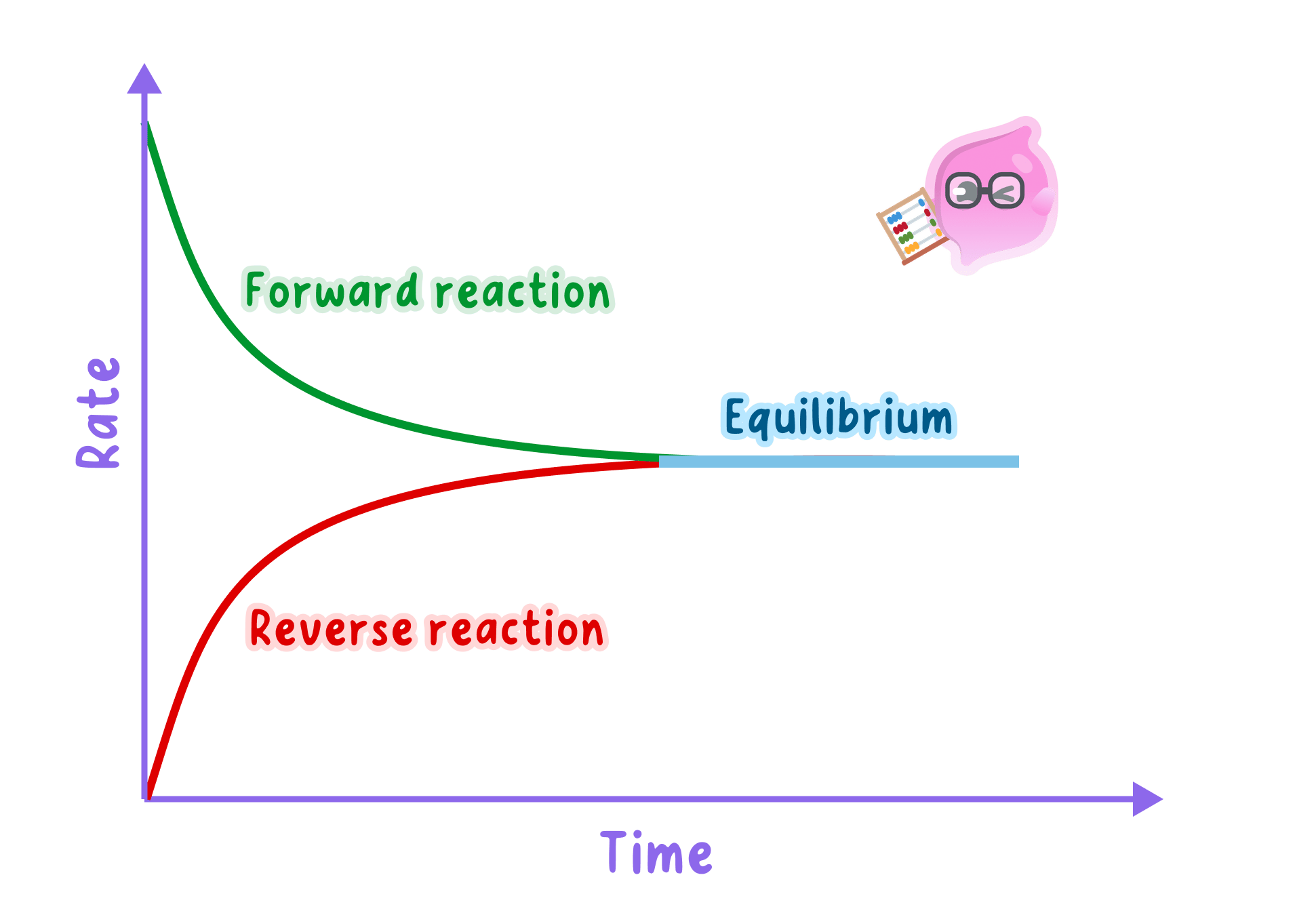
At the start of a reversible reaction, you may have lots of reactants and very little product. So the forward reaction is usually faster than the reverse reaction.
As products build up, the reverse reaction can happen more often. Over time:
- the forward reaction may slow down
- the reverse reaction may speed up
- eventually the two rates become equal
That point is equilibrium.
Dynamic equilibrium
Now we can put the key definition together.
Dynamic equilibrium
Dynamic equilibrium is reached in a closed system when the forward and reverse reactions occur at exactly the same rate.
The word dynamic means that things are still happening. The reaction has not stopped.
At equilibrium:
- the forward reaction is still happening
- the reverse reaction is still happening
- the two reactions happen at the same rate
- the amounts of reactants and products stay constant
Equilibrium is active, not stopped
At dynamic equilibrium, the reaction looks unchanged overall, but particles are still reacting both ways all the time.
Equal rates, not equal amounts
At equilibrium, the rates of the forward and reverse reactions are equal. The amounts of reactants and products do not have to be equal.
What you would observe at equilibrium
Once equilibrium is reached, the visible properties of the reaction mixture stop changing. For example, the colour, pressure, or concentration may become constant.
That does not mean every particle has stopped moving or reacting. It means the changes caused by the forward reaction are exactly balanced by the changes caused by the reverse reaction.
Busy doorway
Imagine people walking through a doorway in both directions. If 10 people per minute go in and 10 people per minute come out, the number of people in the room stays constant. But people are still moving. That is like dynamic equilibrium.
Interpreting an equilibrium graph
A common way to show equilibrium is with a graph of reaction rate against time.
At the start:
- the forward reaction rate is high because there are many reactant particles
- the reverse reaction rate may be low or zero because little product has formed
As time passes:
- the forward rate decreases
- the reverse rate increases
At equilibrium:
- the forward and reverse rates are equal
- both rates remain constant
- the amounts of reactants and products remain constant
Interpreting equal reaction rates
A reversible reaction is carried out in a sealed container. At one time, the forward reaction is faster than the reverse reaction. Later, the two rates become equal. Explain what has happened.
- Because the container is sealed, no reactants or products escape, so the reaction can behave as a closed system.
- While the forward rate is faster than the reverse rate, the overall amounts are still changing: reactants are being converted into products faster than products are being converted back.
- When the two rates become equal, the forward and reverse changes balance each other, so the reaction has reached dynamic equilibrium.
How to write a strong GCSE definition
A full GCSE answer should include the main conditions and the rate idea.
A strong definition is:
Dynamic equilibrium is reached in a closed system when the forward and reverse reactions occur at exactly the same rate.
You can also add:
The concentrations or amounts of reactants and products remain constant.
Best wording
If an exam asks “What is dynamic equilibrium?”, aim to include closed system and forward and reverse reactions at the same rate. Those are the key scoring points.
What equilibrium does not mean
Equilibrium can be a bit misleading because it sounds like “everything is equal”. In chemistry, the most important equality is the equality of rates.
At equilibrium, it is possible to have:
- lots of reactants and only a little product
- lots of product and only a little reactant
- similar amounts of both
All of these can still be equilibrium, as long as the forward and reverse reaction rates are equal.
Do not assume half and half
Equilibrium does not mean 50% reactants and 50% products. The position of equilibrium can lie more to one side, but this section only requires you to know that the rates are equal at equilibrium.
Putting it all together
For a reversible reaction to reach dynamic equilibrium:
- The reaction must be reversible, so both forward and reverse reactions can occur.
- The apparatus must be closed, so no reactants or products escape.
- Over time, the forward and reverse rates change.
- Equilibrium is reached when the forward rate and reverse rate are exactly equal.
- The reaction mixture then appears unchanged because the amounts of substances stay constant.
In the exam
- If asked for the definition, write: closed system and forward and reverse reactions occur at the same rate.
- If given a graph, identify equilibrium where the forward and reverse rate lines become equal and stay equal.
- If a gas escapes or the container is open, be careful: the reaction may be reversible, but equilibrium may not be reached properly.
Check yourself
- What does the symbol
⇌tell you about a reaction? - Why is a closed system needed for equilibrium?
- At equilibrium, what is equal: the amounts of substances or the rates of the forward and reverse reactions?