Question 10
FCalcium carbonate decomposes when it is heated strongly.
calcium carbonate ⇌ \rightleftharpoons\,⇌ calcium oxide + carbon dioxide
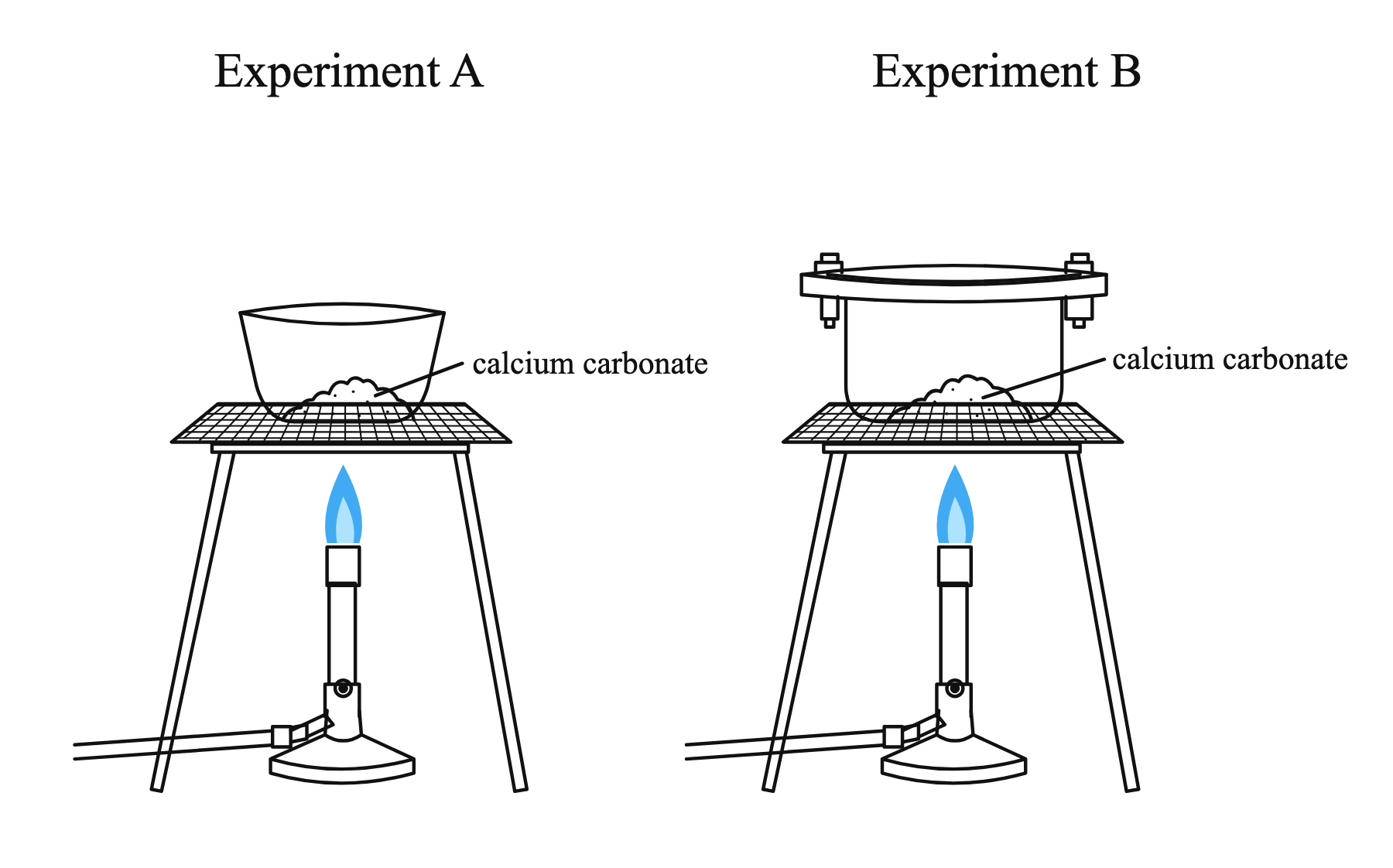
Figure shows two experiments. In experiment A the calcium carbonate is heated in an open crucible and all of it decomposes. In experiment B the calcium carbonate is heated in a sealed steel container and only some of it decomposes.
Figure: The two sets of apparatus used to heat calcium carbonate in an open crucible and in a sealed steel container
a.[2]
Explain why all of the calcium carbonate decomposes in experiment A.
b.[2]
Explain why only some of the calcium carbonate decomposes in experiment B.
c.[1]
Give the name used for a container from which no reactants or products can escape.
6.2 Reversible reactions and dynamic equilibrium Questions
109 exam-style questions on AQA GCSE Chemistry 6.2 Reversible reactions and dynamic equilibrium, covering 6.2.1 Reversible reactions, 6.2.2 Energy changes and reversible reactions, 6.2.3 Equilibrium, 6.2.4 The effect of changing conditions on equilibrium, 6.2.5 The effect of changing concentration, 6.2.6 The effect of temperature changes on equilibrium, and 6.2.7 The effect of pressure changes on equilibrium. Each one has a worked solution and a mark scheme showing where the marks go.