Question 4
FA student adds four metals, W, X, Y and Z, to solutions of the sulfates of the other three metals. The table shows the results.
Table: Results of adding four metals to solutions of the sulfates of the other three metals
| Metal added | W sulfate solution | X sulfate solution | Y sulfate solution | Z sulfate solution |
|---|---|---|---|---|
| W | not done | no reaction | reaction | no reaction |
| X | reaction | not done | reaction | no reaction |
| Y | no reaction | no reaction | not done | no reaction |
| Z | reaction | reaction | reaction | not done |
a.[2]
Use the table to place the four metals in order of reactivity, starting with the most reactive.
b.[2]
One of the four metals is copper. Suggest which one it is. Give a reason for your answer.
c.[1]
The figure shows the tube in which metal Z was added to X sulfate solution.
Figure: A boiling tube containing metal Z in X sulfate solution, at the start of the experiment and after 10 minutes
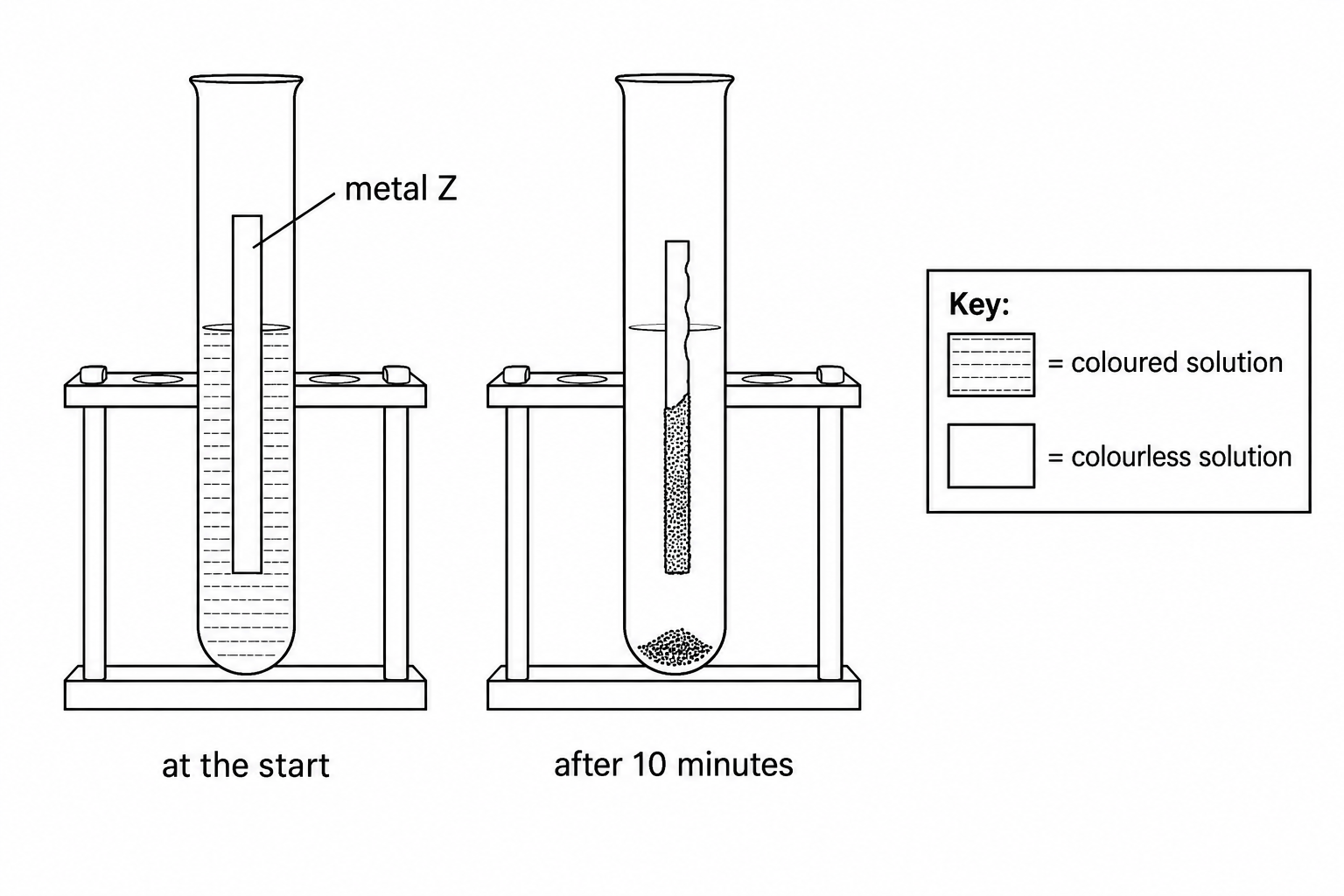
Give one observation from the figure that shows a reaction has taken place.
4.1 Reactivity of metals Questions
39 exam-style questions on AQA GCSE Chemistry 4.1 Reactivity of metals, covering 4.1.1 Metal oxides, 4.1.2 The reactivity series, 4.1.3 Extraction of metals and reduction, and 4.1.4 Oxidation and reduction in terms of electrons. Each one has a worked solution and a mark scheme showing where the marks go.