Question 6
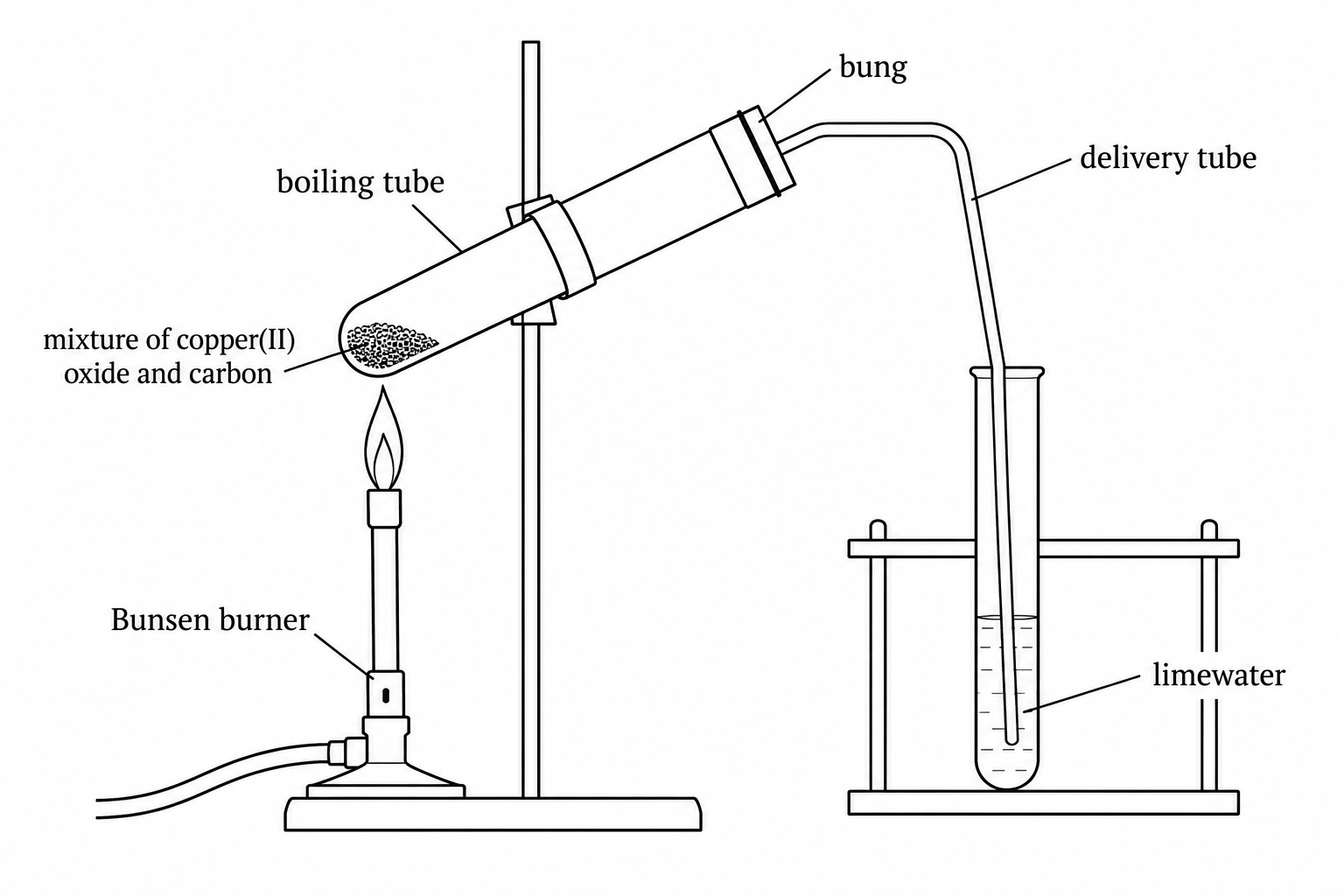
FA student heats a mixture of copper(II) oxide and carbon powder in a boiling tube. The gas produced is passed through limewater. The figure shows the apparatus.
Figure: The apparatus used to heat a mixture of copper(II) oxide and carbon powder and to test the gas produced
a.[1]
The limewater turns cloudy. Name the gas that causes this change.
b.[1]
After heating, a pink or brown solid is seen in the boiling tube. Name this solid.
c.[2]
Which substance in the boiling tube is reduced? Give one reason for your answer in terms of oxygen.
d.[1]
Balance the equation for the reaction.
........CuO+C→........Cu+CO2........\text{CuO} + \text{C} \rightarrow ........\text{Cu} + \text{CO}_2........CuO+C→........Cu+CO2
e.[1]
Suggest why the delivery tube should be lifted out of the limewater before the Bunsen burner is turned off.
4.1 Reactivity of metals Questions
39 exam-style questions on AQA GCSE Chemistry 4.1 Reactivity of metals, covering 4.1.1 Metal oxides, 4.1.2 The reactivity series, 4.1.3 Extraction of metals and reduction, and 4.1.4 Oxidation and reduction in terms of electrons. Each one has a worked solution and a mark scheme showing where the marks go.