A reaction only starts when particles collide with enough energy
Definition
Activation energy
The minimum energy that colliding particles must have before they can react.
Definition
Reacting particle
An atom, ion or molecule that can take part in a chemical reaction.
- A chemical reaction can happen only when reacting particles collide with each other.
- The colliding particles must also have enough energy for the reaction to take place.
- The activation energy is the minimum energy that colliding particles must have for a reaction to occur.
- If the particles collide with less than the activation energy, they simply bounce apart and no reaction happens.
Key Idea
- Reacting particles must collide with at least the activation energy for a reaction to occur.
- A collision with too little energy does not lead to a reaction.
A reaction profile compares the energy of reactants and products as the reaction proceeds
Definition
Reactant
A reactant is a substance that is changed or used up during a chemical reaction.
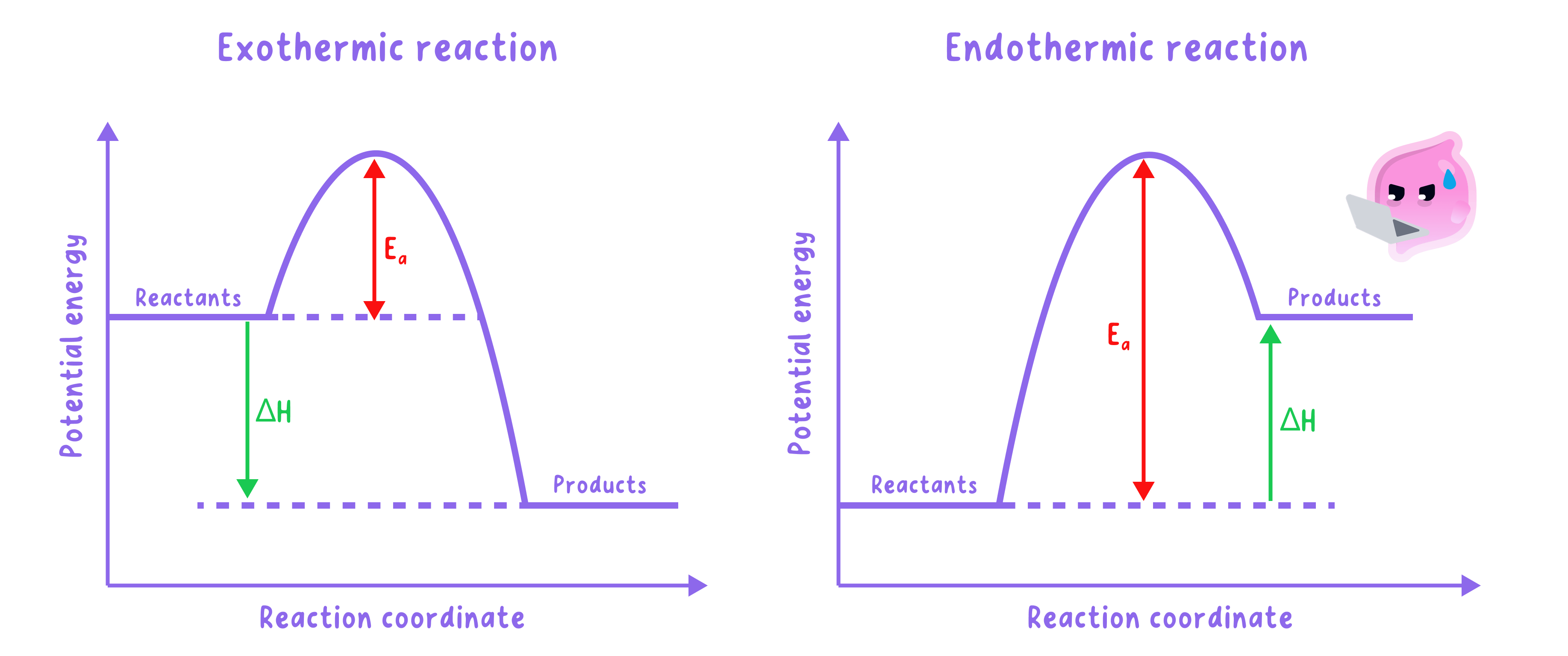
- A reaction profile is an energy level diagram that shows how the relative energy changes as a reaction proceeds.
- The vertical axis is labelled energy.
- The horizontal axis is labelled progress of reaction.
- The reactants are drawn as a horizontal energy level at the start of the profile.
- A curved line rises from the reactant level to a peak and then falls to the product level.
- The peak is the highest energy the particles must reach before they can turn into products.
- The products are drawn as a horizontal energy level at the end of the profile.
- The vertical gap between the reactant and product levels is the overall energy change.
Note
- The diagram shows relative energies, so a higher position means more energy even when the axis has no numbers on it.
- The horizontal axis shows the progress of the reaction, not time or the distance a particle travels.
Drawing a profile: two labelled axes, two energy levels, a curve and two arrows
Definition
Product
A product is a substance formed during a chemical reaction.
- Set up the axes.
- Label the vertical axis energy.
- Label the horizontal axis progress of reaction.
- Add the two energy levels.
- Draw and label a horizontal line for the reactants.
- Draw and label a horizontal line for the products, below the reactant level for an exothermic reaction or above it for an endothermic one.
- Draw the reaction pathway.
- Draw a smooth curved line from the reactant level up to a peak and then down to the product level.
- Add the two energy arrows.
- Draw the activation energy arrow vertically from the reactant level up to the top of the curve.
- Draw the overall energy change arrow vertically between the reactant and product levels.
Common Mistake
- Do not start the activation energy arrow at the bottom of the vertical axis; it starts at the reactant level.
- Do not use straight diagonal lines when the question asks for a curved reaction profile.
- Do not move the product level up to the peak; the product level shows the relative energy of the products.
Products below the reactants mean exothermic; products above mean endothermic
- A reaction is exothermic when the products sit at a lower energy level than the reactants.
- On an exothermic profile the overall energy change is shown as a fall from the reactant level to the product level.
- A reaction is endothermic when the products sit at a higher energy level than the reactants.
- On an endothermic profile the overall energy change is shown as a rise from the reactant level to the product level.
- Compare the reactant and product levels to classify the reaction, rather than judging it from the height of the peak.
Example
- A profile has reactants at 100 kJ100\ \text{kJ}100 kJ, a peak at 180 kJ180\ \text{kJ}180 kJ and products at 60 kJ60\ \text{kJ}60 kJ.
- The activation energy is 180−100=80 kJ180 - 100 = 80\ \text{kJ}180−100=80 kJ.
- The energy falls by 100−60=40 kJ100 - 60 = 40\ \text{kJ}100−60=40 kJ overall, so the reaction is exothermic.
The peak height and the level gap measure two different things
- The vertical distance from the reactant level up to the peak is the activation energy.
- The vertical distance between the reactant and product levels is the overall energy change.
- A tall peak on its own does not tell you whether a reaction is exothermic or endothermic.
- To explain activation energy in words, say that particles need at least this minimum energy when they collide before they can react.
Exam technique
- Label both axes, energy and progress of reaction; unlabelled axes lose easy marks.
- Draw the activation energy arrow from the reactant level up to the top of the curve, not from the baseline.
- To classify a profile, compare the reactant and product levels and ignore how tall the peak is.
Self review
- What is meant by activation energy?
- Why does not every collision between reacting particles cause a reaction?
- Where should the activation energy arrow begin and end on a reaction profile?
- How can you tell an exothermic reaction from its reaction profile?
- How can you tell an endothermic reaction from its reaction profile?
