Energy is conserved: reactions move energy between the chemicals and their surroundings
- Energy is conserved in every chemical reaction, so the total amount of energy in the universe is the same before and after the reaction.
- Energy can move between the reacting chemicals and their surroundings, but it cannot be created or destroyed.
- The surroundings are everything outside the reacting chemicals that can gain or lose energy, such as the solution, the container and the nearby air.
- If a reaction transfers energy out to the surroundings, the products end up with less energy than the reactants by the amount transferred.
- If a reaction takes energy in from the surroundings, the products end up with more energy than the reactants by the amount taken in.
Key Idea
- Any energy lost by the reacting chemicals is gained by the surroundings.
- Any energy gained by the reacting chemicals is taken from the surroundings.
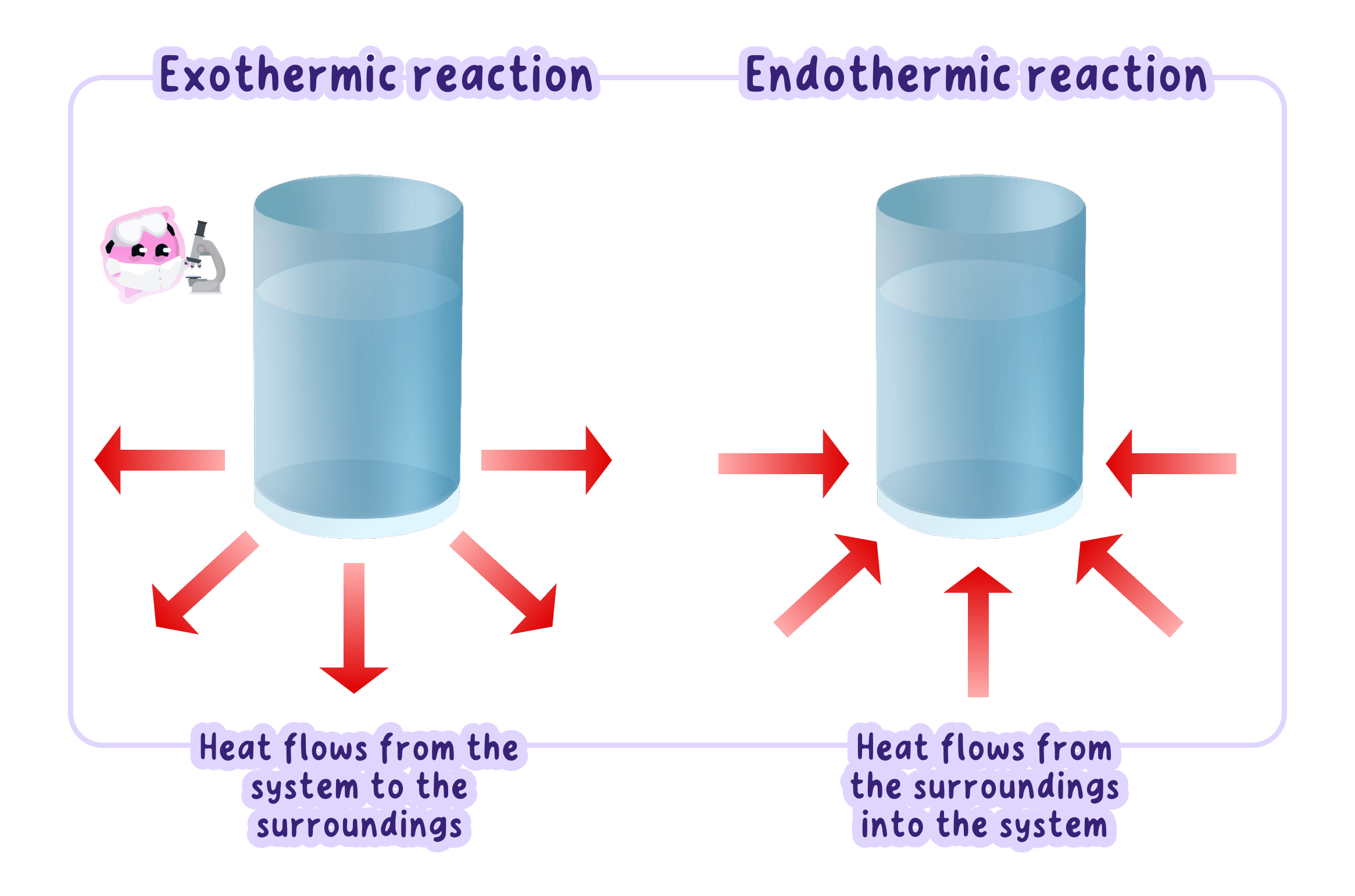
Exothermic reactions warm the surroundings up
Definition
Exothermic reaction
A reaction that transfers energy to the surroundings, so the temperature of the surroundings rises.
Definition
Neutralisation
Neutralisation is the reaction of an acid with a base to produce a salt and water.
- An exothermic reaction transfers energy to the surroundings, so the temperature of the surroundings rises.
- The products of an exothermic reaction have less energy than the reactants because energy has been transferred out.
- Combustion, many oxidation reactions and neutralisation reactions are exothermic.
- A self-heating can uses an exothermic reaction to warm food or drink without any external heat source.
- A hand warmer uses a slow, controlled exothermic reaction so that energy is released gently over a useful length of time.
Example
- The iron powder in a disposable hand warmer reacts with oxygen from the air in an exothermic oxidation reaction.
- Energy is transferred to the surroundings, so the temperature inside the pack rises and your hands feel warm.
- Salt and other materials in the pack control the rate so the warmth lasts for hours rather than minutes.
Endothermic reactions cool the surroundings down
Definition
Endothermic reaction
A reaction that takes in energy from the surroundings, so the temperature of the surroundings falls.
Definition
Thermal decomposition
Thermal decomposition is a reaction in which a compound breaks down into simpler substances when heated.
- An endothermic reaction takes energy in from the surroundings, so the temperature of the surroundings falls.
- The products of an endothermic reaction have more energy than the reactants because energy has been transferred into the chemicals.
- Thermal decomposition reactions are endothermic because energy must be supplied continuously to keep breaking the compound down.
- The reaction between citric acid and sodium hydrogencarbonate is endothermic and makes the mixture noticeably colder.
- Some sports injury packs use an endothermic reaction to cool a knock or sprain without needing a freezer.
Example
- Squeezing an instant cold pack mixes two chemicals that were stored apart inside it.
- The endothermic reaction takes energy in from the surroundings, so the pack turns cold within seconds.
- The cooling reduces pain and swelling and stops once the reaction has finished.
The direction of the temperature change tells you the type of reaction
- A temperature rise in the surroundings shows that the reaction is exothermic.
- A temperature fall in the surroundings shows that the reaction is endothermic.
- For an exothermic reaction, the size of the rise is temperature change=highest temperature−starting temperature\text{temperature change} = \text{highest temperature} - \text{starting temperature}temperature change=highest temperature−starting temperature.
- For an endothermic reaction, the size of the fall is temperature change=starting temperature−lowest temperature\text{temperature change} = \text{starting temperature} - \text{lowest temperature}temperature change=starting temperature−lowest temperature.
- Follow the thermometer to its highest or lowest value before reading it, because the temperature drifts back towards room temperature afterwards.
Common Mistake
- Do not decide a reaction is exothermic just because you heated the chemicals to start it.
- Judge the reaction from the change in the temperature of the surroundings, not from any heating you did first.
- Do not swap the definitions: exothermic means energy leaves the chemicals, while endothermic means energy enters them.
A good heating or cooling product matches its temperature change to the job
- Direction of the change: a hand warmer or self-heating can needs an exothermic reaction, while a cold pack needs an endothermic one.
- Size of the change: the product must get hot or cold enough to do its job.
- A change that is too large could burn skin, damage tissue or spoil the contents of a can.
- Speed and how long it lasts: consider how quickly the temperature changes and how long the effect is needed.
- A sports pack may need rapid cooling, while a hand warmer needs a smaller rise that lasts for hours.
- Safety, cost and practicality: weigh up any harmful chemicals, the price, the mass and how the product is stored and thrown away.
- Final judgement: choose the product whose advantages best fit its intended use, and support the choice with the figures given.
Example
- Cold pack A lowers the temperature by 10 ∘C10\,^\circ\text{C}10∘C for 121212 minutes; cold pack B lowers it by 6 ∘C6\,^\circ\text{C}6∘C for 303030 minutes.
- Pack A suits a situation that needs fast, strong cooling, as long as its lowest temperature is safe against skin.
- Pack B suits gentler cooling that needs to last much longer.
Practical
Investigation: measuring the temperature change when an acid reacts with an alkali
You add sodium hydroxide solution to hydrochloric acid in small steps inside an insulated cup, recording the highest temperature after each addition, to find how the temperature change depends on the volume of alkali added.
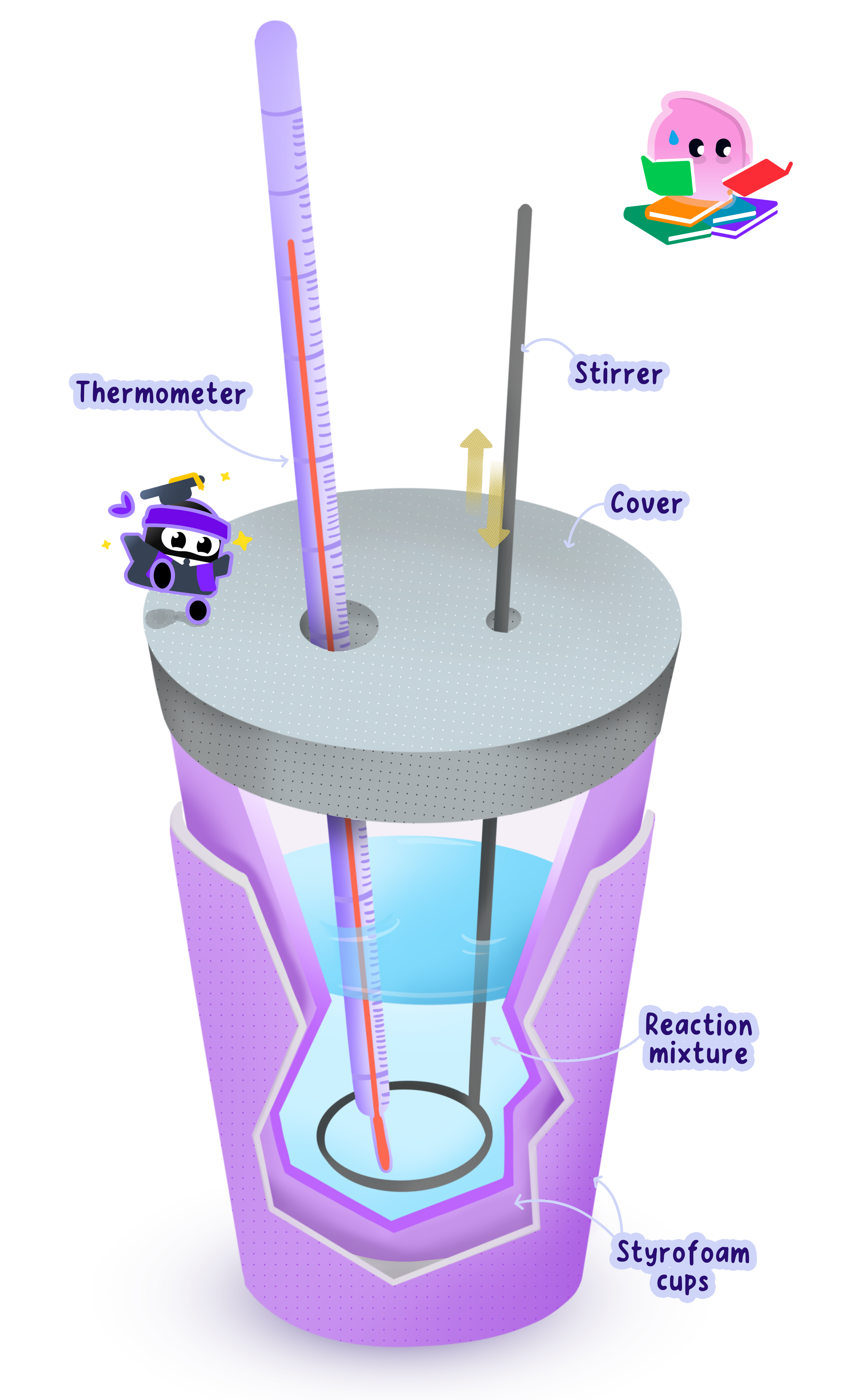
- Use a measuring cylinder to pour 30 cm330\ \text{cm}^330 cm3 of dilute hydrochloric acid into an expanded polystyrene cup, then stand the cup inside a beaker so it cannot tip over.
- Measure the starting temperature of the acid with a thermometer and record it in ∘C^\circ\text{C}∘C.
- Measure 5 cm35\ \text{cm}^35 cm3 of dilute sodium hydroxide solution in a small measuring cylinder.
- Pour the sodium hydroxide into the cup, fit a lid with a hole for the thermometer, and stir the mixture gently.
- Watch the thermometer and, when the reading stops rising, record the highest temperature reached.
- Add the sodium hydroxide in further 5 cm35\ \text{cm}^35 cm3 steps, recording the highest temperature each time, until a total of 40 cm340\ \text{cm}^340 cm3 has been added.
- Repeat the whole experiment a second time and work out the mean highest temperature for each volume to reduce the effect of random error.
- Plot the mean highest temperature against the volume of sodium hydroxide added, then draw two straight lines of best fit that cross.
- Read off the volume where the lines cross, because this is the point where neutralisation is just complete and the temperature is highest.
- Keep the control variables the same each time: the volume and concentration of the acid, the starting temperatures and the apparatus, so the test is fair.
- The polystyrene cup and lid cut energy transfer to the surroundings because polystyrene is a good thermal insulator, giving a larger and more reliable temperature rise.
- Wear eye protection, because dilute sodium hydroxide is irritant and especially harmful to the eyes, and wipe up any spills straight away.
- The temperature rises while acid is still present to react, then falls once all the acid is used up, because extra cold alkali simply cools the mixture.
Exam technique
- For a temperature change, subtract the starting temperature from the highest or lowest reading; never quote a single thermometer value on its own.
- Link the direction of energy transfer to the sign of the change: energy out with a temperature rise is exothermic, energy in with a temperature fall is endothermic.
- In an evaluation, back your choice with the figures in the question, such as the size of the temperature change, the time and the safety information.
Self review
- What does it mean to say energy is conserved during a chemical reaction?
- How does the temperature of the surroundings change during an exothermic reaction, and during an endothermic reaction?
- Give one everyday use of an exothermic reaction and one of an endothermic reaction.
- Why is the reaction mixture placed in a polystyrene cup with a lid?
- Name one control variable in the investigation of temperature changes when an acid reacts with an alkali.
