4.1.4 Oxidation and reduction in terms of electrons
Electron transfer: oxidation is loss of electrons and reduction is gain of electrons
Definition
Electron
A negatively charged subatomic particle that can be transferred between species during a redox reaction.
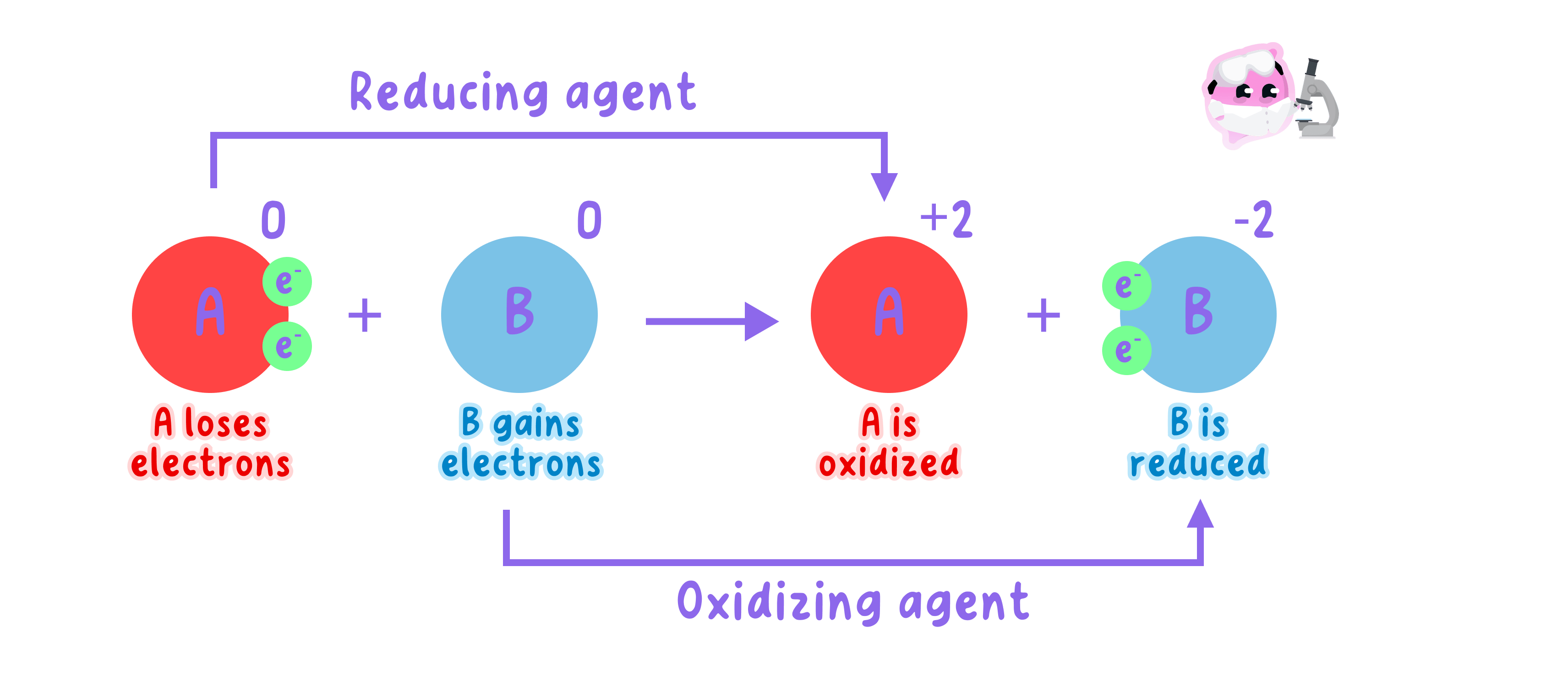
- Oxidation is the loss of electrons.
- Reduction is the gain of electrons.
- The memory aid OIL RIG stands for Oxidation Is Loss, Reduction Is Gain of electrons.
- They always happen together, because the electrons lost by one species are gained by another.
- A species becomes more positively charged when it loses negative electrons, and less positive when it gains them.
Key Idea
- Electron loss is oxidation, so the electrons appear on the right of the half equation.
- Electron gain is reduction, so the electrons appear on the left of the half equation.
Half equations: the side the electrons sit on tells you the process
Definition
Ion
An atom or group of atoms with an overall electrical charge because electrons have been lost or gained.
Definition
Half equation
An equation that shows the electrons lost or gained by a single species in a redox reaction.
- A half equation shows the electron loss or gain for a single species in a redox reaction.
- Balance both the atoms and the total charge; add electrons until the charge matches on each side.
- Magnesium is oxidised, losing two electrons.
- Mg(s)→Mg2+(aq)+2e−\text{Mg}(s) \rightarrow \text{Mg}^{2+}(aq) + 2\text{e}^{-}Mg(s)→Mg2+(aq)+2e−
- Silver ions are reduced, each gaining one electron.
- 2Ag+(aq)+2e−→2Ag(s)2\text{Ag}^{+}(aq) + 2\text{e}^{-} \rightarrow 2\text{Ag}(s)2Ag+(aq)+2e−→2Ag(s)
- Because both half equations use two electrons, the electrons cancel when they are combined.
Exam technique
- If electrons are on the right, the species is oxidised; if on the left, it is reduced.
- Always check the charge balances: a half equation with unequal charge will not score.
Ionic equations: cancel the ions that never change
Definition
Soluble ionic compound
An ionic compound that dissolves in water to split into separate aqueous ions.
Definition
Spectator ion
An ion that is present in the mixture but is unchanged by the reaction, so it is left out of the ionic equation.
- Start from the balanced symbol equation for the displacement reaction.
- Zn(s)+CuSO4(aq)→ZnSO4(aq)+Cu(s)\text{Zn}(s) + \text{CuSO}_4(aq) \rightarrow \text{ZnSO}_4(aq) + \text{Cu}(s)Zn(s)+CuSO4(aq)→ZnSO4(aq)+Cu(s)
- Split each soluble ionic compound into its separate aqueous ions; leave solids as atoms.
- Zn(s)+Cu2+(aq)+SO42−(aq)→Zn2+(aq)+SO42−(aq)+Cu(s)\text{Zn}(s) + \text{Cu}^{2+}(aq) + \text{SO}_4^{2-}(aq) \rightarrow \text{Zn}^{2+}(aq) + \text{SO}_4^{2-}(aq) + \text{Cu}(s)Zn(s)+Cu2+(aq)+SO42−(aq)→Zn2+(aq)+SO42−(aq)+Cu(s)
- The sulfate ions are unchanged on both sides, so they are spectator ions and cancel.
- Zn(s)+Cu2+(aq)→Zn2+(aq)+Cu(s)\text{Zn}(s) + \text{Cu}^{2+}(aq) \rightarrow \text{Zn}^{2+}(aq) + \text{Cu}(s)Zn(s)+Cu2+(aq)→Zn2+(aq)+Cu(s)
- The final ionic equation balances because the atoms and the total charge are equal on both sides.
Common Mistake
- Do not leave spectator ions in the final ionic equation.
- Do not split solid metals into ions.
- Never change a formula or a charge to balance; only change the large numbers in front.
Identifying redox: track each species and its electrons
Definition
Species
An atom, molecule or ion that takes part in a chemical reaction.
- In a half equation, electrons on the right mean oxidised and electrons on the left mean reduced.
- In an ionic equation, the species that becomes more positive is oxidised and the one that becomes less positive is reduced.
- In Fe(s)+CuSO4(aq)→FeSO4(aq)+Cu(s)\text{Fe}(s) + \text{CuSO}_4(aq) \rightarrow \text{FeSO}_4(aq) + \text{Cu}(s)Fe(s)+CuSO4(aq)→FeSO4(aq)+Cu(s) iron atoms become Fe2+\text{Fe}^{2+}Fe2+ ions, so iron is oxidised.
- In the same reaction Cu2+\text{Cu}^{2+}Cu2+ ions become copper atoms, so the copper ions are reduced.
- In any displacement, the more reactive metal is oxidised and the less reactive metal's ions are reduced.
- Name the exact species: write that Cu2+\text{Cu}^{2+}Cu2+ ions are reduced, not that copper sulfate is reduced.
Self review
- Define oxidation and reduction in terms of electrons.
- Which process is shown by Al(s)→Al3+(aq)+3e−\text{Al}(s) \rightarrow \text{Al}^{3+}(aq) + 3\text{e}^{-}Al(s)→Al3+(aq)+3e−?
- Write the half equation for the reduction of Cu2+\text{Cu}^{2+}Cu2+ ions.
- Write the ionic equation for magnesium displacing silver ions.
- In Fe+CuSO4→FeSO4+Cu\text{Fe} + \text{CuSO}_4 \rightarrow \text{FeSO}_4 + \text{Cu}Fe+CuSO4→FeSO4+Cu, which species is oxidised?
