Question 1
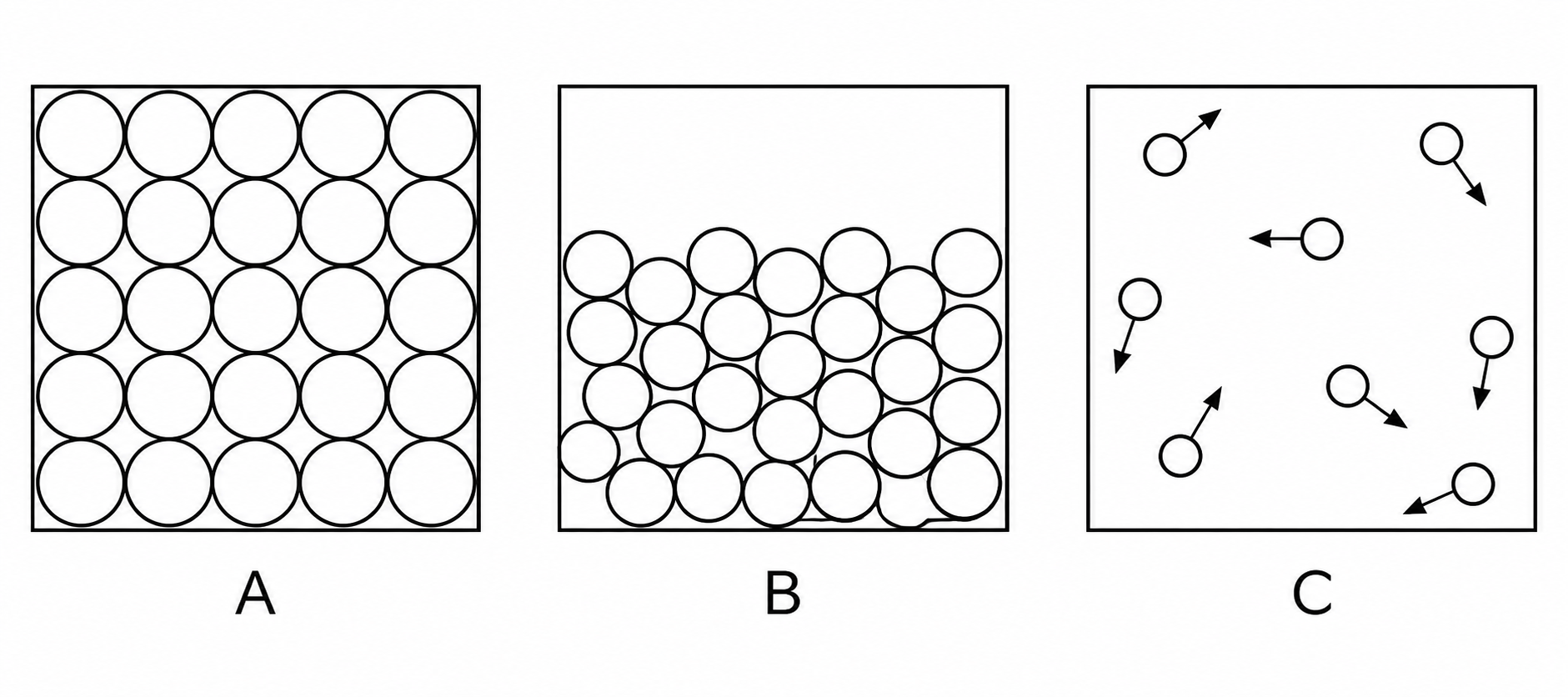
F93%The figure shows the arrangement of the particles in a substance in three different states of matter.
Figure: The arrangement of the particles in a substance in three different states of matter
a.[1]
Give the letter, A, B or C, of the box that shows the substance as a liquid.
b.[1]
Name the change of state that takes place when the substance changes from the arrangement shown in box B to the arrangement shown in box A.
2.2 How bonding and structure are related to the properties of substances Questions
42 exam-style questions on AQA GCSE Chemistry 2.2 How bonding and structure are related to the properties of substances, covering 2.2.1a The three states of matter, 2.2.1b Limitations of the simple particle model, 2.2.2 State symbols in chemical equations, 2.2.3 Properties of ionic compounds, 2.2.4 Properties of small molecules, 2.2.5 Polymers, 2.2.6 Giant covalent structures, 2.2.7 Properties of metals and alloys, and 2.2.8 Metals as conductors. Each one has a worked solution and a mark scheme showing where the marks go.