x

Revision notes for AQA GCSE Chemistry Halides. Open the guide for explanations and worked examples. Written against the AQA GCSE Chemistry (8462) specification, so the content matches what's examinable rather than general Chemistry background.

Halides

What you'll learn

  • How to carry out the chemical test for halide ions in solution.
  • The specific colours of the precipitates formed by chloride, bromide, and iodide ions.
  • Why we must add dilute nitric acid before testing.
  • How to write the ionic equations for these precipitation reactions.

Introduction to Halides

You will remember from the Periodic Table that the elements in Group 7 are called the halogens (fluorine, chlorine, bromine, iodine). When these non-metals react and gain one electron to achieve a full outer shell, they form negatively charged ions with a 1−1-1− charge. These are called halide ions (e.g. chloride, Cl−Cl^-Cl−; bromide, Br−Br^-Br−; iodide, I−I^-I−).

Halide ions are found in many common salts, like sodium chloride (table salt) or potassium iodide. When these salts are dissolved in water, the halide ions float freely in the solution. We use a specific chemical test to identify exactly which halide ion is hiding in an unknown solution.

The Halide Test

To test for halide ions, we use a reaction that forms a solid out of two liquids.

Definition

Precipitate

A precipitate is a solid that forms when two solutions are mixed together. The process of forming this solid is called precipitation.

The test uses two reagents (chemicals) added in a very specific order:

  1. Dilute nitric acid (HNO3\text{HNO}_3HNO3​)
  2. Silver nitrate solution (AgNO3\text{AgNO}_3AgNO3​)

The Method

If you are given a test tube containing an unknown solution and asked to check for halides, you should follow these steps:

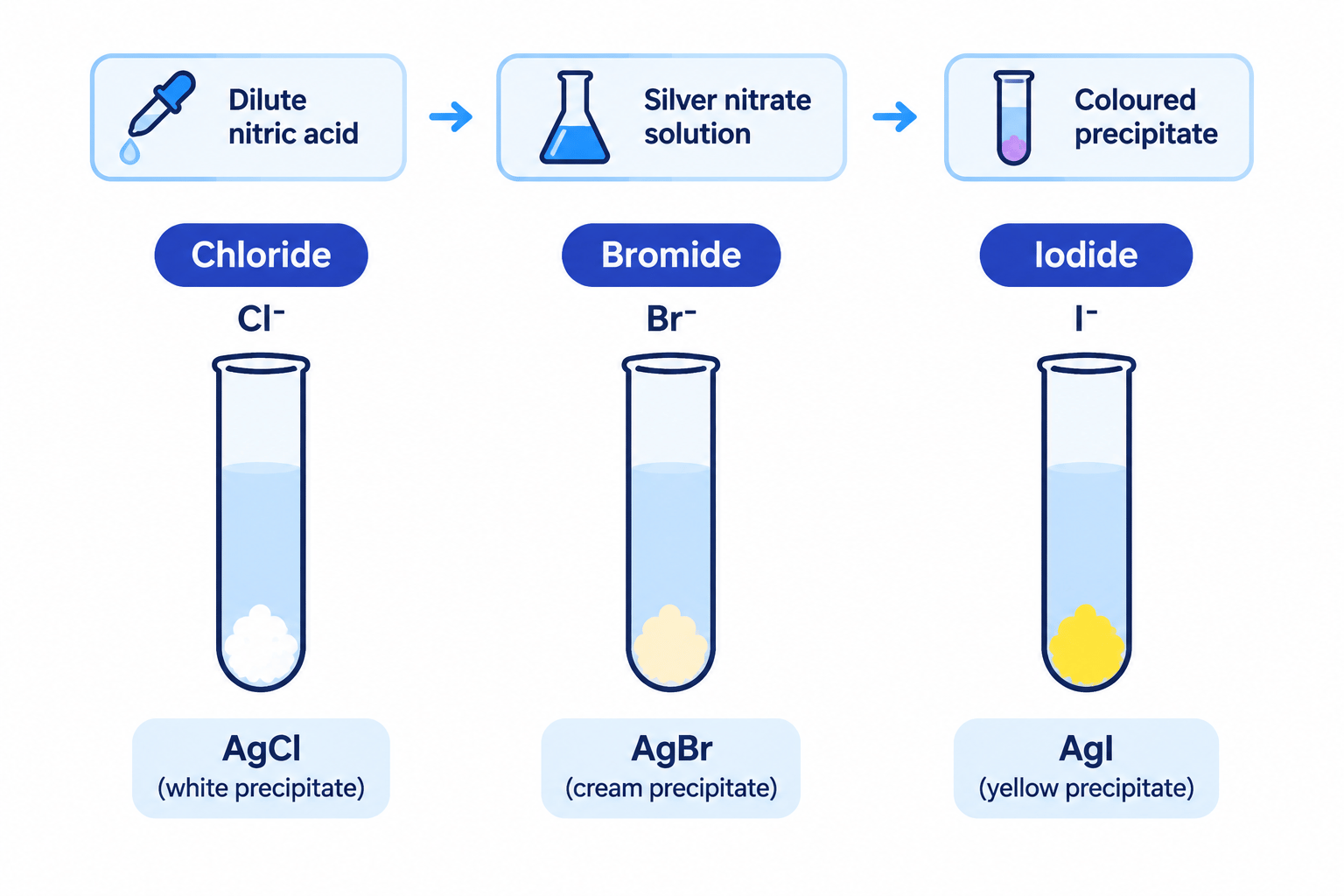
  1. Add a few drops of dilute nitric acid to the unknown solution.
  2. Add a few drops of silver nitrate solution.
  3. Observe the test tube. If a halide ion is present, the solution will immediately turn cloudy as a solid precipitate forms.

The Results

The colour of the precipitate tells you exactly which halide ion is present.

  • Chloride ions (Cl−Cl^-Cl−) produce a white precipitate of silver chloride.
  • Bromide ions (Br−Br^-Br−) produce a cream precipitate of silver bromide.
  • Iodide ions (I−I^-I−) produce a yellow precipitate of silver iodide.

Test tubes showing white, cream, and yellow precipitates for chloride, bromide, and iodide ions

Tip

Remembering the colours

A great way to remember the colours in order as you go down Group 7 (Chlorine →\to→ Bromine →\to→ Iodine) is to think of dairy products getting richer: Milk (White) →\to→ Cream (Cream) →\to→ Butter (Yellow).

Key Idea

The Halide Test Summary

To test for halides, add dilute nitric acid followed by silver nitrate solution. Chloride = White precipitate. Bromide = Cream precipitate. Iodide = Yellow precipitate.

Why do we add dilute nitric acid?

A very common exam question asks why we bother adding nitric acid before the silver nitrate.

The purpose of the acid is to remove any carbonate ions (CO32−CO_3^{2-}CO32−​) that might be present in the solution as impurities. If carbonate ions are in the test tube and you add silver nitrate, they will react to form silver carbonate. Silver carbonate is a pale precipitate that looks very much like silver chloride or silver bromide. This would give you a "false positive" result, tricking you into thinking a halide is present when it isn't.

Adding dilute nitric acid first reacts with any rogue carbonate ions, turning them into carbon dioxide gas (which bubbles away), leaving the solution clean and ready for the real test.

Common Mistake

Using the wrong acid

You might wonder why we don't just use dilute hydrochloric acid instead. Never use hydrochloric acid for this test. Hydrochloric acid has the formula HCl\text{HCl}HCl. It contains chloride ions! If you add it to your test tube, you are dumping chloride ions into the mixture. When you add the silver nitrate, it will immediately form a white precipitate of silver chloride, regardless of what was originally in the unknown solution. Always use nitric acid (HNO3\text{HNO}_3HNO3​).

Writing the Equations

When the silver nitrate (AgNO3\text{AgNO}_3AgNO3​) meets the halide ions, a reaction takes place. The positive silver ions (Ag+\text{Ag}^+Ag+) are strongly attracted to the negative halide ions (X−X^-X−). Together, they form an insoluble silver halide compound (AgX\text{AgX}AgX), which crashes out of the solution as the solid precipitate.

Because we are only interested in the ions that actually form the precipitate, we usually write this as an ionic equation. We ignore the nitrate ions and whatever positive ion was attached to the halide (like sodium or potassium), as they just float around and do not take part. These ignored ions are called spectator ions.

Here are the ionic equations for the three tests. Notice the state symbols: the ions start dissolved in water (aq) and form a solid precipitate (s).

For chloride ions:

Ag+(aq)+Cl−(aq)→AgCl(s) \text{Ag}^+\text{(aq)} + \text{Cl}^-\text{(aq)} \to \text{AgCl(s)} Ag+(aq)+Cl−(aq)→AgCl(s)

For bromide ions:

Ag+(aq)+Br−(aq)→AgBr(s) \text{Ag}^+\text{(aq)} + \text{Br}^-\text{(aq)} \to \text{AgBr(s)} Ag+(aq)+Br−(aq)→AgBr(s)

For iodide ions:

Ag+(aq)+I−(aq)→AgI(s) \text{Ag}^+\text{(aq)} + \text{I}^-\text{(aq)} \to \text{AgI(s)} Ag+(aq)+I−(aq)→AgI(s)
Example

Identifying an unknown salt

A student dissolves an unknown potassium salt in distilled water. They add a few drops of dilute nitric acid, followed by silver nitrate solution. A pale cream precipitate forms. Identify the unknown salt and write the ionic equation for the precipitation reaction.

  1. Identify the positive ion (cation) from the start of the question: The question states it is a "potassium salt". Therefore, the positive ion is potassium.
  2. Use the observation to identify the negative ion (anion): The test produced a "pale cream precipitate" with silver nitrate. The halide that produces a cream precipitate is bromide (Br−Br^-Br−).
  3. Combine the ions to name the salt: Potassium + Bromide = Potassium bromide.
  4. Write the ionic equation: The precipitate is formed by silver ions reacting with the identified halide ions.
Ag+(aq)+Br−(aq)→AgBr(s) \text{Ag}^+\text{(aq)} + \text{Br}^-\text{(aq)} \to \text{AgBr(s)} Ag+(aq)+Br−(aq)→AgBr(s)
Exam technique

In the exam

  1. Always specify the acid used is dilute nitric acid. Just writing "acid" will often lose you a mark.
  2. When asked to describe what you would see, use the exact word "precipitate". Don't just say "it turns white" or "a yellow solid forms"; write "a white precipitate forms".
  3. Don't confuse the test for the halogen gas with the test for the halide ion. Chlorine gas bleaches damp litmus paper, but chloride ions form a white precipitate with silver nitrate.
Self review

Check yourself

  • What two reagents are needed to test for halide ions, and in what order must they be added?
  • Why is it a mistake to use hydrochloric acid to clear impurities before a halide test?
  • A student tests an unknown solution and observes a yellow precipitate. Which ion is present?
  • What are the state symbols used in the ionic equation for a precipitation reaction?

Identification of ions by chemical and spectroscopic means (chemistry only)

Guide 4 of 7

You've reached the end

Test yourself on this topic, or move on to the next guide.

Next guideSulfatesStart

How was this guide?

Halides Revision Guide

  1. GCSE
  2. /Chemistry
  3. /Halides