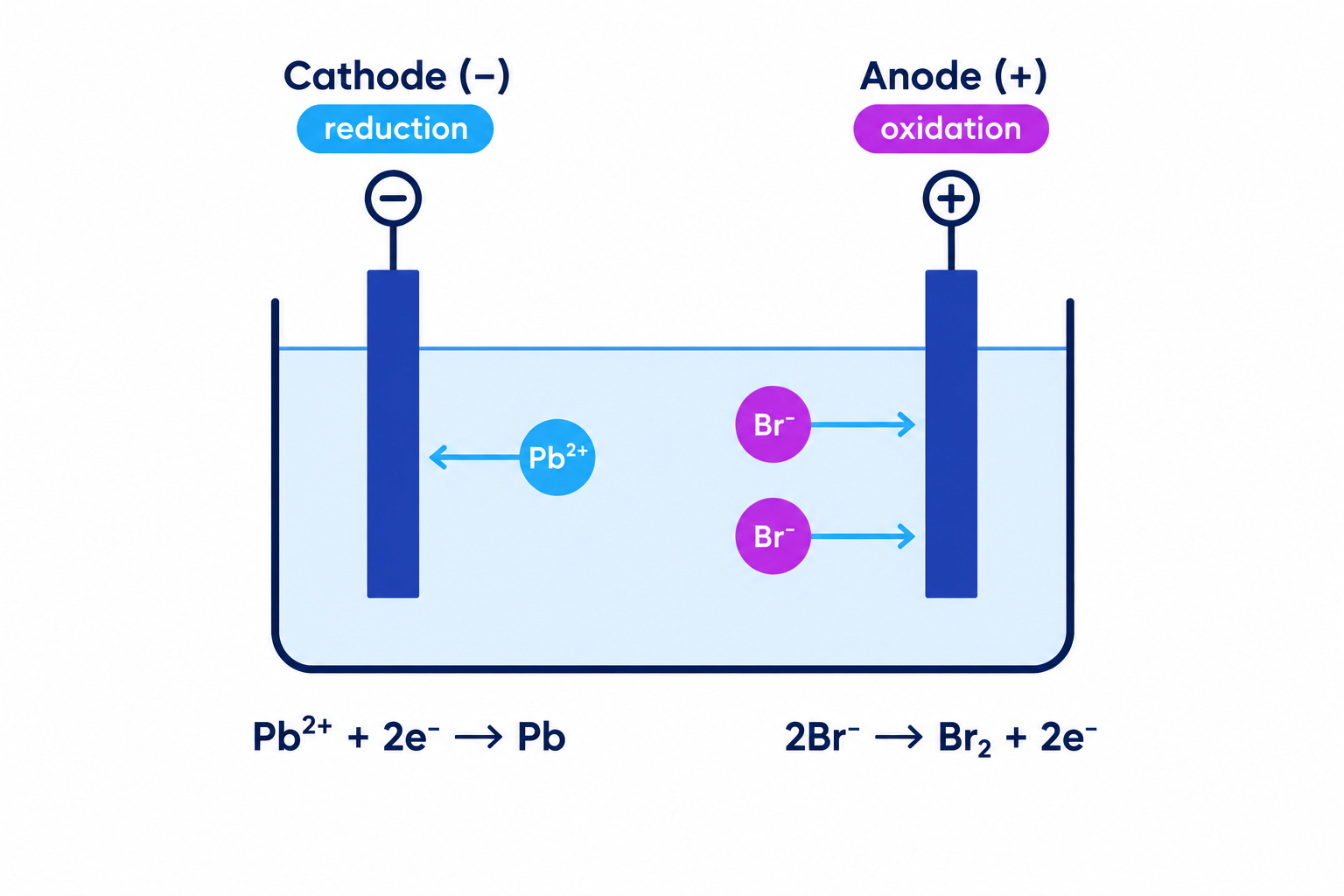
Each electrode has its own half equation
Definition
Half equation
An equation that shows the electrons lost or gained by a single species in a redox reaction.
Definition
Electron
A negatively charged subatomic particle that can be transferred between species during a redox reaction.
- A half equation shows the electrons gained or lost at one electrode.
- At the cathode, ions gain electrons, which is reduction.
- At the anode, ions lose electrons, which is oxidation.
- Balance both the atoms and the charge by adding the right number of electrons.
Key Idea
- Cathode: electrons are on the left, because the ion gains them.
- Anode: electrons are on the right, because the ion loses them.
Cathode half equations: the positive ion gains electrons
Definition
Cathode
The negative electrode during electrolysis, where positively charged ions gain electrons.
- Write the positive ion, then add electrons on the left until the charge is zero.
- Lead ions: Pb2++2e−→Pb\text{Pb}^{2+} + 2\text{e}^{-} \rightarrow \text{Pb}Pb2++2e−→Pb
- Hydrogen ions: 2H++2e−→H22\text{H}^{+} + 2\text{e}^{-} \rightarrow \text{H}_22H++2e−→H2
- Aluminium ions: Al3++3e−→Al\text{Al}^{3+} + 3\text{e}^{-} \rightarrow \text{Al}Al3++3e−→Al
Exam technique
- Add one electron for each unit of positive charge on the ion.
- Check the charge is the same on both sides, then the half equation is balanced.
Anode half equations: the negative ion loses electrons
Definition
Anode
The positive electrode during electrolysis, where negatively charged ions lose electrons.
Definition
Coefficient
A large whole number placed before a chemical formula to show the relative number of particles or moles in a balanced equation.
- Write the negative ion, then add electrons on the right so the charge balances.
- Bromide ions: 2Br−→Br2+2e−2\text{Br}^{-} \rightarrow \text{Br}_2 + 2\text{e}^{-}2Br−→Br2+2e−
- Chloride ions: 2Cl−→Cl2+2e−2\text{Cl}^{-} \rightarrow \text{Cl}_2 + 2\text{e}^{-}2Cl−→Cl2+2e−
- A coefficient of 2 is needed because the halogen forms a molecule of two atoms.
Self review
- At which electrode does reduction happen?
- On which side of a cathode half equation do the electrons go?
- Write the cathode half equation for lead ions.
- Write the anode half equation for bromide ions.
- Why is a 2 written in front of the chloride ions in the anode half equation?