Five factors change how fast a reaction goes
Definition
Concentration
The mass of solute present per unit volume of solution, usually measured in g/dm3\text{g}/\text{dm}^3g/dm3 for this calculation.
- The concentration of reactants in solution.
- The pressure of any reacting gases.
- The surface area of any solid reactants.
- The temperature of the reaction.
- The presence of a catalyst.
Concentration and pressure pack more particles into the same space
Definition
Pressure
The force exerted per unit area when gas particles collide with the walls of their container.
- Increasing the concentration of a dissolved reactant puts more particles in each unit of volume.
- The particles then collide more often, so the reaction speeds up.
- Increasing the pressure of a gas pushes its particles closer together.
- This also makes collisions more frequent, so the reaction speeds up.
Breaking a solid into smaller pieces exposes more of its particles
Definition
Surface area
The total area of a solid that is exposed to the other reactants.
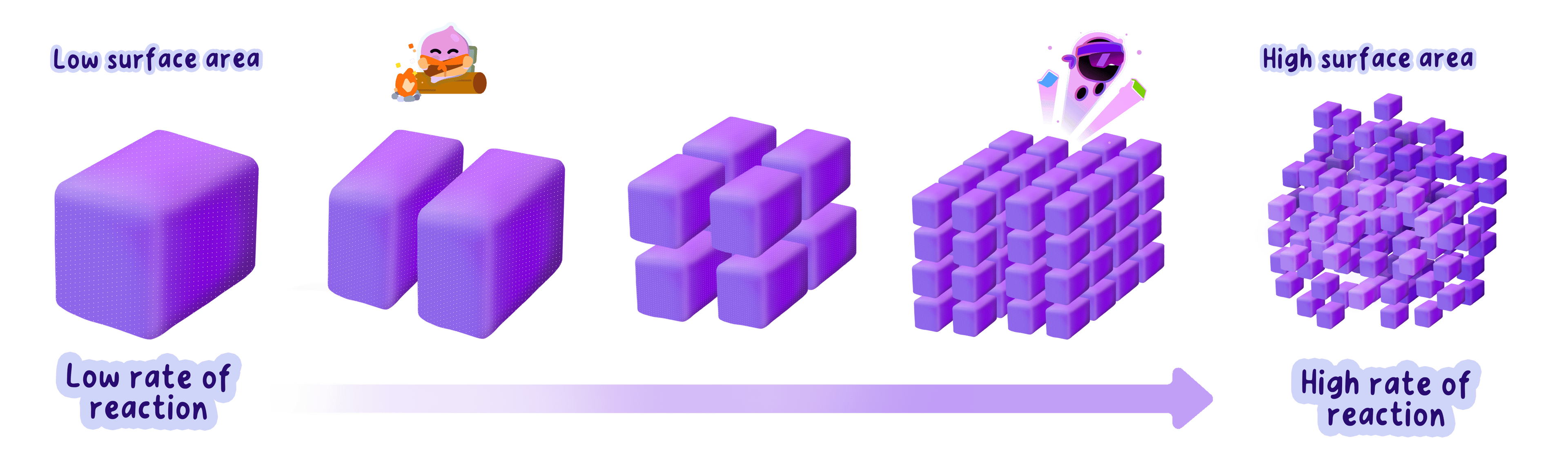
- Cutting a solid into smaller pieces, or grinding it to a powder, increases its surface area.
- More of the solid's particles are then exposed to the other reactant.
- Collisions happen over a larger area, so the reaction goes faster.
Higher temperature and a catalyst both raise the rate
- Raising the temperature makes the particles move faster and collide more often.
- The collisions are also harder, so more of them lead to a reaction.
- A catalyst speeds a reaction up without being used up, and is covered in more detail in a later article.
How you measure the rate decides what you record
Definition
Turbidity
The cloudiness of a liquid caused by suspended solid particles.
- Gas volume: collect the gas in a gas syringe or an upturned measuring cylinder.
- Mass loss: record the falling mass on a balance as a gas escapes.
- Turbidity: time how long a reaction takes to make a solution too cloudy to see a mark through.
- For a cloudiness method the rate is proportional to 1÷time1 \div \text{time}1÷time, so a shorter time means a faster reaction.
Practical
Investigation: how the concentration of an acid affects the rate of reaction
You measure the same reaction at two acid concentrations in two ways, by collecting the gas given off and by timing how long a reaction takes to turn a solution cloudy.
- Clean a 3 cm3\ \text{cm}3 cm strip of magnesium ribbon with fine sandpaper to remove the dull oxide layer.
- Measure 50 cm350\ \text{cm}^350 cm3 of 1.0 mol/dm31.0\ \text{mol/dm}^31.0 mol/dm3 hydrochloric acid into a 100 cm3100\ \text{cm}^3100 cm3 conical flask.
- Fill a measuring cylinder with water and invert it over a water trough with a delivery tube ready, or connect a gas syringe instead.
- Drop in the magnesium, quickly push in the bung with the delivery tube, and start the stopclock at the same moment.
- Record the volume of hydrogen collected every 10 s10\ \text{s}10 s until the volume stops changing.
- Repeat the run with 1.5 mol/dm31.5\ \text{mol/dm}^31.5 mol/dm3 acid, keeping the length of magnesium, the volume of acid and the temperature the same.
- Plot both runs on the same axes as gas volume against time; the steeper curve, which also levels off sooner, is the faster reaction.
- For the cloudiness method, stand a conical flask on a printed black cross.
- Measure 10 cm310\ \text{cm}^310 cm3 of sodium thiosulfate solution into the flask and add water to set its concentration, for example 10 cm310\ \text{cm}^310 cm3 of thiosulfate with 40 cm340\ \text{cm}^340 cm3 of water.
- Add 10 cm310\ \text{cm}^310 cm3 of dilute hydrochloric acid, swirl once and start the stopclock.
- Look down through the solution and stop the clock when the cross can no longer be seen.
- Repeat with more concentrated thiosulfate each time, keeping the volume of acid and the temperature the same.
- Work out the rate as 1÷time1 \div \text{time}1÷time and plot it against concentration; a shorter time means a faster reaction.
- Control the temperature, the volumes and the apparatus each time so that only the concentration changes.
- Wear eye protection, and for the thiosulfate method work in a ventilated room because the reaction gives off sulfur dioxide.
Exam technique
- Explain a faster rate by saying particles collide more often, or more successfully, not just that the reaction speeds up.
- For a cloudiness experiment, remember that a shorter time means a faster rate, so compare 1÷time1 \div \text{time}1÷time.
- Name the control variables you kept the same, such as temperature and volume, to show the test was fair.
Self review
- List the five factors that affect the rate of a reaction.
- Why does increasing the concentration of a solution speed up a reaction?
- Why does powdering a solid make it react faster?
- In the cloudiness method, why does a shorter time mean a faster reaction?
- Name one control variable in the magnesium and acid investigation.
