What you'll learn:
- Why electrolysing dissolved compounds is more complicated than electrolysing molten ones.
- How water molecules naturally break down into hydrogen ions and hydroxide ions.
- The rules for predicting which element is produced at the cathode and the anode.
- How to carry out the required practical to investigate aqueous electrolysis.
In the previous topic, you looked at the electrolysis of molten ionic compounds. When a substance is molten, it only contains two types of ion: the positive metal ion and the negative non-metal ion.
However, most of the time it is much easier and cheaper to dissolve an ionic compound in water rather than melting it, because dissolving doesn't require extreme heat.
Aqueous solution
A mixture formed when a substance (the solute) is dissolved in water (the solvent). In chemical equations, this is shown using the state symbol (aq).
When we electrolyse an aqueous solution, the water itself gets involved. Water molecules naturally break down (ionise) a tiny bit to form hydrogen ions (H+H^+H+) and hydroxide ions (OH−OH^-OH−).
H2O(l)⇌H+(aq)+OH−(aq)
H_2O(l) \rightleftharpoons H^+(aq) + OH^-(aq)
H2O(l)⇌H+(aq)+OH−(aq)
This means that in an aqueous solution, there are always four types of ions floating around:
- The positive metal ion from the dissolved compound.
- The negative non-metal ion from the dissolved compound.
- The H+H^+H+ ion from the water.
- The OH−OH^-OH− ion from the water.

When we turn the power on, both the metal ion and the H+H^+H+ ion are attracted to the negative electrode (cathode). At the same time, both the non-metal ion and the OH−OH^-OH− ion are attracted to the positive electrode (anode).
However, only one type of ion can actually be discharged (turned into an element) at each electrode. The other ion stays dissolved in the solution. To figure out which ion wins the competition at each electrode, we have to use two simple rules based on reactivity.
At the cathode, the positive metal ions and the positive H+H^+H+ ions compete to gain electrons.
The rule is simple: the least reactive element is discharged.
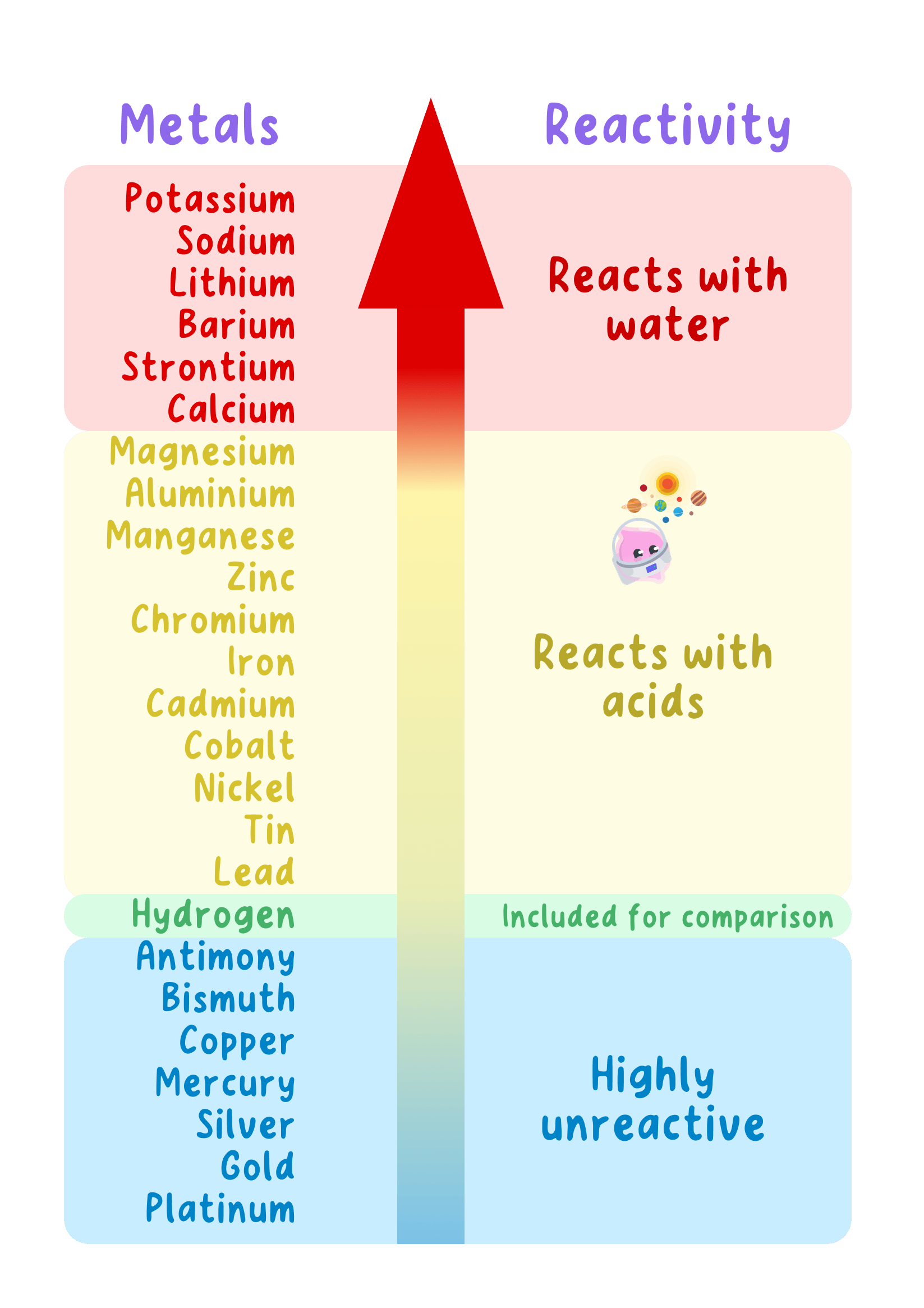
- If the metal is more reactive than hydrogen (e.g. sodium, magnesium, aluminium), it stays in the solution as an ion. Instead, the hydrogen ions are discharged and hydrogen gas is produced.
- If the metal is less reactive than hydrogen (e.g. copper, silver, gold), the metal ions are discharged and solid metal coats the electrode.
Cathode Rule Summary
Hydrogen is produced at the cathode unless the metal is less reactive than hydrogen.
Checking reactivity
If you forget whether a metal is more or less reactive than hydrogen, check the Reactivity Series. Most common metals (like group 1 and group 2 metals) are highly reactive, so hydrogen gas is produced. Copper is the most common example at GCSE where the metal itself is produced.
At the anode, the negative non-metal ions and the negative OH−OH^-OH− ions compete to lose electrons.
The rule here depends on whether a halide ion is present. Halide ions are from Group 7 of the periodic table: chloride (Cl−Cl^-Cl−), bromide (Br−Br^-Br−), or iodide (I−I^-I−).
- If a halide ion is present, it gets discharged. You will see the corresponding halogen produced (chlorine gas, bromine water, or solid iodine).
- If there is no halide ion present (for example, if the compound contains sulfate, SO42−SO_4^{2-}SO42−, or nitrate, NO3−NO_3^-NO3−), the OH−OH^-OH− ions from the water are discharged instead. This produces oxygen gas (and water).
Oxygen or hydroxide?
When OH−OH^-OH− ions are discharged, students often incorrectly write that "hydroxide gas" is produced. Hydroxide is an ion, not a stable gas. The gas produced is always oxygen (O2O_2O2).
Now that we have the rules, let's look at how to predict the products for different solutions.
Predicting the products of aqueous sodium chloride
Predict the products at the anode and the cathode when aqueous sodium chloride (NaClNaClNaCl) is electrolysed.
- Identify the four ions present in the solution.
Sodium chloride provides Na+Na^+Na+ and Cl−Cl^-Cl−. The water provides H+H^+H+ and OH−OH^-OH−.
- Determine the product at the cathode (negative electrode).
The Na+Na^+Na+ and H+H^+H+ ions are attracted here. Sodium is more reactive than hydrogen. The least reactive element is discharged, so hydrogen gas is produced.
- Determine the product at the anode (positive electrode).
The Cl−Cl^-Cl− and OH−OH^-OH− ions are attracted here. Chloride (Cl−Cl^-Cl−) is a halide ion. The rule states that if a halide is present, the halogen is formed, so chlorine gas is produced.
Predicting the products of aqueous copper(II) sulfate
Predict the products at the anode and the cathode when aqueous copper(II) sulfate (CuSO4CuSO_4CuSO4) is electrolysed.
- Identify the four ions present.
Copper(II) sulfate provides Cu2+Cu^{2+}Cu2+ and SO42−SO_4^{2-}SO42−. The water provides H+H^+H+ and OH−OH^-OH−.
- Determine the product at the cathode.
The Cu2+Cu^{2+}Cu2+ and H+H^+H+ ions are attracted here. Copper is less reactive than hydrogen. The least reactive element is discharged, so solid copper is produced.
- Determine the product at the anode.
The SO42−SO_4^{2-}SO42− and OH−OH^-OH− ions are attracted here. Sulfate is not a halide ion. Therefore, the OH−OH^-OH− ions are discharged, meaning oxygen gas is produced.
You must know how to set up an experiment to investigate the electrolysis of different aqueous solutions and how to test the gases produced.
To do this, you pour your chosen aqueous solution (like copper(II) chloride or sodium sulfate) into a beaker. You then insert two inert electrodes into the solution.
Inert electrode
An electrode made from an unreactive material, such as graphite (carbon) or platinum. Inert electrodes allow electricity to flow into the solution but do not participate in the chemical reactions themselves.
You connect the electrodes to a low-voltage DC power supply using crocodile clips and wires. As soon as you turn the power on, you should look closely at both electrodes.
- If you see bubbles forming, a gas is being produced (hydrogen, oxygen, or chlorine).
- If you see a coloured solid forming on the cathode, a metal is being deposited.
You can collect the gases using small test tubes inverted over the electrodes and perform standard gas tests to confirm your predictions:
- Hydrogen: Hold a lit splint at the mouth of the test tube. You will hear a 'squeaky pop'.
- Oxygen: Place a glowing splint inside the test tube. It will relight.
- Chlorine: Hold damp blue litmus paper near the gas. It will be bleached white.
Developing a hypothesis
In this practical, you may be asked to develop a hypothesis. A hypothesis is an educated prediction based on scientific theory. For example: "I hypothesise that electrolysing copper(II) chloride will produce solid copper at the cathode, because copper is less reactive than hydrogen, and chlorine gas at the anode, because chloride is a halide ion."
In the exam
- Always check the state symbol. If it says (aq) or "solution", you must include the H+H^+H+ and OH−OH^-OH− rules. If it says (l) or "molten", you only care about the two ions from the compound.
- Read carefully to see which electrode the question is asking about. Cathode = Negative (attracts positive ions), Anode = Positive (attracts negative ions).
- If asked why hydrogen is produced instead of a metal, write: "Because [Metal] is more reactive than hydrogen." Do not just write "because of reactivity".
- If asked why a certain material was chosen for the electrodes, look for the word "inert" or explain that graphite/platinum "will not react with the electrolyte".
Check yourself
- What are the formulas of the two ions provided by the breakdown of water?
- If you electrolysed aqueous potassium iodide, what would be produced at the cathode, and what would be produced at the anode?
- Why is graphite a good choice of material for electrodes in this experiment?
- What is the test for chlorine gas?