x

Revision notes for AQA GCSE Chemistry Catalysts. Open the guide for explanations and worked examples. Written against the AQA GCSE Chemistry (8462) specification, so the content matches what's examinable rather than general Chemistry background.

Catalysts

What you'll learn

  • What a catalyst is and how to recognise one in an experiment or equation.
  • How catalysts increase reaction rate using activation energy.
  • How to read and draw a reaction profile for a catalysed reaction.
  • Why different reactions need different catalysts, including enzymes in living systems.

Start point: rate of reaction

The rate of reaction means how quickly reactants are turned into products. Reactants are the starting substances, and products are the substances made.

A catalyst matters because it changes this rate. To tell whether a catalyst has worked, you often compare how much product is made in a fixed time, or how long it takes to make a fixed amount of product.

Common rate measurements include:

  • volume of gas made, in cubic centimetres, cm³
  • loss of mass when a gas escapes, in grams, g
  • time taken for a colour change or precipitate to appear

For example, hydrogen peroxide solution slowly decomposes to form water and oxygen:

2H₂O₂(aq) → 2H₂O(l) + O₂(g)

If you collect the oxygen gas, a faster reaction gives a larger volume of oxygen per second.

Example

Comparing mean rates

A sample of hydrogen peroxide produces 24 cm³ of oxygen in 120 s without a catalyst. With a catalyst, it produces 24 cm³ of oxygen in 30 s.

  1. Use the mean-rate relationship: mean rate=quantity of product formedtime taken\text{mean rate} = \frac{\text{quantity of product formed}}{\text{time taken}}mean rate=time takenquantity of product formed​.

  2. Without the catalyst, the mean rate is 24 cm3120 s=0.20 cm3/s\frac{24\ \text{cm}^3}{120\ \text{s}} = 0.20\ \text{cm}^3\text{/s}120 s24 cm3​=0.20 cm3/s.

  3. With the catalyst, the mean rate is 24 cm330 s=0.80 cm3/s\frac{24\ \text{cm}^3}{30\ \text{s}} = 0.80\ \text{cm}^3\text{/s}30 s24 cm3​=0.80 cm3/s.

  4. Compare the two rates: 0.80÷0.20=40.80 \div 0.20 = 40.80÷0.20=4. The catalysed reaction is four times faster.

What is a catalyst?

Definition

Catalyst

A catalyst is a substance that changes the rate of a chemical reaction but is not used up during the reaction.

In GCSE Chemistry, catalysts you meet are used to increase the rate of reaction.

“Not used up” means the catalyst is still present at the end. It may take part temporarily during the reaction, but overall it is regenerated, so it can be recovered chemically unchanged.

Because a catalyst is not a reactant or a product, it is not written on the left-hand or right-hand side of the overall chemical equation. Sometimes a catalyst is written above the reaction arrow as a condition, but it is not part of the balanced equation itself.

Common Mistake

Catalyst is not a reactant

Do not include a catalyst as something that gets consumed in the equation. If a substance is used up to make products, it is a reactant, not a catalyst.

Why catalysts increase rate

To understand catalysts, you need the particle model of reactions.

For a reaction to happen, reacting particles must collide successfully. A successful collision is a collision that leads to a chemical reaction. For this to happen, the particles need enough energy.

Definition

Activation energy

Activation energy is the minimum energy particles need for a collision to result in a reaction.

A catalyst provides a different reaction pathway. A reaction pathway is the route, or sequence of steps, by which reactants become products.

The catalysed pathway has a lower activation energy than the uncatalysed pathway. At the same temperature, more particles have enough energy to react, so there are more successful collisions each second. This increases the rate of reaction.

Key Idea

Catalytic action

A catalyst increases reaction rate by providing an alternative pathway with a lower activation energy.

A catalyst does not usually change the amount of product made if the reaction goes to completion. It helps the reaction get there faster.

Reaction profile diagrams

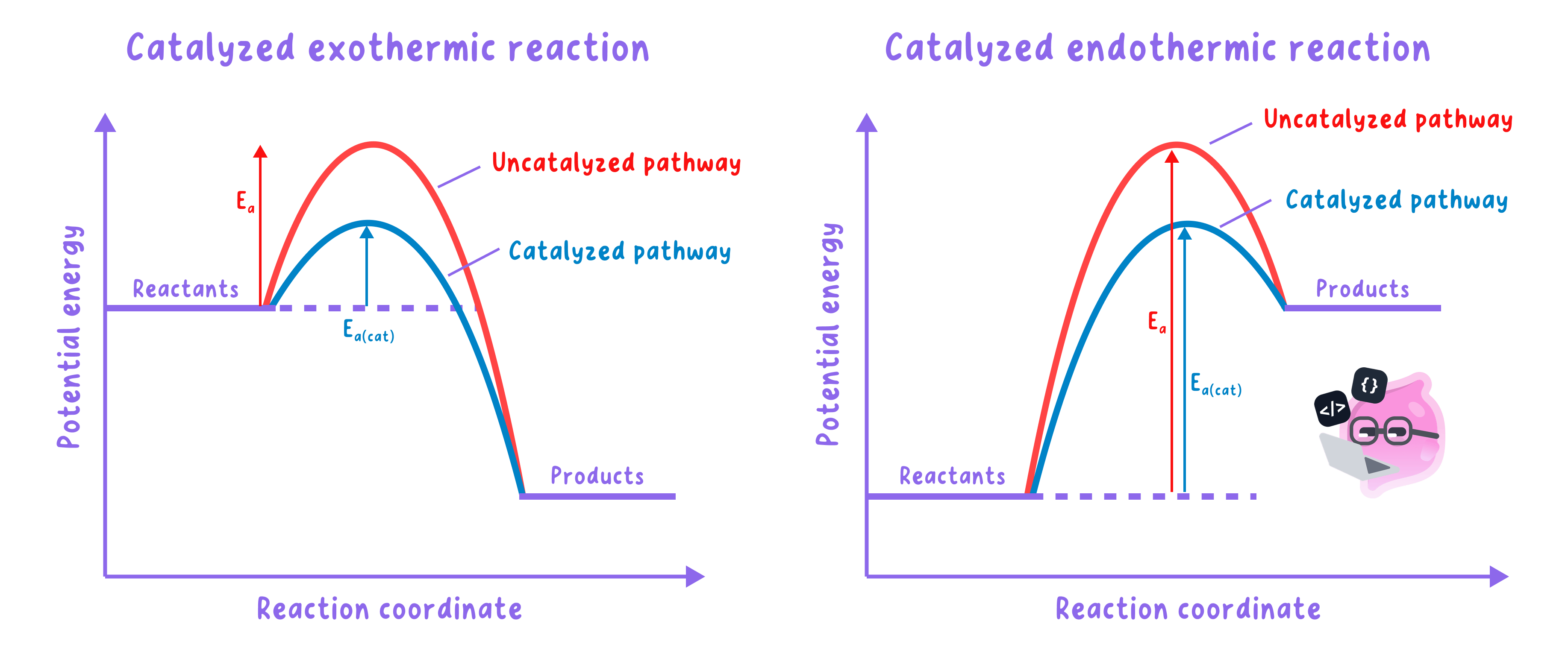
A reaction profile is a graph that shows the energy of substances as a reaction progresses. The vertical axis is energy, and the horizontal axis is progress of reaction. The diagram below compares the uncatalysed and catalysed pathways for an exothermic reaction, where the products have lower energy than the reactants.

Reaction profile diagram comparing uncatalysed and catalysed pathways with different activation energies

On a reaction profile:

  • the reactants are at the start
  • the products are at the end
  • the peak of the curve represents the highest-energy point on the pathway
  • the activation energy is measured from the reactants’ energy level up to the peak
  • a catalyst gives a lower peak, so the activation energy is lower
  • both curves start and finish at the same energy levels

That last point is very important: the catalyst changes the pathway, not the energy of the reactants or products.

Example

Reading activation energy from a reaction profile

A reaction profile shows reactants at 40 kJ/mol. The uncatalysed peak is 110 kJ/mol, the catalysed peak is 70 kJ/mol, and the products are at 15 kJ/mol.

  1. Use the rule Ea=peak energy−reactant energyE_\text{a} = \text{peak energy} - \text{reactant energy}Ea​=peak energy−reactant energy, because activation energy is measured from the reactants to the peak.

  2. Without the catalyst, Ea=110−40=70 kJ/molE_\text{a} = 110 - 40 = 70\ \text{kJ/mol}Ea​=110−40=70 kJ/mol.

  3. With the catalyst, Ea=70−40=30 kJ/molE_\text{a} = 70 - 40 = 30\ \text{kJ/mol}Ea​=70−40=30 kJ/mol.

  4. The catalyst lowers the activation energy by 70−30=40 kJ/mol70 - 30 = 40\ \text{kJ/mol}70−30=40 kJ/mol.

  5. The overall energy change is products−reactants=15−40=−25 kJ/mol\text{products} - \text{reactants} = 15 - 40 = -25\ \text{kJ/mol}products−reactants=15−40=−25 kJ/mol. This is unchanged by the catalyst.

Common Mistake

Lower peak, same finish

A catalyst lowers the activation energy peak. It does not lower the products, raise the reactants, or change whether the reaction is exothermic or endothermic.

How to identify a catalyst

In questions, you may be asked whether a substance is acting as a catalyst. Look for two pieces of evidence:

  1. The reaction is faster when the substance is present.
  2. The substance is not used up and is not included as a reactant or product in the overall equation.
Example

Deciding whether a substance is a catalyst

A reaction is tested with and without substance X. Without X, it takes 80 s to make a fixed volume of gas. With X, it takes 20 s. The mass of X before the reaction is 0.50 g, and the dry recovered mass of X after the reaction is 0.50 g. The equation is A(aq) + B(aq) → C(aq) + D(g).

  1. The same amount of gas is made in 20 s instead of 80 s, so the reaction is faster when X is present.

  2. For the same fixed amount of product, the rate is proportional to 1time\frac{1}{\text{time}}time1​, so the reaction is 80÷20=480 \div 20 = 480÷20=4 times faster with X.

  3. The mass of X is unchanged, because 0.50 g is recovered at the end.

  4. X is not shown as a reactant or product in the equation, so X is acting as a catalyst.

Different reactions need different catalysts

A catalyst that works for one reaction may not work for another. This is because different reactions have different pathways and different activation energies.

You do not need to memorise lots of catalyst names for this section unless a named catalyst is specifically required elsewhere in the course. The key skill is explaining what a catalyst does and recognising its effect.

Tip

Focus on the evidence

If a question gives an unfamiliar catalyst, do not panic. Use the evidence: faster reaction, lower activation energy, and not used up.

Enzymes as catalysts

Definition

Enzyme

An enzyme is a biological catalyst: it speeds up chemical reactions in living organisms and is not used up.

Enzymes are important in biological systems, such as digestion and respiration. Just like other catalysts, enzymes work by providing a pathway with a lower activation energy. Different enzymes catalyse different reactions.

Investigating catalysts in the lab

A common investigation is to compare how different substances affect the decomposition of hydrogen peroxide:

2H₂O₂(aq) → 2H₂O(l) + O₂(g)

You could add different metal salt solutions and measure the volume of oxygen gas produced over time using a gas syringe. A more effective catalyst gives a faster rate, so the gas volume increases more quickly.

To make the comparison fair, keep these the same:

  • volume and concentration of hydrogen peroxide
  • temperature
  • amount and concentration of the catalyst solution
  • total time measured
  • apparatus used to collect the gas

The best evidence usually comes from a graph of volume of oxygen against time. The steeper the initial gradient, the faster the initial rate.

Common Mistake

Faster does not mean more product

If the same amount of hydrogen peroxide fully decomposes, a catalyst should not make extra oxygen overall. It makes the oxygen form more quickly.

Exam technique

In the exam

  1. When explaining a catalyst, always include both ideas: it increases the rate and is not used up.

  2. For reaction profiles, measure activation energy from the reactants’ energy level to the peak, not from the bottom of the graph.

  3. If asked why the rate increases, use collision theory: lower activation energy means a greater proportion of collisions are successful.

Self review

Check yourself

  • How can you tell from experimental results that a substance is acting as a catalyst?
  • On a reaction profile, what changes when a catalyst is used and what stays the same?
  • Why does lowering activation energy increase the rate of reaction?
You've reached the end

Test yourself on this topic, or move on to the next guide.

FlashcardsSelf-test with active recall
Reversible reactionsUp next

How was this guide?

Catalysts Revision Guide

  1. GCSE
  2. /Chemistry
  3. /Catalysts