Question 3
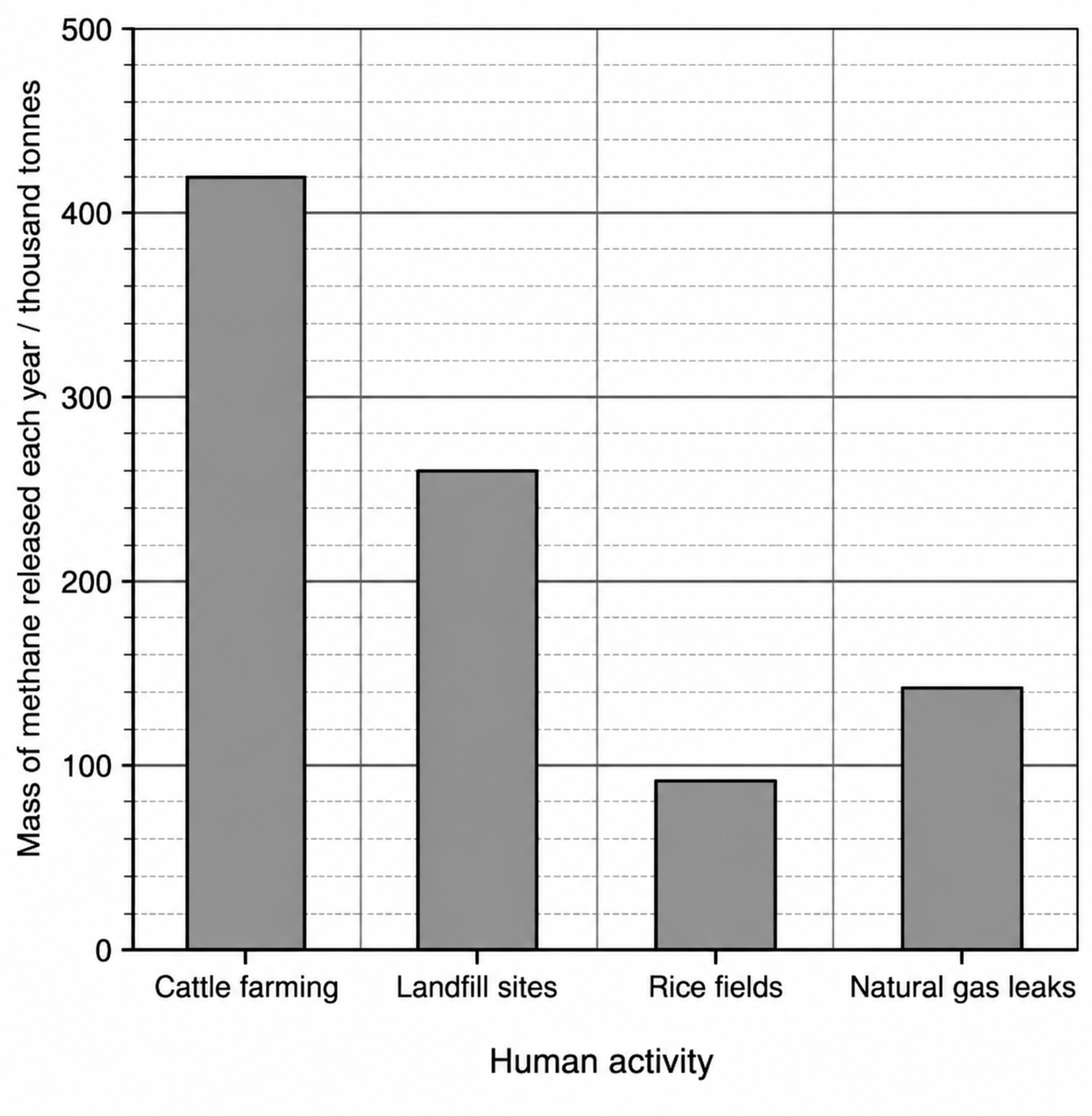
FFigure shows the mass of methane released each year by four human activities in one country.
Figure: The mass of methane released each year by four human activities in one country
a.[1]
Use Figure. Give the human activity that releases the greatest mass of methane each year.
b.[1]
Use Figure. Calculate the total mass of methane released each year by landfill sites and by rice fields.
c.[3]
The country decides to cover its landfill sites and collect the methane that is released.
Explain how this action reduces the effect of the country's methane emissions on the average global temperature.
9.2 Carbon dioxide and methane as greenhouse gases Questions
40 exam-style questions on AQA GCSE Chemistry 9.2 Carbon dioxide and methane as greenhouse gases, covering 9.2.1 Greenhouse gases, 9.2.2 Human activities which contribute to an increase in greenhouse gases in the, 9.2.3 Global climate change, and 9.2.4 The carbon footprint and its reduction. Each one has a worked solution and a mark scheme showing where the marks go.