x

Revision notes for AQA GCSE Chemistry Alternative methods of extracting metals (HT only). Open the guide for explanations and worked examples. Written against the AQA GCSE Chemistry (8462) specification, so the content matches what's examinable rather than general Chemistry background.

Alternative methods of extracting metals (HT only)

What you'll learn

  • Why copper ores are becoming harder to use by traditional mining.
  • How phytomining and bioleaching extract copper compounds from low-grade ores.
  • How copper metal is obtained from copper compound solutions by displacement or electrolysis.
  • How to evaluate these alternative biological methods in Higher Tier questions.

Why do we need alternative extraction methods?

A resource is a material from the Earth that humans use. Metal ores are finite resources, meaning they are limited and form much more slowly than we use them.

Most metals are not found as pure elements. They are usually found in compounds: substances where atoms of different elements are chemically joined. Extraction means obtaining a metal from its ore or compound.

Definition

Ore and ore grade

An ore is a rock containing a metal or metal compound that can be extracted. The grade of an ore tells you how concentrated the useful metal compound is: a high-grade ore contains a larger percentage of the wanted metal, while a low-grade ore contains only a small percentage.

Copper is very useful for electrical wiring, plumbing and alloys, so humans have mined lots of the richest copper ores already. As high-grade copper ores become scarce, we increasingly have to use low-grade ores.

Traditional mining can involve digging up, moving and disposing of huge amounts of rock. If the ore contains only a tiny amount of copper, most of what is dug up is waste.

Example

Comparing ore grades

A low-grade copper ore contains 0.5% copper by mass. How much ore is needed to contain 1.0 kg of copper, assuming all the copper is extracted?

  1. Convert the percentage into a fraction: 0.5%=0.5100=0.0050.5\% = \frac{0.5}{100} = 0.0050.5%=1000.5​=0.005.
  2. Link the copper mass to the ore mass: mass of copper=mass of ore×0.005\text{mass of copper} = \text{mass of ore} \times 0.005mass of copper=mass of ore×0.005, so mass of ore=1.0 kg0.005\text{mass of ore} = \frac{1.0\ \text{kg}}{0.005}mass of ore=0.0051.0 kg​.
  3. Calculate the ore mass: mass of ore=200 kg\text{mass of ore} = 200\ \text{kg}mass of ore=200 kg.
  4. Interpret the answer: to get 1.0 kg of copper, about 199 kg is unwanted material, so traditional mining of low-grade ore creates a lot of waste rock.

The big picture: from low-grade ore to copper metal

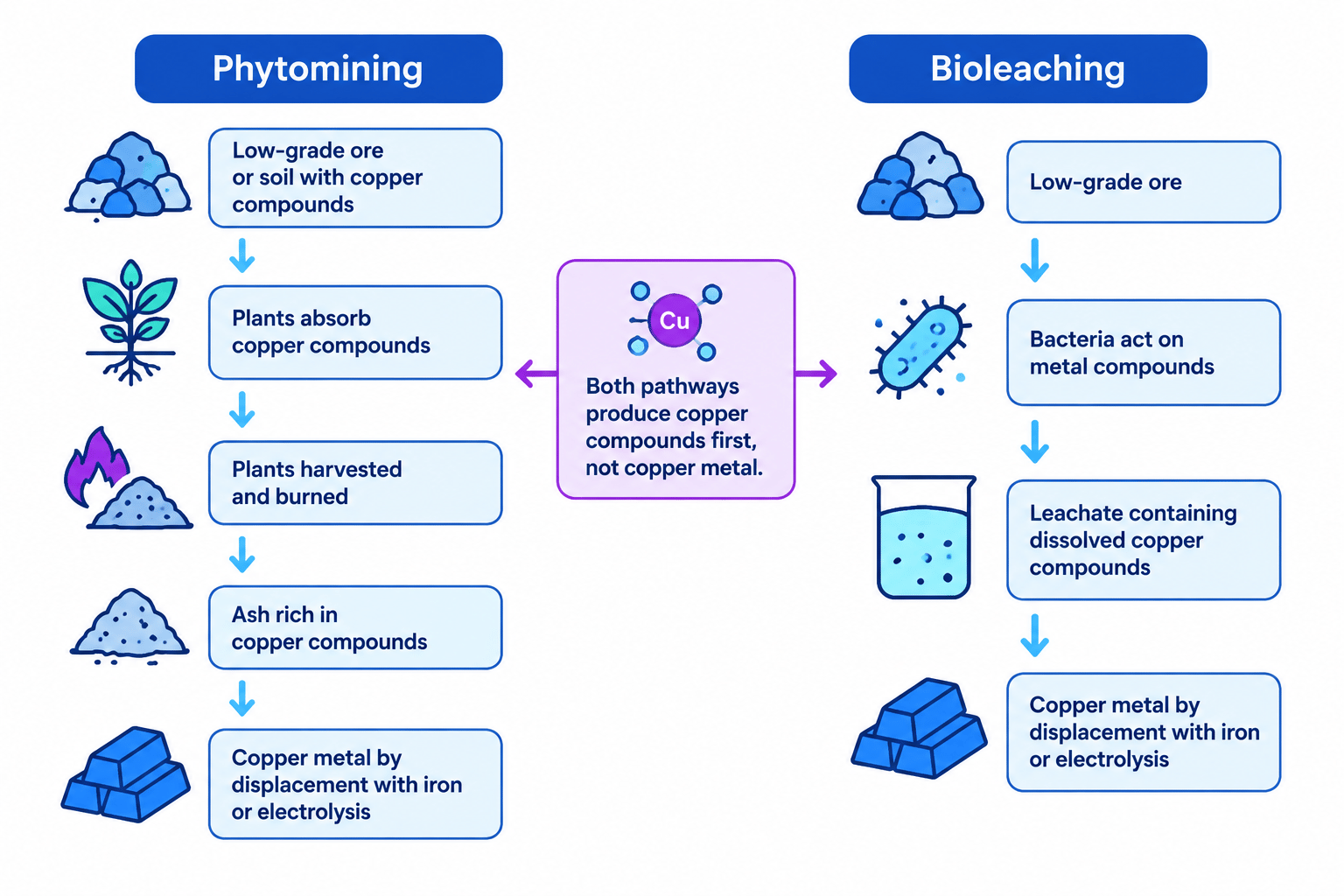
This Higher Tier topic is about biological methods, which use living organisms or material from living organisms. Phytomining uses plants, while bioleaching uses bacteria, which are microscopic single-celled organisms.

Both methods help produce a copper compound solution. That solution must then be processed to obtain copper metal.

Flowchart comparing phytomining and bioleaching routes from low-grade copper ore to copper metal

Phytomining: using plants

Definition

Phytomining

Phytomining uses plants to absorb metal compounds from soil or low-grade ore. The plants are harvested, then burned to form ash containing metal compounds.

The basic sequence is:

  1. Plants are grown on soil containing copper compounds.
  2. The roots absorb copper compounds from the soil.
  3. The plants are harvested, meaning cut and collected.
  4. The plants are burned to produce ash, the solid powder left after burning.
  5. The ash is processed to make a solution containing copper compounds.
  6. Copper metal is extracted from that solution.

The useful idea is concentration. The copper compounds are spread out through a large amount of low-grade material at first, but after plant growth and burning, they are concentrated into a much smaller amount of ash.

Common Mistake

Plants do not make copper metal

Phytomining does not produce pure copper straight away. It produces plant material and then ash containing copper compounds; further processing is needed to obtain copper metal.

Bioleaching: using bacteria

Definition

Bioleaching

Bioleaching uses bacteria to produce a solution called a leachate that contains metal compounds from low-grade ores.

In bioleaching, bacteria act on copper compounds in the ore. They help convert some copper compounds into soluble compounds, meaning compounds that can dissolve in water.

Definition

Leachate

A leachate is a solution containing dissolved substances that have been washed out of a solid material. In this topic, the leachate contains copper compounds.

Bioleaching is useful because it can extract copper from low-grade ores and waste rock without digging up as much new rock. However, it is slow, and the leachate may be acidic or contain substances that must be carefully controlled to avoid pollution.

Key Idea

Phytomining vs bioleaching

Phytomining uses plants and produces ash containing metal compounds. Bioleaching uses bacteria and produces leachate containing metal compounds. Both still need a final step to obtain copper metal.

Turning copper compound solution into copper metal

After phytomining or bioleaching, the copper is in a solution as copper ions. An ion is a charged particle. Copper ions are often written as Cu2+(aq)\text{Cu}^{2+}\text{(aq)}Cu2+(aq), where (aq) means aqueous, dissolved in water.

To make copper metal, copper ions must become copper atoms. There are two GCSE methods you need to know here:

  • displacement using scrap iron
  • electrolysis

Method 1: displacement using scrap iron

Scrap iron means unwanted or recycled iron. Using it can be cheaper than using new materials.

Definition

Displacement reaction

A displacement reaction is a reaction where a more reactive element takes the place of a less reactive element in a compound.

Iron is more reactive than copper, so iron can displace copper from a copper compound solution. For example, if the solution contains copper sulfate:

Fe(s)+CuSO4(aq)→FeSO4(aq)+Cu(s)\text{Fe(s)} + \text{CuSO}_{4}\text{(aq)} \to \text{FeSO}_{4}\text{(aq)} + \text{Cu(s)}Fe(s)+CuSO4​(aq)→FeSO4​(aq)+Cu(s)

The copper forms as a solid. In observations, copper is often seen as a reddish-brown solid.

Example

Using scrap iron to displace copper

A leachate contains copper sulfate solution. Explain how scrap iron can be used to obtain copper.

  1. Compare the metals in the reactivity series: iron is more reactive than copper, so iron can displace copper from its compound.
  2. Identify what changes: iron atoms enter the solution as iron ions, while copper ions become copper metal.
  3. Write the equation with state symbols: Fe(s)+CuSO4(aq)→FeSO4(aq)+Cu(s)\text{Fe(s)} + \text{CuSO}_{4}\text{(aq)} \to \text{FeSO}_{4}\text{(aq)} + \text{Cu(s)}Fe(s)+CuSO4​(aq)→FeSO4​(aq)+Cu(s).
  4. Link to the product: the solid copper can be separated from the remaining solution.
Tip

Displacement check

A metal can only displace another metal from its compound if it is more reactive. Iron works for copper because iron is above copper in the reactivity series.

Method 2: electrolysis

Definition

Electrolysis

Electrolysis is the splitting up or changing of an ionic substance using electricity when it is molten or dissolved in solution.

In electrolysis, the conducting liquid or solution is called the electrolyte. The conducting rods or plates are electrodes. The cathode is the negative electrode.

Copper ions are positive, so they move to the negative cathode. There, they gain electrons and form copper atoms:

Cu2+(aq)+2e−→Cu(s)\text{Cu}^{2+}\text{(aq)} + 2\text{e}^{-} \to \text{Cu(s)}Cu2+(aq)+2e−→Cu(s)

This produces copper metal on the cathode.

Example

Predicting copper deposition

A copper compound solution is electrolysed using inert electrodes. Where does the copper form?

  1. Identify the copper particles in solution: copper is present as positive Cu2+(aq)\text{Cu}^{2+}\text{(aq)}Cu2+(aq) ions.
  2. Use electrode attraction: positive ions move to the negative electrode, which is the cathode.
  3. Apply the electron change: each copper ion gains two electrons, Cu2+(aq)+2e−→Cu(s)\text{Cu}^{2+}\text{(aq)} + 2\text{e}^{-} \to \text{Cu(s)}Cu2+(aq)+2e−→Cu(s).
  4. Conclude the observation: copper metal is deposited as a solid coating on the cathode.

Electrolysis can produce purer copper than displacement, but it uses electricity, so it can be more expensive and may have a higher energy demand.

Common Mistake

Electrolysis detail

For this topic, focus on copper being deposited from copper ions at the cathode. The exact reaction at the other electrode depends on the solution and the electrodes used.

Evaluating phytomining and bioleaching

In Higher Tier questions, you may be asked to evaluate alternative biological methods. To evaluate means to make a judgement using evidence, not just list facts.

Key Idea

Balanced evaluation

A strong evaluation gives both advantages and disadvantages, then links the final judgement to the priority in the question: cost, speed, environmental impact, yield or purity.

Advantages of biological methods

Phytomining and bioleaching can:

  • use low-grade ores that would otherwise be uneconomic to mine
  • reduce the need to dig, move and dispose of large amounts of rock
  • help conserve limited high-grade ores
  • sometimes use waste material from previous mining

Disadvantages of biological methods

They can also have drawbacks:

  • they are usually slower than traditional extraction methods
  • the solutions produced may be dilute, meaning they contain a low concentration of copper compounds
  • further processing is always needed to obtain copper metal
  • burning plants in phytomining can release gases and requires land to grow the plants
  • leachate in bioleaching must be contained to prevent pollution
Common Mistake

Vague evaluation

Do not just write “it is better for the environment”. Say why: for example, less rock is dug up, less waste rock is produced, or less energy is needed for moving large amounts of material.

Example

Recommending a method from information

A company has a large heap of low-grade copper waste rock. It does not need copper immediately, but it wants to reduce landscape damage. Would bioleaching be a sensible choice?

  1. Match the method to the resource: bioleaching can use low-grade waste rock, so it is suitable for material that would be difficult to process by traditional mining.
  2. Compare environmental impact: bioleaching avoids digging up and moving as much new rock, so it helps reduce landscape damage.
  3. Check the drawback against the priority: bioleaching is slow, but the company does not need the copper immediately, so speed is less important here.
  4. Make a justified judgement: bioleaching is a sensible choice, provided the leachate is controlled and the copper compound solution is later processed to obtain copper metal.
Exam technique

In the exam

  1. For phytomining, use the sequence: plants absorb copper compounds → harvested → burned → ash contains copper compounds → processed to obtain copper.
  2. For bioleaching, mention bacteria and leachate; do not say it directly produces pure copper.
  3. For evaluation, always link your judgement to the question’s priority, such as lower waste, slower speed, cost, energy use or purity.
Self review

Check yourself

  • What happens to the plants after they absorb copper compounds in phytomining?
  • What is leachate, and which extraction method produces it?
  • Why can scrap iron be used to obtain copper from a copper compound solution?

Using the Earth's resources and obtaining potable water

Guide 4 of 4

You've reached the end

Test yourself on this topic, or move on to the next guide.

Next guideLife cycle assessmentStart

How was this guide?

Alternative methods of extracting metals (HT only) Revision Guide

  1. GCSE
  2. /Chemistry
  3. /Alternative methods of extracting metals (HT only)