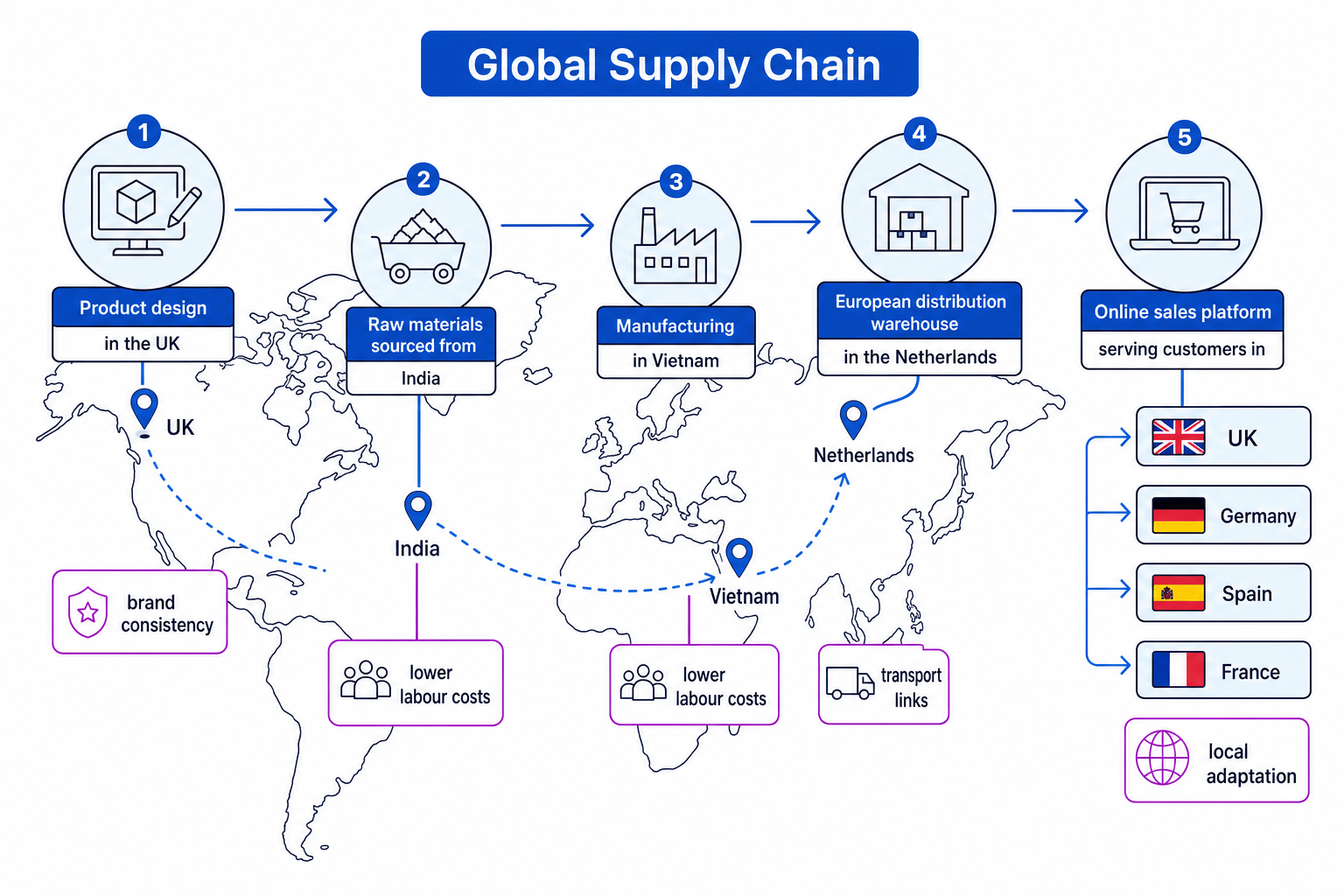
2.4.1 How UK businesses compete internationally
Globalisation and UK businesses
Definition
Globalisation: the growing links between the world's economies, so that businesses buy, sell and produce across national borders as if in one large market.
Import: a good or service a UK business buys from a supplier based in another country.
Export: a good or service a UK business sells to a customer based in another country.
- Cheap container shipping, the internet and the lowering of trade barriers have made buying and selling abroad normal even for small UK firms.
- Trade runs in both directions for a UK business, as imports coming in and exports going out.
- Many UK manufacturers do both at once, importing components and exporting the finished product, so globalisation reaches them from two sides.
Example
- JCB builds diggers in Staffordshire and sells them in well over a hundred countries, so most of its customers are not British.
- Scotch whisky is made only in Scotland, yet the bulk of every year's output is shipped overseas.
How UK businesses compete internationally
- Better design: a product that works in a way rivals cannot copy gives overseas customers a reason to choose it, as Dyson does with its bagless vacuum cleaners and cordless motors.
- Higher quality: better materials, reliability and finish let a firm charge more and still win the order, which is how JCB machinery and Jaguar Land Rover vehicles sell abroad.
- Lower prices: a business with genuinely lower costs, from large-scale production or efficient methods, can undercut overseas rivals and still make a profit.
- Few UK firms beat producers in low-wage countries on price alone, so the realistic version of this is offering better quality at a competitive price rather than the cheapest price on the market.
- Strong branding: a trusted name and British origin let a firm charge a premium, as Burberry does with its coats and Scotch whisky does with its protected name.
- E-commerce: selling through its own website and online marketplaces lets a UK business take orders from overseas customers without opening a single shop abroad.
- The website has to work for that customer, which means overseas delivery, a returns route and prices and product information they understand.
Example
- Gymshark grew into an international brand by selling online and through social media, rather than by opening stores country by country.
- Burberry takes the opposite route, competing on brand and quality so that customers overseas accept a high price for a British-made coat.
Benefits of globalisation for a UK business
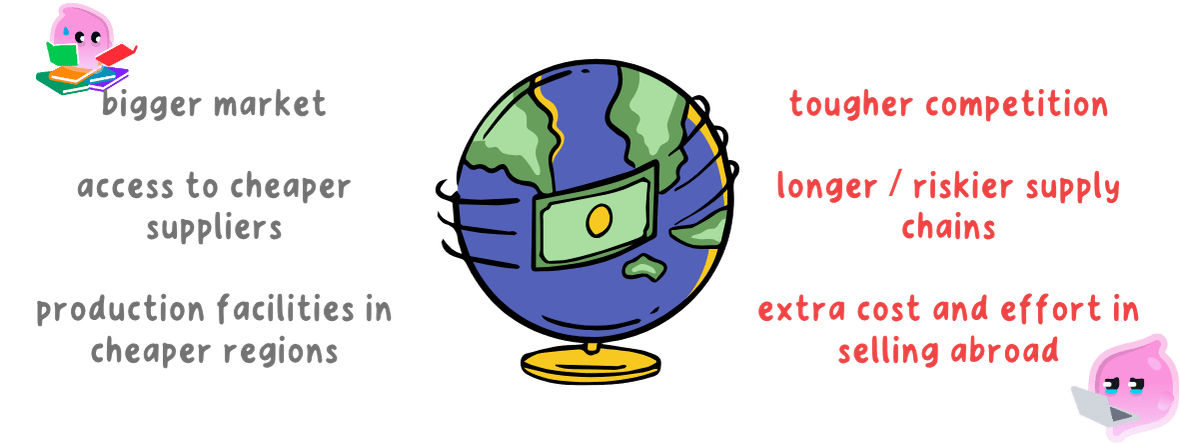
- A much bigger market: exporting puts millions of extra customers within reach, so sales can keep growing even when the UK market is full.
- Selling in several countries also spreads risk, because weak demand in one market can be offset by stronger demand in another.
- Cheaper supplies: buying materials and components from overseas suppliers cuts costs, so the business can widen its profit margin or pass the saving on as a lower price.
- A wider choice of suppliers also means access to materials and parts that are not made in the UK at all.
- Producing abroad: a UK business can set up or use factories overseas where wages are lower or where it is closer to its customers, cutting production and delivery costs.
Example
- Dyson designs in the UK but manufactures in Asia, which keeps its costs down and puts production near fast-growing Asian markets.
- Jaguar Land Rover sells heavily in China and the United States, so its sales no longer depend on how many cars British buyers want.
Drawbacks of globalisation for a UK business
- Tougher competition at home: overseas firms sell into the UK too, often at prices a UK producer cannot match, so a business can lose sales in its own market.
- The response is either to cut price and accept a thinner margin, or to improve design, quality or service so customers still choose it.
- Longer, riskier supply chains: goods travel thousands of miles, so delays at ports, rising shipping costs and faulty batches are slower to spot and harder to put right.
- A late shipment can stop production or empty the shelves, so some firms hold extra stock as protection, which ties up cash.
- Checking quality and working conditions at a distant supplier is difficult, and a problem there becomes the UK brand's problem.
- Extra cost and effort in selling abroad: the product and its packaging often have to be adapted to local tastes, languages and rules, and transport adds cost to every sale.
Note
How cheap a UK export looks abroad, and how much an imported supply costs in pounds, also depend on the exchange rate, which is covered in 2.4.2.
Exam technique
- A common wording is analyse the benefits and drawbacks of globalisation for this business, so pair each benefit you give with the drawback that actually threatens that business.
- Read what the business does first: an exporter cares most about bigger markets, while a firm selling only in the UK cares most about foreign rivals arriving here.
- When asked how a business could compete internationally, pick the method that suits its product and explain why an overseas customer would choose it over a local rival.
Self review
- What is globalisation?
- What is the difference between an import and an export?
- Name four ways a UK business can compete against overseas rivals.
- How does e-commerce help a small UK business reach customers abroad?
- Give one benefit and one drawback of globalisation for a UK manufacturer that imports its components.
2.4.2 Exchange rates
What an exchange rate is
Definition
Exchange rate: the price of one currency in terms of another, such as how many euros or dollars a pound will buy.
Stronger pound: each pound buys more foreign currency than it did before.
Weaker pound: each pound buys less foreign currency than it did before.
- Exchange rates move every day, so a UK business that trades abroad finds the price its overseas customers see, and the cost of the supplies it buys in, changing without it deciding anything.
- Two kinds of business feel the movement: the exporter that sells abroad, and the importer that buys from abroad.
- A movement that helps one of them hurts the other, so the effect only makes sense once you have said which of the two you are talking about.
Analogy
- Treat the pound as a ticket for buying abroad: a stronger pound makes the ticket go further overseas, and a weaker pound makes it go less far.
- Foreign customers buying British goods hold the opposite ticket, which is why every movement has a winner and a loser.
A weaker pound
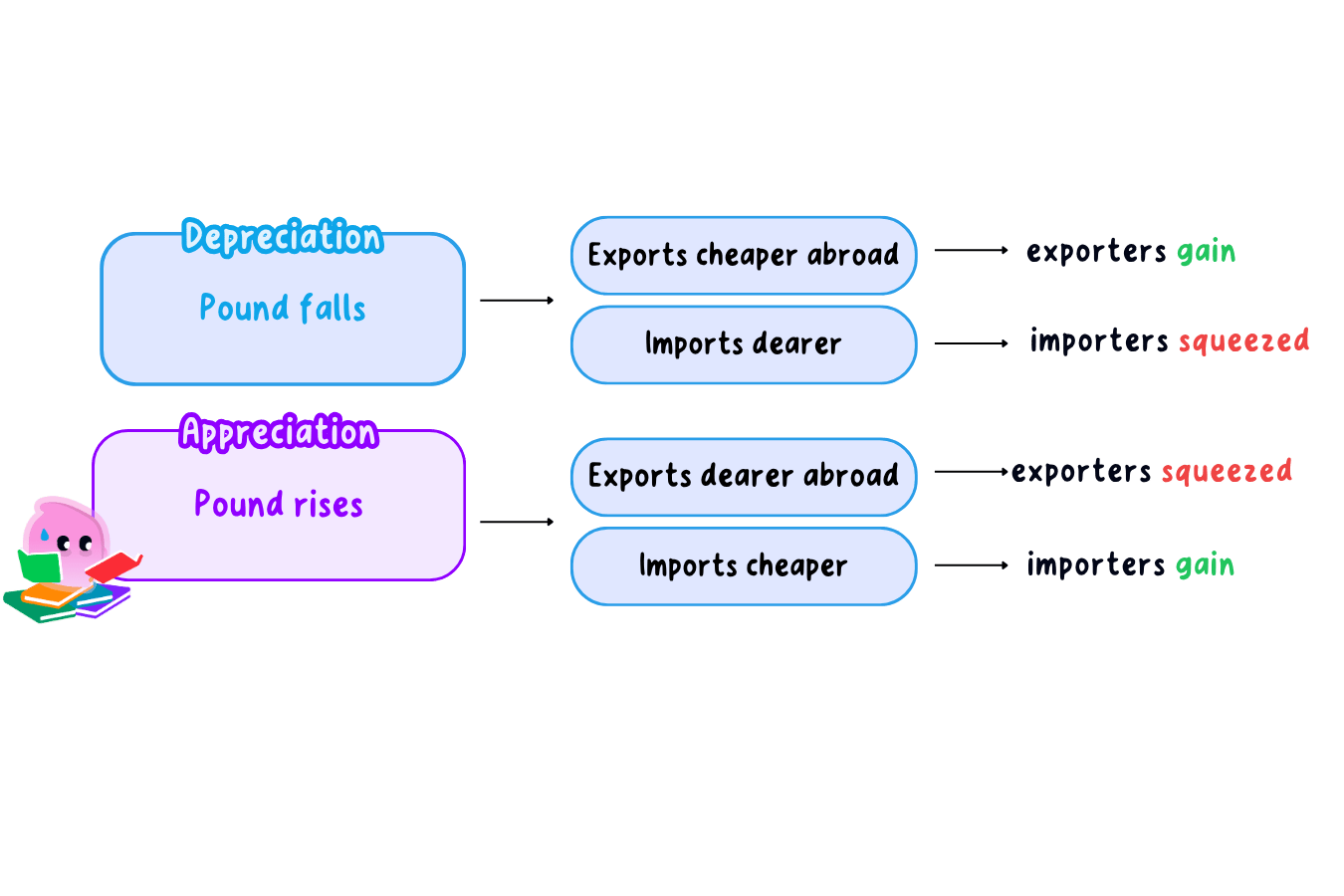
- UK exports become cheaper abroad. An overseas customer needs less of their own currency to buy the same British product, so it looks better value against local rivals.
- Export sales tend to rise, so the exporter's revenue and profit rise, and it may need extra output to meet the orders.
- The alternative is to leave the overseas price alone and collect more pounds from each sale, which raises profit per unit instead of raising sales.
- Imports become dearer. A UK business buying stock or raw materials priced in another currency must hand over more pounds for exactly the same goods.
- Its costs rise, so profit falls unless it puts its own prices up, and raising prices risks losing customers to a rival that has not.
Key Idea
- Weak pound: exports rise, imports dearer.
- A strong pound is simply the same line read backwards: exports fall, imports cheaper.
A stronger pound
- UK exports become dearer abroad. An overseas customer needs more of their own currency for the same British product, so it looks expensive next to a local rival and export sales tend to fall.
- To keep those customers the exporter can cut the price it charges overseas, but then it receives fewer pounds per sale and its profit margin is squeezed.
- Imports become cheaper. A UK importer hands over fewer pounds for the same stock, so its costs fall and its profit rises if it keeps its selling prices where they are.
- It can also pass the saving on as a lower shelf price and try to win sales from competitors.
Example
- JCB exports diggers, so a weaker pound makes its machines cheaper for buyers in Germany and India and its export orders tend to grow.
- A Scotch whisky distiller gains in the same way, since a weaker pound makes a bottle more affordable in its overseas markets.
- Currys is on the other side of the same movement, because it buys much of its electrical stock from suppliers in Asia and a weaker pound raises what that stock costs it.
Always say who the change is good for
- Name the business before you name the effect, because the same movement that lifts a UK exporter's sales raises a UK importer's costs: a weaker pound is good news for JCB as an exporter and bad news for a retailer importing its stock.
- Plenty of UK businesses are both at once, importing materials and exporting the finished product, so a weaker pound lifts their export sales and their input costs together.
- Which side matters more depends on how much of the product's cost is imported and how much of its output is sold abroad, so use those details from the case.
Common Mistake
- The commonest error is writing that a weaker pound is bad because everything costs more, without saying that it is only bad for the importing side.
- A change in the pound is a change in the price of foreign currency, not a rise in the price of everything sold in the UK.
Exam technique
- The usual wording is explain the impact of a fall in the value of the pound on this business, so decide first whether the business mainly imports or mainly exports.
- Build the chain in order: the direction of the pound, the price the other side now sees, the effect on sales or costs, then the effect on profit.
- You are asked to interpret the direction of the effect, so describe cheaper or dearer rather than trying to work out prices in another currency.
Self review
- What does an exchange rate measure?
- What happens to the overseas price of a UK exporter's product when the pound weakens?
- Why does a weaker pound raise the costs of a UK retailer that buys its stock from Asia?
- Which type of UK business gains from a stronger pound, and why?
- Why must an answer about the pound always say who the change is good for?