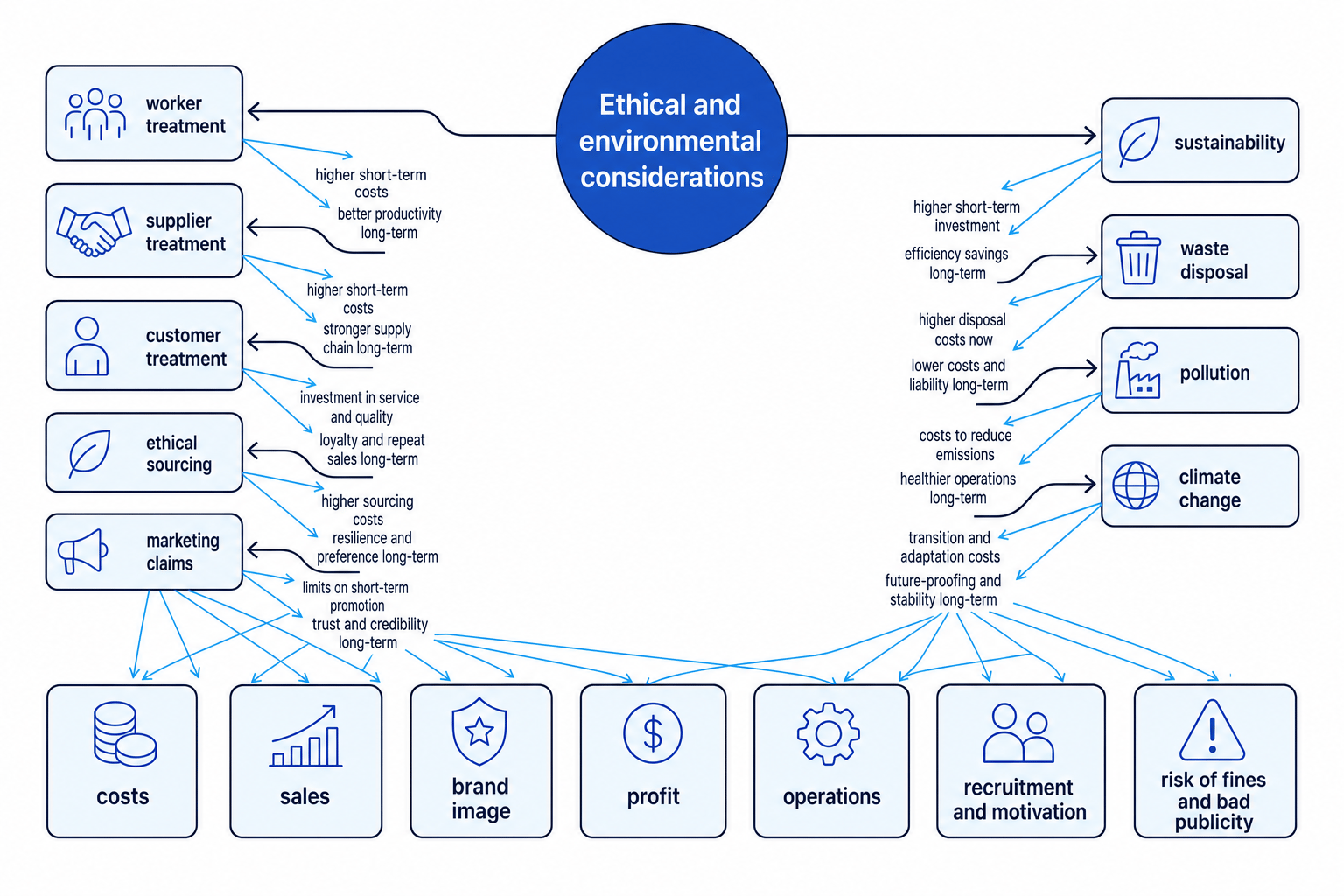
2.2.1 Ethical considerations
What ethical behaviour means
Definition
Business ethics: acting in ways that stakeholders consider fair and honest, even when a cheaper or easier option is available.
- Fair and honest is judged by stakeholders. Customers, workers, suppliers and the local community decide whether the firm's behaviour is acceptable, so what counts as ethical is set outside the business.
- Ethics goes beyond the law. The law is the minimum every firm must meet, such as paying at least the national minimum wage, while ethics asks what is fair rather than what is merely allowed.
- A choice can be legal but unethical. Delaying payment to a small supplier for 90 days breaks no law, but it can push that supplier into a cash shortage.
Common Mistake
- A firm that only meets its legal duties is complying with the law, not behaving ethically, because ethical behaviour is the part it chooses to do.
- Do not confuse ethics with the environment: pollution and waste belong to environmental considerations, while ethics is about fair and honest treatment of people.
Ways a business can behave ethically
Definition
Ethical sourcing: buying materials from suppliers that pay and treat their workers fairly, rather than automatically choosing the cheapest supplier.
- Paying suppliers a fair price: agreeing a price the grower or maker can live on, and settling invoices on the agreed date, keeps that supplier trading instead of squeezing it until it fails.
- Fair wages and conditions for its own staff: paying above the legal minimum, giving predictable hours instead of last-minute shifts, and keeping the workplace safe all go further than the law requires.
- Fair conditions along the supply chain: a UK firm can inspect the overseas factories that make its goods, refuse to use child labour, and drop suppliers whose buildings or hours are unsafe.
- Honest advertising and labelling: describing a product truthfully means not calling a drink "natural" when it is mostly syrup, and not printing a "was" price the item never really sold at.
- Honest treatment of customers: explaining what a contract costs in total, and refunding faults without argument, treats the customer as someone to keep rather than someone to catch out.
Example
- The Co-op sells its own-label bananas, tea and coffee on Fairtrade terms, so growers receive a guaranteed minimum price plus a premium for their community.
- Nationwide is an accredited Living Wage employer, paying every member of staff at least the voluntary real Living Wage rather than stopping at the legal minimum.
- Lush refuses ingredients tested on animals and names the suppliers it buys from, which is a sourcing decision rather than a legal duty.
Benefits of behaving ethically
- A reputation that attracts customers: shoppers who care how a product was made will choose the firm they trust, which brings sales a rival cannot copy by cutting prices.
- The chance to charge a premium price: a Fairtrade label gives customers a reason to accept a higher price, so the extra cost of ethical sourcing can be recovered rather than absorbed.
- Loyal customers and loyal staff: repeat buyers cost little to keep, and well-paid workers leave less often, which cuts what the firm spends on recruiting and training replacements.
- Protection against scandal: checking suppliers before a journalist does avoids the boycotts, lost contracts and falling share price that follow an exposed supply chain.
Example
- Boohoo was heavily criticised in 2020 over pay and conditions in the Leicester factories that supplied it, and its share price fell sharply as retailers reviewed whether to stock its brands.
- The cost of auditing those suppliers would have been small next to the sales and investor confidence lost afterwards.
Drawbacks of behaving ethically
- Higher costs, straight away: Fairtrade beans might add 10p to each cup of coffee, so a cafe selling 500 cups a day carries 500×£0.10=£50500 \times \pounds0.10 = \pounds50500×£0.10=£50 of extra cost every day before it sells anything more.
- Lower profit or higher prices: the firm either absorbs the cost and accepts a smaller profit margin, or passes it on and risks losing customers to cheaper rivals.
- Fewer suppliers to choose from, and a bill for checking them: ruling out factories that fail an inspection shrinks the list of possible suppliers, and someone still has to visit sites and read wage records.
- Promises are hard to keep. A firm that advertises its ethics is judged against that claim, so one bad supplier does more damage to it than to a rival that never made the promise.
Note
- Supply chains are long, so a UK retailer may know its direct supplier well but have little idea who that supplier subcontracts to.
- That is why the extra cost of ethical behaviour is certain while the reputation gain is not.
The trade-off between ethics and profit
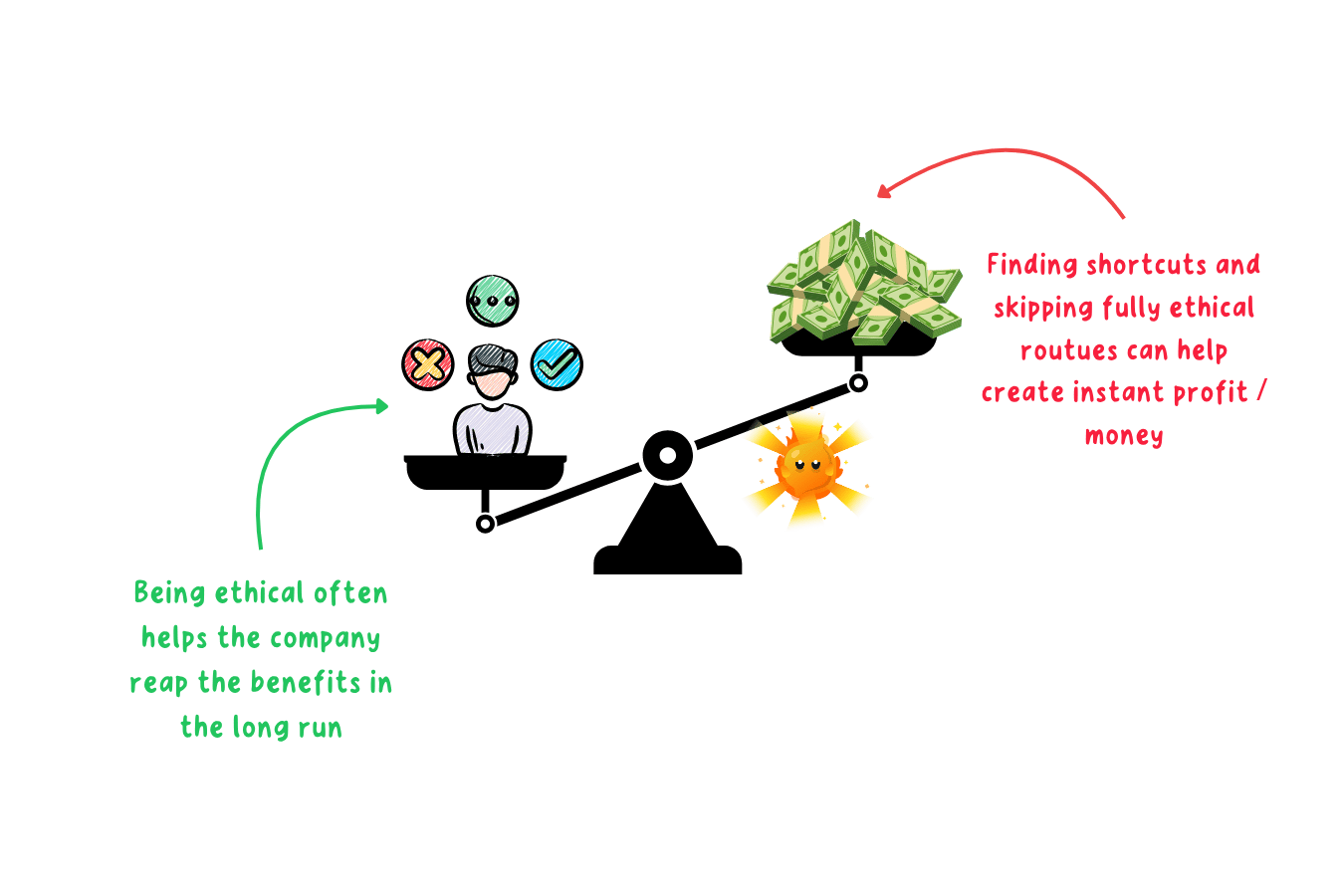
- The trade-off is that the fair choice normally costs more. Paying a supplier above the market price, or a worker above the legal minimum, raises costs, so some profit is given up to gain the fairer outcome.
- Timing decides how painful it feels. The higher costs land this month, while loyalty and reputation build over years, which is hard for a firm that is short of cash now.
- Whether customers will pay decides the outcome. If the target market values ethical sourcing enough to accept a higher price, profit can rise; if shoppers compare only price, the cost cannot be passed on.
- The behaviour has to be visible. Ethical sourcing nobody hears about brings the extra cost with none of the reputation gain, which is why firms put the certification on the packaging.
Exam technique
- When you are asked to analyse the trade-off between ethics and profit for this business, build one chain showing the cost and one showing the gain, then say which is bigger for this firm and why.
- Name the ethical practice precisely, because "being ethical" is too vague to develop, while "paying its cocoa growers a guaranteed minimum price" leads somewhere.
- The mistake students actually make is asserting that ethics always pays; whether the cost can be passed on depends on the target market.
Self review
- What does it mean for a business to behave ethically?
- Why can a decision be legal but still unethical?
- Give three ways a business can behave ethically towards suppliers or workers.
- State two benefits and two drawbacks of ethical behaviour.
- What decides whether the ethics and profit trade-off leans towards ethics?
2.2.2 Environmental considerations
The environmental impact of business activity
- Traffic congestion: deliveries, staff driving to work and customers arriving by car all add vehicles to local roads, so journeys take longer for everyone in the area.
- A large distribution centre can generate hundreds of lorry and van movements a day, which is why councils often refuse or restrict planning permission near housing.
- Disposing of waste: packaging, offcuts, unsold stock and food that has passed its date have to go somewhere, and landfill takes up land and leaks liquid and gas as the waste rots.
- Businesses pay for commercial waste collection and landfill tax, so waste is a direct cost as well as an environmental problem.
- Noise pollution: machinery, deliveries and building work disturb people living nearby, especially early in the morning and late at night.
- Air pollution: burning fuel in factories, boilers and delivery vehicles releases fumes that worsen air quality and affect the health of people in the surrounding streets.
Example
- A firm running older diesel vans in London pays the Ultra Low Emission Zone charge of £12.50 a day for each one, which turns air pollution into a bill.
- Airports such as Heathrow restrict night flights because of complaints from residents under the flight path.
- A supermarket that throws away unsold bread each evening is paying twice: once for the flour and once for the waste collection.
Recycling and reducing waste
Definition
Recycling: processing used materials so they can be made into new products instead of being sent to landfill.
- Sorting waste at source: separate bins for card, glass and plastic mean less goes into general waste, which cuts the collection charges the business pays.
- Redesigning packaging: removing plastic film from a multipack, or switching a tray from black plastic to cardboard, makes the packaging recyclable and uses less material in the first place.
- Reusing and reselling: pallets and crates can be returned and used again, and offcuts such as scrap metal or sawdust can be sold to another business rather than thrown away.
- Redistributing unsold stock: Tesco passes surplus food to charities through its Community Food Connection scheme, which keeps edible food out of landfill.
Common Mistake
- Recycling is not free: someone has to sort the waste, extra bins take up space, and recyclable packaging usually costs more per unit than plastic.
- Packaging also has a job to do, so a lighter box that lets goods arrive damaged creates more waste than it saves.
How businesses accept greater environmental responsibility
- It is a choice, not a legal duty. The law sets limits on emissions and waste disposal, and accepting environmental responsibility means going further than those limits because stakeholders expect it.
- Changing the vehicles: DPD and Royal Mail are replacing diesel vans with electric ones and planning routes to cut mileage, which reduces both fumes and fuel spending.
- Changing the premises: fitting insulation, LED lighting and quieter machinery, and limiting deliveries to daytime hours, reduces energy use and noise for the neighbours at the same time.
- Changing where it buys from: choosing a UK supplier instead of one overseas shortens the journey the materials make, which cuts transport emissions and congestion on long routes.
Example
- UK supermarkets have removed plastic bags for loose fruit, cut back film on multipacks and set up in-store collection points for soft plastic.
- The carrier bag charge of 10p pushed shoppers towards reusable bags and cut the number of single-use bags handed out dramatically.
How consumers accept greater environmental responsibility
- They change what they buy. Shoppers choosing refills, loose vegetables or a product with less packaging shift demand towards firms that offer those options.
- They change how they buy. Taking a reusable cup to a coffee shop, or grouping orders into one delivery instead of three, reduces the waste and mileage the business creates on their behalf.
- They put pressure on firms directly. Customers who complain about excess packaging, boycott a polluter or support a campaign group make the issue expensive enough for the business to act on.
Note
- Consumer pressure works through demand, so a business responds when enough customers act, not when a few complain.
- Global warming, finite resources and the longer-term trade-off with profit are covered in sustainability; this article deals with the immediate impact and the direct costs and benefits.
Costs and benefits of accepting responsibility
- The costs arrive first. Electric vans, cleaner machinery and recyclable materials all have to be paid for before any saving appears, which squeezes the profit margin or forces prices up.
- Some choices lose sales or convenience. Banning night deliveries to protect neighbours means lorries queue in daytime traffic, and a dearer green product can be undercut by a rival that changes nothing.
- Using less of something saves money. Less packaging, less energy and less waste sent to landfill all reduce running costs permanently once the initial spending has been recovered.
- Reputation and fewer penalties: a firm known for acting responsibly wins customers who care, keeps the local community and council on side, and is less likely to face fines or tighter restrictions.
Exam technique
- Name the specific impact rather than writing "it harms the environment", so say congestion, landfill waste, noise or air pollution.
- A question asking you to analyse the costs and benefits of this business accepting greater environmental responsibility needs both sides developed, not a list of green ideas.
- The error to avoid is treating a green change as costless; almost all of them need spending up front.
Self review
- Name four environmental impacts of business activity.
- What is recycling, and how does it reduce a firm's waste costs?
- Give two ways a business can accept greater environmental responsibility.
- Give two ways consumers accept greater environmental responsibility.
- State one cost and one benefit to a business of reducing the pollution it causes.
2.2.3 Sustainability
What sustainability means
Definition
Sustainability: meeting the needs of the present without damaging the ability of future generations to meet their own needs.
- It is a long-term test. A sustainable business asks whether it could keep operating in the same way for decades, rather than only whether it can afford this year's order.
- Two things make an activity unsustainable. Using up resources faster than they can be replaced, and releasing gases that warm the planet, both leave the future worse off than the present.
- It applies to the whole chain. The materials a firm buys, the energy it burns, the distance its goods travel and what happens to the product when the customer has finished with it all count.
Analogy
- A finite resource is like savings in a bank account: once spent, it is gone.
- A renewable resource is like a monthly wage, which keeps arriving as long as you do not spend it faster than it comes in.
Using scarce resources
Definition
Finite resources: resources such as oil, gas and metal ores that exist in limited quantities and cannot be replaced once they have been used.
- Some resources run down. North Sea oil and gas, the metals in a phone battery and the sand used in glass all come from stocks that shrink each time a business draws on them.
- Renewable resources can still be used up. Timber and fish replace themselves, but only if they are harvested slowly enough, which is why fishing quotas and replanted forests exist.
- Scarcity shows up as price. As a material becomes harder to obtain it costs more, so a firm that designs the material out of its product protects itself against future price rises.
- Supply itself is at risk. A furniture maker whose timber supplier clears forests without replanting will eventually have nothing to buy, so sustainability protects the business as well as the environment.
Example
- Drinks makers have redesigned plastic bottles to use thinner walls and lighter caps, so each bottle needs less plastic and a lorry carries less dead weight.
- UK supermarkets have removed shrink wrap from multipacks and cut plastic trays from fruit and vegetables, which uses less material and less waste collection.
- Furniture and paper firms buy timber certified as coming from replanted forests rather than from cleared woodland.
Global warming and what it means for a business
- Burning fossil fuels causes it. Gas boilers, factory furnaces, lorries and aircraft release greenhouse gases that trap heat in the atmosphere and raise average temperatures.
- A firm's contribution is its carbon footprint. This is the total greenhouse gas its activities produce, from the electricity in its offices to the delivery miles its goods travel.
- Extreme weather disrupts supply and premises. Floods close warehouses and shops, and a run of poor harvests raises the price of wheat, which pushes up costs for a bread maker such as Warburtons.
- Rules and taxes tighten as the problem grows. Governments respond with charges on emissions and deadlines for ending petrol and diesel sales, so a firm that ignores its footprint faces a forced change later.
Note
- Global warming reaches a business through its costs and its supply chain, which is why it appears in a business course rather than only in science.
- Local effects such as congestion, noise and waste disposal are covered in environmental considerations.
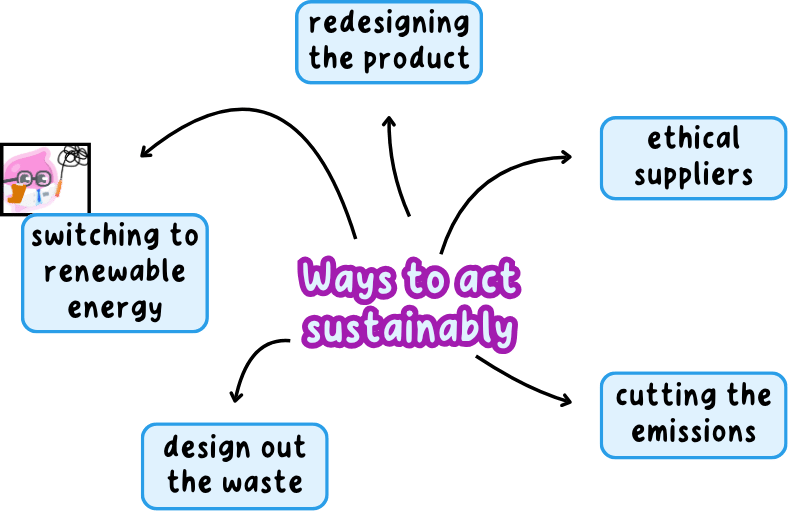
How a business can act more sustainably
- Switch to renewable energy. Tesco buys the electricity for its UK stores from renewable sources, and a smaller firm can fit solar panels to a factory or warehouse roof.
- Redesign the product to use less. Making a bottle thinner, a box smaller or a component out of recycled metal cuts the resources consumed and the cost of every unit made.
- Buy from suppliers that replace what they take. Certified timber, responsibly caught fish and Fairtrade crops all come from sources managed so they will still exist in twenty years.
- Cut the emissions of moving goods. Electric delivery vans, fuller lorries and suppliers closer to the factory all reduce the fuel burned to get a product to the customer.
- Design out the waste. Refill stations, repairable products and take-back schemes keep materials in use instead of sending them to landfill after one life.
The trade-off between sustainability and profit
- The spending comes first and the gain comes later. Solar panels, electric vans and certified materials reduce profit in the year they are bought, and only repay the firm across the years that follow.
- Whether the market will pay decides the outcome. Customers of a premium brand may accept a higher price for a lower-impact product, while shoppers choosing on price alone will move to a rival that changed nothing.
- The firm's cash position limits the choice. A business with reserves can fund the change and wait for the savings, whereas one that is short of cash cannot spend £20,000 now however sensible it looks.
- Sometimes the two point the same way. Using less energy, less packaging and less fuel cuts costs immediately, so the conflict with profit is strongest where the change needs heavy investment.
Common Mistake
- Do not assume the trade-off always runs the same way, because the size of the up-front spending is what decides how much profit is sacrificed.
- A sustainable change customers never hear about carries the cost with none of the reputation gain.
Exam technique
- A question asking you to analyse the trade-off between sustainability and profit for this business wants one chain showing profit falling now and one showing it rising later, then a decision about which matters more to this firm.
- Use the timescale deliberately: say "in the first year" and "over the next five years", because the trade-off is really an argument about when.
- The slip students make is answering about litter and local pollution, which belongs to environmental considerations, instead of scarce resources and global warming.
Self review
- Define sustainability in one sentence.
- What is the difference between a finite resource and a renewable one?
- Give two ways global warming raises costs for a business.
- Name three ways a firm can act more sustainably.
- Explain the trade-off between sustainability and profit, and name one thing that decides which side wins.