What a business plan is, and what writing one does to your thinking
Definition
Business plan: a written document setting out what a business will do and how it will do it, prepared before trading starts.
Forecast: an estimate of a future figure, such as sales or cash, made before the event rather than recorded after it.
- A business plan is written in advance, so every figure in it is a prediction about a business that does not yet trade.
- Writing the plan changes how the owner thinks, because it turns loose guesses into figures that have to sit next to each other on the same page.
- A plan that will not add up on paper is unlikely to work in practice, and discovering that costs a few evenings rather than the owner's savings, a signed lease and a year of work.
- The plan also forces the owner to answer questions in an order that exposes gaps, since a price cannot be set until the target market is known and finance cannot be arranged until the costs are estimated.
Example
- An owner planning a coffee stall starts with "I will sell a lot of coffee at the market", which no plan will accept.
- The plan makes that a price of £2.50 a cup and a number of cups a day, so 80 cups over four days becomes £800 of forecast weekly revenue.
- That sits against £250 stall rent plus the cost of beans, cups and wages, and the gap between the two is the owner's income.
- If honest research points to 40 cups a day instead, the figures stop working, and the owner learns it before paying the first month's rent.
The plan identifies multiple things
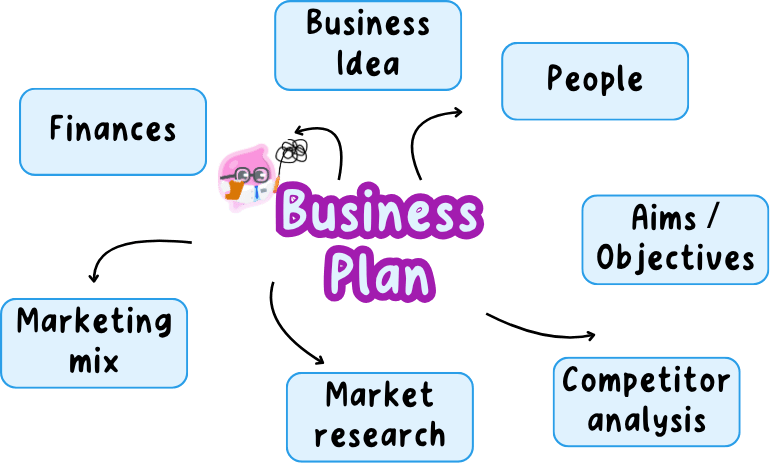
- Edexcel names eight things a business plan identifies, and each one exists to answer a question the reader would otherwise have to ask.
- The business idea: what the business will sell and how it differs from what is already available, answering why a customer would buy this rather than the thing that exists.
- Business aims and objectives: the targets the owner is working towards, such as survival through year one or a set level of sales, answering what would count as this business succeeding.
- Target market and market research: who the customers are and the survey, sales data or competitor evidence behind that claim, answering whether the demand is real or only hoped for.
- Forecast revenue, cost and profit: the sales income expected, the cost of earning it and what is left over, answering whether the idea makes money at the price the owner has chosen.
- Cash-flow forecast: the month-by-month timing of money coming in and going out, answering whether there will be enough in the bank account in month three to pay the bills.
- Sources of finance: how much start-up money is needed and where each pound comes from, answering how much of the risk the owner is carrying personally and how much a lender is being asked to carry.
- Location: where the business will trade, such as a high-street unit, a market stall or online only, answering whether customers can reach it at a rent the forecast can absorb.
- The marketing mix: the planned product, price, place and promotion decisions, answering how customers will hear about the business and be persuaded to buy.
Note
- Each of these eight has its own guide elsewhere in Theme 1, where the detail and any calculations belong.
- Here you need only what each section contains and why it earns its place in the document.
Who reads the plan: the owner and the lender
- The plan has two readers, and the same document does a different job for each.
- The owner uses it to run the business and to check it, by setting each month's actual sales and costs against the forecast and acting on any gap.
- A bank or investor uses it to decide whether to lend, reading the cash-flow forecast and the sources of finance sections hardest because those show whether repayments can be met.
- A lender is risking its own money, so weak evidence means either no loan or a loan at a higher interest rate, which raises the costs the forecast then has to cover.
Note
- Two purposes follow from all of this: a plan helps the owner minimise risk and helps the business obtain finance.
- Both are developed in the next guide, 1.4.4b.
A plan is a living document, not a one-off
- Because every figure in the plan is a forecast, real trading almost always produces different numbers, and the plan is revised to match them rather than filed away.
- Gymshark started in 2012 with Ben Francis screen-printing gym clothing in a garage in Birmingham and selling online through fitness influencers, and a plan written on that basis would need rewriting many times as the location, the costs and the customer base changed.
Exam technique
- Edexcel does not ask you to draw up a full business plan, so no marks come from reciting a template; they come from what a section contains and why its reader wants it.
- Answer in three parts: name the section, say in a phrase what is in it, then say what it tells the reader, such as the cash-flow forecast showing the timing of money in and out so the bank can see whether month three is affordable.
- Use the word forecast for every figure in a plan, because writing that the plan shows the profit the business made turns an estimate into a record and loses the mark.
- Where a question names a firm, choose the sections that matter to that firm, such as location for a shop and the marketing mix for an online seller.
Self review
- What is a business plan, and at what point is it written?
- Which section gives a reader evidence that demand for the idea actually exists?
- Give one question the cash-flow forecast answers that the forecast of profit does not.
- Name the two readers of a business plan and say what each uses it for.
- Why is a business plan revised rather than written once and kept?
