1.2.1a What customer needs are
What a customer need is: the four the specification names
Customer needs: what a buyer expects from a product or service before they will choose it and pay for it.
Value for money: the judgement a customer makes about whether what they receive is worth the price charged.
- Edexcel names four customer needs, and nearly every buying decision comes down to how one shopper weighs them against each other.
- Price: the money handed over, judged against what the product delivers, so the need is value for money rather than the lowest figure on the shelf.
- Quality: the product works, lasts as long as the buyer expected and is the same every time, so a Greggs sausage roll bought in Leeds matches one bought in Cardiff.
- Choice: the range of versions on offer, such as sizes, flavours and ways of paying, so the Greggs vegan sausage roll lets a customer who avoids meat buy at the same counter as everyone else.
- Convenience: how little time and effort the purchase costs, so a PureGym site open 24 hours with no staffed reception lets a night-shift worker train at 4am.
- Quality is judged against the price paid rather than against the best product on the market, so a £4 umbrella that survives one winter satisfies its buyer while £90 boots that split after six months do not.
How a business meets each need, and what it gives up to do it
- A need only turns into a sale when the business changes something it does, and each need points at a different action.
- Meeting price: cut the cost of supplying the product first, which is why Aldi and Lidl stock a narrower range, order far more of each item and sell own-brand goods instead of advertised brands.
- Meeting quality: better materials, trained staff and checks before the product reaches the customer, as Dyson did by building over 5,000 prototypes before its bagless vacuum cleaner went on sale.
- Meeting choice: extra sizes, flavours and price levels plus more ways to buy, so Tesco and Sainsbury's carry a wider range than the discounters and offer click and collect.
- Meeting convenience: shops sited where people already are, longer opening hours and delivery, which is what a Deliveroo customer pays a fee for rather than collecting the meal themselves.
- Every one of those actions costs money, so a business that leads on one need is normally weaker on another.
- Price against quality: heavier materials and extra checking raise the cost of each unit, so Dr Martens charges a premium for boots built to last years rather than one winter.
- Price against choice: stocking more lines means ordering less of each, so bulk discounts fall away and shelf prices drift up, which is the gap between Tesco's range and Aldi's prices.
- Why understanding these needs matters to a business, in sales and survival, is covered in 1.2.1b.
- How a business finds out which need its customers rank first is covered in 1.2.2.
Why the same product suits one customer and not another
- Every buyer wants all four needs met, so what separates customers is the order they put them in.
- A commuter buying lunch at 8am ranks convenience first and pays 60p more at a station kiosk to avoid a ten-minute queue.
- A parent doing a weekly shop for a family of five ranks price, then choice, because one trip has to feed everybody.
- A customer with a nut allergy ranks choice first, because a shop with no safe option is no use at any price.
- The same person reorders the needs from one purchase to the next, buying own-brand pasta to save 40p and still paying a premium for an Innocent smoothie.
- A business therefore aims at the customers whose ranking matches what it does best, which is how Aldi and Tesco both survive selling groceries in the same town.
- Name the need, say what the business does about it, then say what the customer gains, because the marks sit in those links rather than in the word itself.
- Rank the four needs for the customer described in the source booklet, a commuter, a parent or a trade buyer, before you start arguing.
- Do not assume every customer wants the lowest price, since many pay more for durability, range or speed.
- On a justify or evaluate question, show what meeting the need costs the business, because no firm can lead on all four at once.
- Name the four customer needs on the specification.
- What does value for money mean?
- Give two actions a business can take to meet the need for convenience.
- Explain why offering a wider choice tends to push prices up.
- Give one customer who ranks quality above price, and say why.
1.2.1b Importance of understanding customers
Generating sales: customer knowledge decides what you stock and what you charge
Repeat custom: sales made to a customer who has bought from the business before and has chosen to come back.
Word of mouth: existing customers recommending a business to friends, family or people online, which brings in new customers without the business paying for advertising.
- Customers judge a business on price, quality, choice and convenience, which are covered in 1.2.1a, so understanding your customers means knowing which of those four matters most to the particular people you sell to.
- Knowing that answer tells you what to buy in and what to charge, so a far higher share of the stock you pay for actually sells.
- The chain from customer knowledge to higher sales runs in four links.
- The right products: you stock what people came in looking for, so goods sell at full price instead of being cleared at a discount at the end of the season.
- The right price: a price set at what this group of customers will pay means a shopper who was ready to buy does not put the item back, so more visits turn into sales.
- Repeat custom: a customer who got what they wanted comes back, and you spend nothing to bring them back, so the second sale costs less to win than the first.
- Word of mouth: a satisfied customer tells other people, so new customers arrive with no advertising spend behind them.
- Sales therefore rise from two directions at once, more of the stock you already own selling and more people coming through the door, while the money spent to win each sale falls.
- Greggs sells cheap hot food on high streets and retail parks, so it lives on selling a large number of low-priced items rather than a few expensive ones.
- That model only works if almost everything on the counter sells the day it is made, which depends on knowing what the people walking past will buy.
- Its vegan sausage roll answered a want among customers who were already passing its shops, so it could sell in volume at the low prices the chain is built on.
- A product aimed at people who never come near a Greggs would have cost the same to make and sat in the warmer unsold.
Business survival: misreading customers drains the cash the business runs on
- A business survives only while cash keeps coming in fast enough to pay the bills that fall due, and customer knowledge is what decides whether the stock you paid for turns back into cash.
- Get the customer wrong and a chain starts that ends in closure.
- The cash leaves first, because you pay the supplier for stock weeks before any customer pays you for it.
- Stock nobody wants then sits on the shelf, so £8,000 of the owner's money is locked up in boxes instead of sitting in the bank.
- The next supplier invoice arrives with nothing to pay it from, so deliveries stop, the shelves thin out and the customers who were buying drift away too.
- Most new firms that fail go this way rather than because the idea itself was poor: there was a market, but the owner misjudged who would buy, how many would buy and what they would pay.
- Blockbuster rented DVDs from shops and its UK business entered administration in 2013, once customers had moved to streaming with Netflix: the want to watch a film at home never went away, only the way people wanted to get it.
- Size is no protection, since Wilko had traded since 1930 and ran around 400 shops, yet entered administration in August 2023 and had closed every one of them by October, with around 12,500 jobs lost.
- How a business actually finds out what its customers want is market research, covered in 1.2.2.
- Splitting those customers into groups so each one can be served properly is market segmentation, covered in 1.2.3.
Where the money leaks: stock, promotion and price
- Not understanding your customers costs you in three separate places, and only the first one is obvious.
- Wasted stock: goods bought in for customers who never wanted them are either sold off cheaply or thrown away, so most of the money spent buying them never comes back.
- Wasted promotion: a leaflet drop to retired households for a product aimed at students is paid for in full and brings in nobody, so the whole cost is lost.
- The wrong price: pricing above what customers will pay leaves the shelves full and the till quiet while rent and wages still go out, and pricing below it, charging £3 where they would happily have paid £4, hands over £1 on every unit sold and hides itself because the stock still sells.
- Run the chain in full: the owner knows customers want a quick takeaway coffee, so she stocks cups and a fast till rather than table service, so more of the morning queue buys, so revenue rises.
- The link dropped most often is the last one, because answers stop at "customers are happy" and never reach sales, cash or survival.
- If the question asks about survival, take the chain through cash: unsold stock, unpaid supplier, no deliveries, closure.
- Name the customers described in the source booklet rather than writing about "customers" in general, because the application mark depends on that context.
- Define repeat custom.
- Why does word of mouth raise sales without raising costs?
- Give the chain that links misreading customers to a business closing.
- Name the three places where money leaks when a business does not understand its customers.
- Why is pricing below what customers would have paid still a mistake?
1.2.2a The purpose of market research
Understanding customer needs: what buyers want, not what you assume
Market research: gathering and analysing information about customers, competitors and the wider market so that business decisions rest on evidence.
- A business that guesses what people want is betting its start-up money on one person's opinion, and research replaces that opinion with what real buyers say and do.
- Identify and understand customer needs: research shows which features buyers care about, the quality they expect and the price they are ready to pay.
- A clothing start-up that questions 100 shoppers may find that fit and delivery speed matter more than a printed logo, so it spends its budget on sizing and postage instead of branding.
- Building the product around what customers actually said means a larger share of each batch sells at full price, so less stock is marked down and cash returns to the business sooner.
- Greggs sells cheap hot food on high streets and in retail parks, so it lives or dies on knowing what a lunchtime customer will pay for.
- As shoppers moved towards meat-free food, Greggs launched a vegan sausage roll into that demand rather than assuming its existing range still fitted.
- The need, a quick hot lunch, had not changed, but what customers wanted inside the pastry had.
Gaps in the market: a group of customers nobody is serving well
Gap in the market: a customer need that no business is currently meeting well, leaving room for a new product, price or location.
- Identify gaps in the market: research looks for what people say they cannot get and for what rivals do not sell, because a gap is a group of customers rather than a missing object.
- A town whose three coffee shops all close at 4pm has a gap if the local shift workers finish at 6pm and want somewhere warm to sit.
- A business that fills a gap faces little direct competition at first, so it can charge a higher price and build a loyal customer base before larger firms copy the idea.
- PureGym opened budget 24-hour gyms with no staffed reception and a low monthly membership.
- The customers it picked up were people who trained at odd hours and would not pay full-service gym prices.
- The gap sat in the opening hours and the price, not in the equipment, which is much the same as in any other gym.
Reducing risk: evidence before the money is committed
- Reduce risk: research tests whether enough people will buy at your price while the money for a lease, a fit-out and a first order of stock can still be held back.
- Order 500 units when the evidence pointed to 150 and the other 350 sit unsold, tying up cash the business still needs for rent and wages.
- Research is cheap next to the loss it prevents, so £400 spent questioning shoppers is money well spent if it stops a £20,000 launch nobody wanted.
- Research lowers the chance of failure without removing it, because a sample can be small, out of date or full of people who say one thing and then buy another.
- How the information is actually collected, through primary and secondary methods, is covered in 1.2.2b.
- Whether data is qualitative or quantitative, and how far it can be trusted, is covered in 1.2.2c.
Informing decisions: product, price, place and promotion
- Inform business decisions: the findings feed straight into four choices that are expensive to reverse once they are made.
- What to sell: which sizes, flavours or features to stock, and which slow-selling lines to drop.
- What to charge: the price customers accept before they walk to the shop next door, which is why Aldi and Lidl watch rivals' prices so closely on their narrower range.
- Where to locate: which town, which end of the high street, or whether to sell online rather than rent a unit at all.
- How to promote: which channel reaches the buyers the research found, such as social media for an audience of 16 to 24 year olds.
- Getting these four right first time saves the cost of moving premises, reprinting packaging or cutting a price that was set too high, so more of the start-up budget survives to fund trading.
- A define question wants the words gathering information about customers and the market, so learn that phrasing.
- On explain questions name the purpose, then the mechanism, then the effect: research finds the price customers accept, so fewer items are marked down, so profit is protected.
- Write that research reduces the risk of failure, never that it guarantees success, because the stronger claim is not credited.
- Tie the purpose to the business in the source, since a purpose stated in general terms stays at the lowest level.
- What is market research?
- What is a gap in the market?
- Give one way research reduces the risk of a failed product launch.
- Name the four business decisions that market research informs.
- Why can market research never remove risk completely?
1.2.2b Methods of market research
Primary and secondary research: collect it yourself or use what already exists
Primary research: new information you gather first hand yourself, for the exact decision your business is trying to make.
Secondary research: information that already exists because somebody else collected and published it for their own purposes.
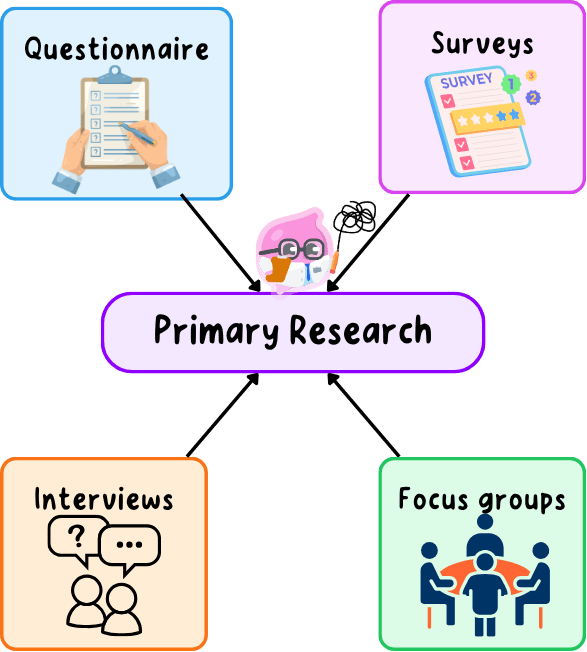
- Every method falls into one of these two groups, and the test is simple: if the information existed before you went looking for it, it is secondary, and if you had to create it, it is primary.
- Primary research is also called field research and secondary research is called desk research, because one sends you out into the market and the other can be done at a laptop from work somebody else has already paid for.
The four primary methods: survey, questionnaire, focus group and observation
- Edexcel names four primary methods, and each one buys you a different kind of answer at a different cost.
- Survey: asking a sample of people a fixed set of questions in the street, by phone or online, though the people willing to stop and answer may not be the people who buy, and a poor response can leave you deciding on 12 replies instead of 200.
- Questionnaire: the written or online list of questions a survey uses, cheap to print or email to a customer list, though the wording steers the answer, since "would you like cheaper delivery?" collects a yes from everybody and tells you nothing about what people would pay.
- Focus group: roughly six to ten customers brought together with a leader to talk through a product, a price or a design, which explains the reasons behind an opinion, though an agency session can cost several hundred pounds and one confident member can pull the whole room towards their view.
- Observation: watching and recording what customers actually do, such as counting footfall past a possible site or noting which shelf shoppers reach for first, though it captures the action and never the reason, so you learn that 390 people walked past and nothing about why they did not come in.
- Taken as a group, primary research is specific, current and exclusive, because you write the questions around this decision, collect the answers this month and own data no competitor can read.
- The same fact makes it slow and expensive, since gathering 200 responses takes weeks and an agency charges for its time while a do-it-yourself survey costs you selling hours, and it is open to bias whenever a leading question or a tiny sample pushes people towards the answer you were hoping for.
- Greggs sells cheap hot food in high volume from high streets and retail parks, and one of its best known launches was a vegan sausage roll.
- An independent bakery in Leeds wondering whether to copy the idea starts by observing the street from 7am to 9am and counts 260 office workers passing before it opens.
- It then leaves a five-question questionnaire by the till asking 200 regulars whether they would swap a £2 meat pasty for a £2.30 vegan one.
- The count proves the trade walks past the door and the questionnaire fixes the price the owner can charge.
The three secondary sources: the internet, market reports and government reports
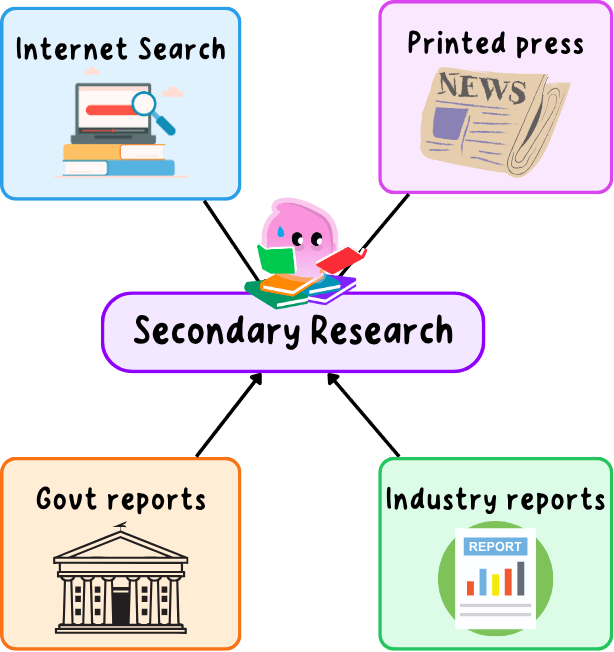
- Secondary research means using work somebody else has already done, and the specification names three sources.
- The internet: search results, competitors' websites, online reviews and trade press, which show you what rivals charge and stock within minutes, though a web page often carries no date, so the figure you copy down may describe a different year or a different part of the country.
- Market reports: paid studies produced by market research companies, setting out how big a market is, how fast it is growing and who the main sellers are, though one report can cost several hundred pounds, a large share of a start-up's budget.
- Government reports: free official statistics on population, ages, incomes and household spending, plus the annual accounts every limited company files at Companies House, though they are gathered for national planning and appear months after collection.
- Taken as a group, secondary research is fast, cheap and wide-ranging, because the data already exists, most of it costs nothing, and a national study covers tens of thousands of households that no small firm could ever reach.
- Its drawbacks all follow from being gathered for somebody else: it is not specific to your business, because a report on the whole UK coffee market never says whether your high street would pay 40p more for oat milk, it may be out of date by the time you read it, and every rival can buy the same copy, so acting on it alone walks you into the gap your competitors are already filling.
Judging which a small business with a limited budget should use
- Start with free or cheap secondary research to understand the market and narrow the decision before spending money collecting new data.
- Use targeted primary research when the decision depends on something published sources cannot answer, such as whether this business's own customers would buy a particular product at a particular price.
- Overall, the best balance depends on budget, how specific the question is and how quickly the answer is needed; small firms often combine secondary research first with a small amount of focused primary research.
- Name the method precisely and keep primary and secondary sources in the correct category.
- Explain what that method would tell this business and which decision the owner could make from it.
- Match the method to the budget and context; for a judgement, weigh it against a realistic alternative and reach a verdict.
- Define primary research and secondary research in one sentence each.
- Which primary method tells you what customers do rather than what they say?
- Give the main weakness of a focus group and of a questionnaire.
- Name the three secondary sources in the specification and say which is free.
- Why does a market report give a business no advantage over its rivals?
1.2.2c The use of data in market research
Quantitative and qualitative data: the size of a problem and its cause
Quantitative data: information in the form of numbers, such as how many people bought, how much they spent, or what percentage would pay more.
Qualitative data: information in the form of opinions and reasons, such as why customers think the packaging looks cheap.
- Quantitative data measures how big something is, so it can be counted, averaged and plotted on a chart to compare with last year.
- Qualitative data explains why the number looks as it does, because it records the reason behind a customer's choice.
- A survey of 200 shoppers might find that 60 per cent would not pay £4 for a sandwich, while the written comments say the filling looks thin for the price.
- The percentage tells the owner the lost sales are large enough to act on and the comments tell them the fix is more filling rather than a lower price, which is why a business normally collects both.
Social media: free, fast feedback from a very large group
- Social media gives a business continuous feedback at no cost, because customers post their reactions without being asked, and it arrives in three usable forms.
- Comments and reviews: qualitative data on what buyers liked or disliked, including what they post on a rival's page.
- Polls and question boxes: quantitative data, such as how many of 400 followers prefer one flavour to another.
- Follower counts and engagement: a rough measure of how much interest an idea attracts and which posts hold attention.
- Speed is the real gain, because a poll can return several hundred answers overnight and lets an owner test a design before committing money to stock.
- The weakness is the sample, since the people who follow a page and bother to post are usually already loyal, younger than the market as a whole, or annoyed enough to type.
- Negative voices are louder than positive ones, so an owner reading the comments can treat a fault that affects a handful of buyers as though it affects everyone.
- Follower numbers are not sales, because following costs nothing while buying does not, and a page with 10,000 followers can still take very few orders.
- Gymshark was started in 2012 by Ben Francis, screen-printing gym clothing in a garage in Birmingham.
- It grew by selling online through fitness influencers, whose followers commented on and shared each new product.
- Those comments showed which designs the target buyers wanted before the business paid for a large production run.
- Its followers were young gym-goers, which is exactly who Gymshark sells to, so its social media data matched its market more closely than most.
Reliability: whether a finding is safe to act on
Sample: the group of people questioned in a piece of research, chosen to stand for all of the business's target customers.
- Size and fit: 30 replies in a town of 20,000 people can be a fluke, and even 500 replies mislead if none of them come from the customers the business is targeting.
- How recent it is: figures collected before a rival opened describe a market that has gone, so an old percentage can point the owner at the wrong price.
- Wording and source: "Would you agree our prices are fair?" pushes the answer the owner wants to hear, and a supplier's own leaflet has a reason to flatter its product where a government statistic has none.
- Weak data costs cash, because an owner who orders 500 units on the strength of 30 friendly replies pays for stock that does not sell and ties up money needed for rent and wages.
Judging whether a small business should rely on social media data
- Social media is fast and cheap, which makes it useful for a cash-limited start-up, but its followers may not represent the wider target market.
- The more expensive or difficult a decision is to reverse, the less sensible it is to rely on social media data alone.
- Overall, social media can narrow options quickly, but major decisions should be checked with research that better represents the target customers.
- Build the chain in three links: name what the data shows, say why that matters to the customer, then say what the business does differently as a result.
- Quote the actual figure or comment from the source booklet, because the application marks are gated on that context.
- When a question involves social media data, name the specific weakness, meaning who is missing from the sample, rather than writing that it may be biased.
- On justify and evaluate questions, judge how reliable the data is before you judge the decision, since that is where the evaluation mark sits.
- What is the difference between quantitative and qualitative data?
- Give two forms of market research data a business can collect from social media.
- Why do follower numbers overstate how many customers a business has?
- State three things that make market research data unreliable.
- What is a sample?
1.2.3a Identifying market segments
Market segments: one market, several groups of customers
Market segment: a group of customers inside a market who share characteristics and want similar things from the same type of product.
Target market: the segment or segments a business chooses to sell to and builds its product, price, promotion and place around.
- A market is rarely one single group, because people buying the same type of product want different things from it.
- Splitting the market into segments lets a business choose a target market and shape its offer around that group instead of guessing at an average customer.
The five bases: ways to split a market
- Edexcel names five bases you can use to divide a market, and each one describes the customers rather than the products.
- Location: grouping customers by where they live or work, which is why Greggs puts shops on high streets, in retail parks and near stations where people already walk past at lunchtime.
- Demographics: grouping customers by measurable personal facts such as gender, family size or occupation, which is why Tesco stocks family multipacks next to single portions.
- Lifestyle: grouping customers by how they spend their time and what they value, which is why Greggs launched a vegan sausage roll for shoppers cutting down on meat.
- Income: grouping customers by how much they have to spend, which is why Aldi and Lidl compete on price with a narrower range while Dyson sells on design and engineering at a premium.
- Age: grouping customers into bands such as children, teenagers, young adults and the over-60s, which is why Gymshark sells through fitness influencers on the social media young adults use.
- Most businesses use two or three bases at once, so Gymshark targets young adults (age) who train regularly (lifestyle) and buy online.
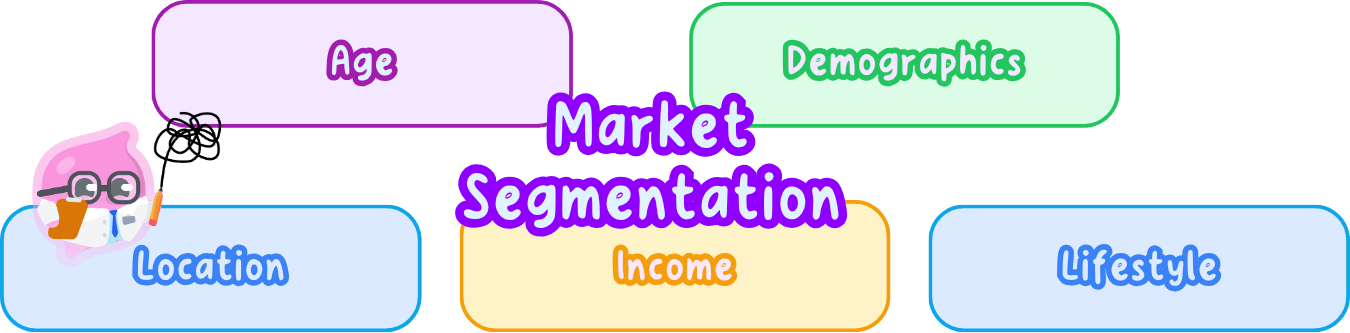
This diagram illustrates market segmentation generally. For GCSE Edexcel, use the five bases in this article: location, demographics, lifestyle, income and age.
- The UK grocery market is served by several segments at the same time.
- Aldi and Lidl aim at shoppers who put price first, with low prices and a narrower product range.
- Tesco and Sainsbury's carry a wider range and offer click and collect for shoppers who value choice and convenience more than the lowest price.
- Both models work because each is built around one group rather than trying to please every shopper.
Why a business segments: targeting one group with every decision
- Knowing exactly who the customer is lets the business aim all four marketing decisions at the same people.
- Product: the business designs for one group's needs instead of compromising for everyone, so the product fits those customers better and more of them buy it.
- Promotion: the segment tells the business where those customers look, so the advert goes on that channel and less of the budget is spent reaching people who will never buy.
- Price: the segment's income shows what it will accept, so PureGym sets a low monthly membership for price-sensitive members while Dr Martens charges a premium to buyers who want boots that last.
- Place: the segment decides the channel, so a brand aimed at students sells through an app and a brand aimed at commuters takes a unit near the station.
- Because all four decisions pull in the same direction, a higher share of the people who see the product actually buy it, which raises revenue without raising the marketing spend.
- That focus is how a new firm competes with a large rival, by serving one group better than a business trying to serve the whole market can.
- Once the segments are named, a business can plot them on a chart to see which groups nobody is serving well.
- That technique is market mapping, and the next guide covers it.
The limits: segment size and the customers you give up
- A segment is only worth serving if enough people are in it, because designing a separate product and running separate advertising costs the same whether ten customers buy or ten thousand.
- A bakery in Leeds selling only gluten-free birthday cakes might take too few orders a week to cover its rent, so it keeps a standard range alongside.
- Targeting one segment also means giving up sales to others, because the choices that attract one group put another off.
- PureGym wins price-sensitive members by having no staffed reception, and loses the members who want classes, a pool and someone on the desk.
- Depending on one segment concentrates risk, so if that group's spending falls the business has no other customers to fall back on.
- Name the base and describe the group, for example "by income, targeting shoppers on a tight budget", because a bare base name earns nothing.
- A segment is always a group of customers, never the product sold to them, so "our segment is trainers" loses the mark.
- Read the price, the packaging and the place of sale in the source booklet, since those details tell you which segment the firm has chosen.
- Carry the point through to the business: the segment is known, so promotion goes where those customers look, so less of the budget is wasted and more of the spend turns into sales.
- What is a market segment?
- Name the five bases of segmentation in the specification.
- Give one example of a UK business targeting a lifestyle segment.
- Explain how knowing the target market cuts wasted promotion spending.
- State one reason a segment might not be worth serving.
1.2.3b Market mapping
What a market map is: two axes and one dot for every rival
Market map: a grid that plots the products in a market against two features customers care about, one feature on each axis, also called a positioning map.
- A market map is a grid: one feature runs left to right along the horizontal axis, a second runs bottom to top along the vertical axis, and a line drawn through the middle of each splits the grid into four quarters.
- Each axis needs an opposite at either end, so that any product can be placed somewhere between them.
- Price: low price at the left-hand end of the horizontal axis, high price at the right-hand end.
- Quality: basic at the bottom of the vertical axis, premium at the top.
- Any other pair customers care about: traditional against modern, plain against heavily branded, or narrow range against wide range.
- You then mark each competing product as a labelled dot, placed by where customers think it sits on those two features, not by where the owner would like it to sit.
- Map the UK supermarkets with price from low on the left to high on the right, and product range from narrow at the bottom to wide at the top.
- Aldi and Lidl sit low and near the bottom, because they compete on price with a narrower range.
- Tesco and Sainsbury's sit further right and near the top, with higher prices, a wider range and click and collect.
- The two pairs land in different quarters, so they are chasing shoppers who want different things rather than fighting over the same one.
Reading the map: clusters show competition, empty space suggests a gap
Gap in the market: a position on the map where customers might want a product but no competitor is currently selling one.
- A cluster, meaning several dots bunched close together, marks the part of the market where competition is fiercest.
- Launching into a cluster means taking customers away from rivals those customers already know, which usually forces a lower price or heavier spending on promotion, so the profit on each sale is squeezed.
- An empty space is a possible gap in the market, because no product on the grid currently offers that combination of the two features.
- A business that moves into an empty space has no direct rival beside it, so it can set its own price rather than match one, and it becomes the obvious choice for anyone who wants that combination.
What a business does with the map
- The finished map supports three decisions.
- Position a new product: aim the price, packaging and promotion at an empty space, so the product is different from the day it launches rather than a copy of something already selling.
- Identify who the real rivals are: the nearest dots are the firms competing for the same customers, which is often a shorter list than every business in the industry.
- Check its own dot: a business sitting on top of a larger competitor is fighting a firm with a better-known name and deeper pockets, so it may reposition to a quieter part of the grid.
- PureGym sits at low monthly membership with 24-hour access and no staffed reception, which keeps it clear of gyms selling on service and facilities, so it wins members on price instead of competing on something rivals already do better.
- A map shows where a rival sits, not how strong it is.
- Judging what competitors do well and badly is covered in 1.2.4a.
Limits of the map: an empty space is a question, not an answer
- A space may be empty because nobody wants that combination, which is why high price with basic quality is bare on almost every map ever drawn.
- The grid shows only the two features you chose, so a product that wins on service, delivery speed or brand image can look identical to a rival on your axes while feeling completely different to a shopper.
- Where you plot a rival is partly opinion, because words such as premium have no measurement, so two people mapping the same market can produce two different maps.
- The map carries no numbers, so a gap has to be tested with market research before any money is spent, because the grid cannot tell you how many customers sit in that space or what they would pay.
- Name the two features on the axes before you comment on anything, because the application marks depend on using that market's axes rather than a memorised price against quality map.
- If the paper prints a map, quote real positions and name the brands, for example that three rivals cluster at low price.
- Carry the chain through: name the gap, say what product would fill it, then say why customers in that space would buy it.
- Where the question asks whether the business should fill the gap, add that the space may be empty because demand there is too small, and recommend market research first.
- What do the two axes on a market map show?
- Define a gap in the market.
- What does a cluster of brands tell you about competition in that part of the market?
- Give two reasons why an empty space on a map might not be worth filling.
- Why can two people mapping the same market end up with different maps?
1.2.4a Strengths and weaknesses of competitors
The five things customers compare: each one cuts both ways
Competitive environment: the set of rival businesses selling to the same customers, and how strong each of them is.
Competitor: another business selling something your customers could buy instead of yours.
- A rival is strong or weak only on the things its customers actually notice, and Edexcel names five of them.
- Each of the five can be a strength or a weakness depending on the rival you hold it against, so never label a feature good or bad on its own.
- Price: a low price pulls price-sensitive shoppers away from a rival, but it signals lower quality to some buyers and leaves a thin margin on every sale.
- Quality: high quality supports a higher price and brings customers back, but better materials and skilled staff cost more, and the price that follows narrows the product to buyers who can afford it.
- Location: a unit on a busy high street brings passing trade the rival never has to advertise for, but the rent can be several times that of a side street, so those extra sales have to cover it.
- Product range: a wide range suits more types of customer but ties up cash in stock that may not sell, while a narrow range is cheaper to hold and sends some customers elsewhere.
- Customer service: staff who know the product and remember regulars build loyalty, but they have to be trained and paid enough to stay, which raises costs every week.
- Which of the five decides the sale depends on the customer, so a shopper on a tight budget forgives a narrow range while a shopper buying a gift will not forgive slow service.
- Aldi and Lidl compete on price with a narrower product range than Tesco or Sainsbury's.
- For a shopper doing a weekly budget shop, the low price is the strength and the narrow range barely registers.
- For a shopper hunting one unusual ingredient, that same narrow range is the weakness, and they go to Tesco, which carries more lines and offers click and collect.
- The feature has not changed, only the customer and the rival it is judged against.
Finding out about a rival: four sources a small business can actually use
- Guesswork about a rival is worth nothing in an exam answer or in a real business, so gather evidence from four places.
- Visit the rival: go in as a customer and record how busy it is, how long the queue takes and how the staff deal with you.
- Check its prices and its website: write down what it charges for the products you also sell, then read the site for opening hours, delivery times and the full range it lists.
- Read its online reviews: reviews name the weakness in the customer's own words, such as cold food or empty shelves, which is exactly what the rival will never advertise.
- Listen to your own customers: people who have used both will tell you why they came to you this time, and why they sometimes do not.
- All four are cheap or free, but each is partial, because one visit shows one day and online reviews are written mostly by the very pleased and the very annoyed.
Why it matters: where you can win and where not to fight
- A rival's weakness is a gap you can fill, because the customers it disappoints are already nearby and already spending money on this type of product.
- A new sandwich shop opening near Greggs cannot win on price, because Greggs sells cheap hot food in high volume and buys its ingredients far more cheaply, so matching those prices would leave almost nothing on each sale.
- The same shop can win on what Greggs does not offer, such as fillings made to order and staff who know the regulars, so a weakness in the rival becomes the reason a customer walks past it.
- Knowing where a rival is strong is worth as much as knowing where it is weak, because it tells you which fight would cost more than it could ever earn back.
- Strengths and weaknesses shift as rivals react, so a judgement made a year ago can point you at a gap that has already closed.
- Name the base, say whether the rival is stronger or weaker on it, then give the consequence for the business in the source booklet.
- Listing the five bases with no verdict on any of them stays at Level 1.
- Quote the evidence you are given, such as the rival charging £3.20 against your £3.80, rather than writing that it is cheap.
- On a justify or evaluate question, say which of the five matters most to that firm's customers, because the judgement mark sits there.
- Name the five bases used to judge a competitor's strengths and weaknesses.
- Give two drawbacks of a rival charging a very low price.
- Why can a wide product range be a weakness?
- Name two places a small business can find information about a rival.
- Why is knowing a rival's strength useful, and not just its weakness?
1.2.4b Impact of competition on decision making
Competition as an external influence: a rival's move forces a response
Competition: rivalry between businesses selling similar products to the same group of customers.
Competitive advantage: the reason a customer chooses one business over the rivals available to them.
- Competition is an external influence, so a rival can cut its price, open a shop two streets away or launch a better product whether you want it to or not.
- A rival's move reaches your profit along a chain, because customers start switching, so you change your price, hours, product or service to hold on to them.
- Every response costs money, in wages, printing or revenue given away on each sale, so competition decides what you can afford as well as what you sell.
- Aldi and Lidl compete on price and carry a narrower product range.
- Tesco and Sainsbury's answered with a much wider range and click and collect rather than by copying the discounters.
- A shopper choosing on price goes one way and a shopper choosing on choice and convenience goes the other.
- Each chain has aimed its response at what the other is weakest at.
Competing on price: the quickest response and the hardest to win
Price war: a run of price cuts between rivals in which each cut is answered by another.
- Matching the rival's price removes the customer's reason to switch and takes nothing more than a new price list, which is why it is the quickest response available.
- Undercutting goes further by pricing below the rival to pull in bargain hunters, and it is just as easy for the rival to answer within days.
- Cutting the price leaves less on every sale to cover the rent and the wages, so the shop needs noticeably more customers each week just to stand still.
- Those extra customers are the least likely thing to arrive, because the price was cut precisely because customers had started to leave.
- A price cut therefore forces a second decision, on costs, which helps when it strips out waste such as buying supplies in larger quantities and hurts when it strips out the reason customers came.
- Cutting the price is the response easiest to reach for and usually the worst one for a small firm.
- A national chain buys in far larger quantities, so its cost per unit is already lower before the price war starts.
- It can also carry a thin margin in one shop out of the profits of hundreds of others.
- A single outlet has neither cushion, so it runs out of cash first even though both sides are losing money.
- Write it as a chain: the chain can hold a low price for longer, therefore it wins the price war, therefore the small firm should fight somewhere else.
Competing without touching the price: product, promotion, place and service
- Every response that leaves the price alone works by making comparison harder, and each one carries a catch.
- Product and quality: add a feature the rival cannot supply, as Dyson does by selling bagless vacuum cleaners on design and engineering at a premium price, although over 5,000 prototypes came before there was anything to sell.
- Promotion: buy attention through social media, local sponsorship or a stall at a school fair, as Gymshark did by selling online through fitness influencers, although a rival copies an offer within a week and the spending then buys nothing lasting.
- Place: sell where you meet fewer rivals per customer, on an estate the chain has not reached or online through a marketplace such as Etsy, although a quieter pitch brings fewer passers-by and a website puts you in front of every other online seller.
- Customer service: know customers by name, take special orders and settle a complaint without an argument, which costs wages and training but is the hardest response for a chain with high staff turnover to copy.
Judging the response: fight on price or fight on difference
- Competing on price can protect sales quickly, but it is only sustainable when the business has lower costs or enough cash to survive the thinner margin.
- Competing through product, service, promotion or place protects more margin and can be harder to copy, but the spending comes before the result.
- Overall, a small firm facing a large chain is usually better competing on a difference the chain cannot easily copy unless it has a genuine cost advantage.
- Trace the chain from the rival's action to the customer effect, the business response and the impact on profit.
- Use the source-booklet business and include the cost or drawback of the response.
- For a judgement, compare a price response with a non-price response and commit to the better fit.
- Why is competition treated as an external influence?
- Give one reason matching a rival's price is the quickest response a business can make.
- Why does a shop that cuts its price need more customers than before just to stand still?
- Give one benefit and one catch of responding to a rival through promotion.
- Name two things the best response to a strong rival depends on.
