Skimming and penetration: two opposite ways to price a launch
Definition
Pricing strategy: the approach a business takes to deciding what to charge, rather than the price itself.
Mark-up: the amount added on top of what a unit costs the business to make, which becomes the profit on that sale.
- Price skimming launches the product high and then steps the price down in stages, taking the largest profit per unit from the buyers who are least willing to wait.
- Use it when the product is genuinely new, because the first buyers have nothing to compare it with and judge the price against how much they want it, which is how a games console can sell at £999 and then £599 a year later.
- The risk is that a fat margin advertises the market, so rivals copy the product, the business is forced to cut faster than planned, and the early customers who paid full price feel overcharged.
- Price penetration launches below the going rate to buy customers quickly, then lifts the price once people are in the habit of buying and switching feels like effort.
- Use it when rivals are already established, because a new name gives a shopper no reason to move unless the price does, and volume is what makes a fixed cost such as rent affordable per unit.
- The risk is that the low price has to be paid for, so start-up costs are recovered slowly, and customers recruited by cheapness are the first to leave when the price rises.
Common Mistake
- Both are decisions about a launch, so the test is which way the price will move afterwards, not whether it looks high or low today.
- Skimming only works where the product is new or hard to copy, so recommending it for an ordinary product with close rivals throws away the application mark.
- A price that starts low and stays low is not penetration, it is a permanent low-price, high-volume position, which is how Greggs sells cheap hot food.
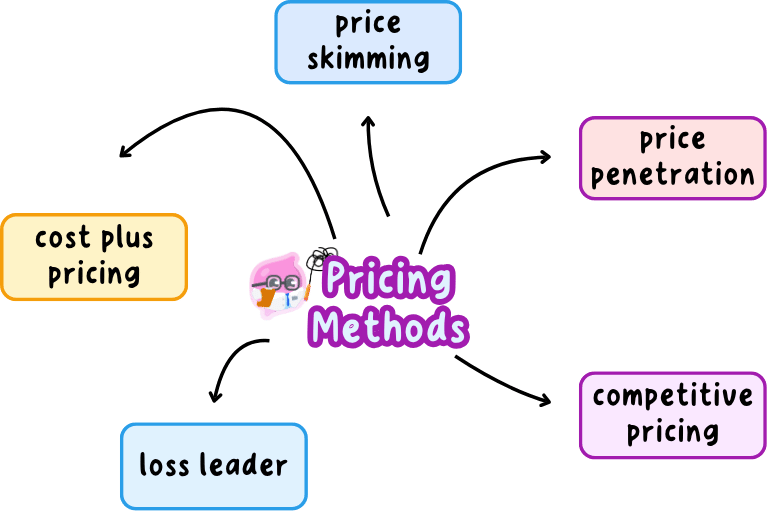
Pricing from costs, from rivals and from the shopper's head
- Cost-plus pricing builds the price from the inside out: work out what one unit costs to make, add a set mark-up, and that sum is the price.
- It suits a business whose unit cost is easy to pin down, such as a bakery costing flour, labour and packaging per loaf, or a plumber quoting a job before starting it.
- The risk is that nobody outside the business is consulted, so the price can land above what shoppers will pay and sales stall, or below what they would have paid and profit is given away for nothing.
- Competitive pricing starts from the going rate and holds the price level with it, which keeps a business in the running where two products are near enough identical that a shopper will switch over pennies.
- The risk is that rivals now set your margin, so when Aldi or Lidl cut a headline line, Tesco either follows and earns less per item or holds firm and loses the trolley, and the business has to defend itself on range, service or convenience instead.
- Loss leader pricing sells one line below what it cost the business, accepting the loss because the shopper who came in for that line fills the rest of the basket at a normal margin.
- The risk is the cherry-picker who buys the cheap line and nothing else, so it works only where one item alone is not worth the trip, which is why a supermarket can run it on milk and a single-product market stall cannot run it at all.
- Psychological pricing stops the price just short of a round number so the shopper anchors on the first figure, and £9.99 is filed away as nine pounds rather than ten.
- The risk is that the gain is thin and the trick is well known, so it shifts a decision only where prices are scanned quickly, and a clean rounded price signals quality better on a premium product such as a pair of Dr Martens boots.
Example
- A new gym opening in Leeds charges £9.99 a month while nearby clubs charge £24, filling the floor before lifting the fee to £16.99.
- That is penetration, because the low price is temporary and its job is to build a membership base fast.
- The same £9.99 figure is also psychological pricing, so one price can serve two strategies at once.
- Say which purpose you mean, because the strategy is the intention behind the price, not the digits on the label.
The six strategies side by side
This table sets each strategy against what it means and the situation it is built for.
| Strategy | What it means | When it is used |
|---|---|---|
| Cost-plus | Add a fixed mark-up to the cost of making the product | When the business must be sure each sale covers its costs |
| Price skimming | Launch high, then lower the price over time | New technology with early adopters willing to pay |
| Price penetration | Launch low to win customers, then raise the price | Entering a market with established rivals |
| Competitive pricing | Set the price at or near what rivals charge | Crowded markets where products are similar |
| Loss leader | Sell one product below cost to draw customers in | Supermarkets, where shoppers buy other items too |
| Psychological pricing | Set the price just below a round number, such as £9.99 | Retail, where the price looks smaller than it is |
- Skimming and penetration are the only two rows that describe a launch, and they answer the same question in opposite directions, so a scenario about a new product is usually asking you to pick between those two and defend the choice.
- Cost-plus is the safest row and the least responsive, because it is the only one that never looks at a rival or a customer, so a business using it can be the last to discover that shoppers would happily have paid more.
- The loss leader row depends entirely on what else is bought, so it is a strategy about the whole basket rather than the product, and it collapses the moment customers can take the bargain and leave.
- What decides which row a particular business picks, including its costs, its rivals and where the product sits in its life cycle, is the subject of the next guide.
Exam technique
- Name the strategy and then say which way the price moves over time, since "a low price" on its own does not identify penetration.
- When the command word is explain, run the chain: the strategy, why it fits this market, and what it does to revenue, market share or profit per unit.
- Apply it to the business in the source booklet, because the same strategy is right for a firm with a patented product and wrong for one selling what everybody else sells.
- When the command word is justify or evaluate, name the strategy you rejected and say why it would work less well here.
Self review
- Which two strategies are launch decisions, and which way does each move the price afterwards?
- State the main risk of price skimming.
- How does cost-plus pricing arrive at a selling price?
- Why can a supermarket use a loss leader when a single-product stall cannot?
- Give one reason a business might choose £10.00 over £9.99.
