Primary and secondary research: collect it yourself or use what already exists
Definition
Primary research: new information you gather first hand yourself, for the exact decision your business is trying to make.
Secondary research: information that already exists because somebody else collected and published it for their own purposes.
- Every method falls into one of these two groups, and the test is simple: if the information existed before you went looking for it, it is secondary, and if you had to create it, it is primary.
- Primary research is also called field research and secondary research is called desk research, because one sends you out into the market and the other can be done at a laptop from work somebody else has already paid for.
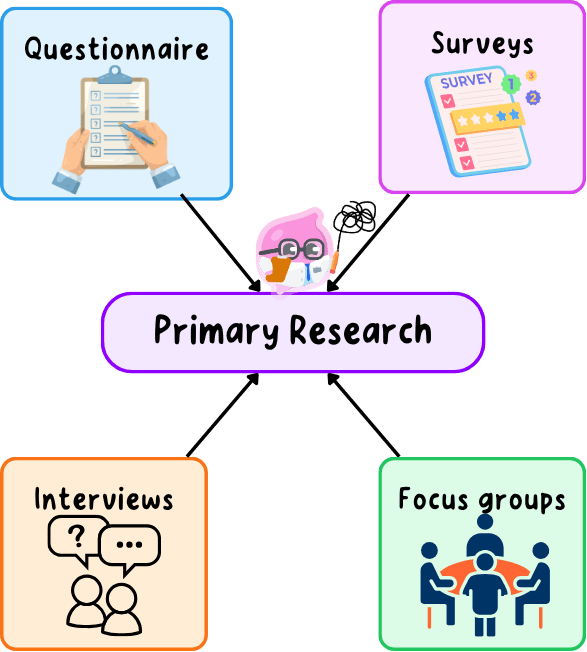
The four primary methods: survey, questionnaire, focus group and observation
- Edexcel names four primary methods, and each one buys you a different kind of answer at a different cost.
- Survey: asking a sample of people a fixed set of questions in the street, by phone or online, though the people willing to stop and answer may not be the people who buy, and a poor response can leave you deciding on 12 replies instead of 200.
- Questionnaire: the written or online list of questions a survey uses, cheap to print or email to a customer list, though the wording steers the answer, since "would you like cheaper delivery?" collects a yes from everybody and tells you nothing about what people would pay.
- Focus group: roughly six to ten customers brought together with a leader to talk through a product, a price or a design, which explains the reasons behind an opinion, though an agency session can cost several hundred pounds and one confident member can pull the whole room towards their view.
- Observation: watching and recording what customers actually do, such as counting footfall past a possible site or noting which shelf shoppers reach for first, though it captures the action and never the reason, so you learn that 390 people walked past and nothing about why they did not come in.
- Taken as a group, primary research is specific, current and exclusive, because you write the questions around this decision, collect the answers this month and own data no competitor can read.
- The same fact makes it slow and expensive, since gathering 200 responses takes weeks and an agency charges for its time while a do-it-yourself survey costs you selling hours, and it is open to bias whenever a leading question or a tiny sample pushes people towards the answer you were hoping for.
Example
- Greggs sells cheap hot food in high volume from high streets and retail parks, and one of its best known launches was a vegan sausage roll.
- An independent bakery in Leeds wondering whether to copy the idea starts by observing the street from 7am to 9am and counts 260 office workers passing before it opens.
- It then leaves a five-question questionnaire by the till asking 200 regulars whether they would swap a £2 meat pasty for a £2.30 vegan one.
- The count proves the trade walks past the door and the questionnaire fixes the price the owner can charge.
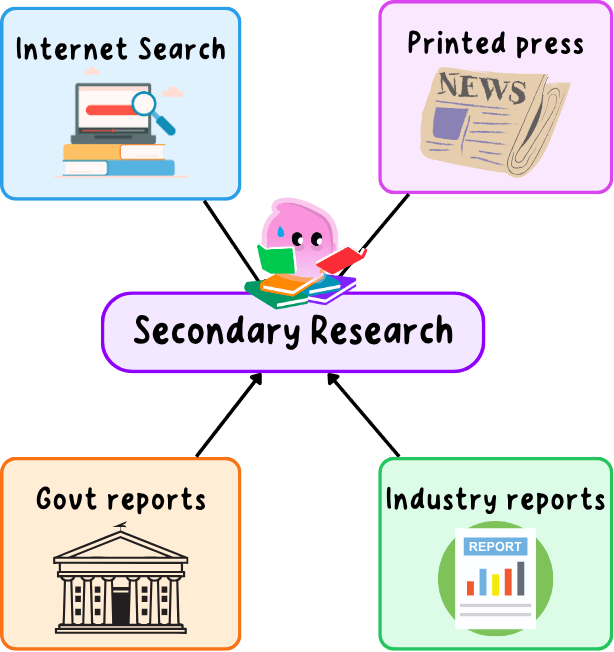
The three secondary sources: the internet, market reports and government reports
- Secondary research means using work somebody else has already done, and the specification names three sources.
- The internet: search results, competitors' websites, online reviews and trade press, which show you what rivals charge and stock within minutes, though a web page often carries no date, so the figure you copy down may describe a different year or a different part of the country.
- Market reports: paid studies produced by market research companies, setting out how big a market is, how fast it is growing and who the main sellers are, though one report can cost several hundred pounds, a large share of a start-up's budget.
- Government reports: free official statistics on population, ages, incomes and household spending, plus the annual accounts every limited company files at Companies House, though they are gathered for national planning and appear months after collection.
- Taken as a group, secondary research is fast, cheap and wide-ranging, because the data already exists, most of it costs nothing, and a national study covers tens of thousands of households that no small firm could ever reach.
- Its drawbacks all follow from being gathered for somebody else: it is not specific to your business, because a report on the whole UK coffee market never says whether your high street would pay 40p more for oat milk, it may be out of date by the time you read it, and every rival can buy the same copy, so acting on it alone walks you into the gap your competitors are already filling.
Judging which a small business with a limited budget should use
- Start with free or cheap secondary research to understand the market and narrow the decision before spending money collecting new data.
- Use targeted primary research when the decision depends on something published sources cannot answer, such as whether this business's own customers would buy a particular product at a particular price.
- Overall, the best balance depends on budget, how specific the question is and how quickly the answer is needed; small firms often combine secondary research first with a small amount of focused primary research.
Exam technique
- Name the method precisely and keep primary and secondary sources in the correct category.
- Explain what that method would tell this business and which decision the owner could make from it.
- Match the method to the budget and context; for a judgement, weigh it against a realistic alternative and reach a verdict.
Self review
- Define primary research and secondary research in one sentence each.
- Which primary method tells you what customers do rather than what they say?
- Give the main weakness of a focus group and of a questionnaire.
- Name the three secondary sources in the specification and say which is free.
- Why does a market report give a business no advantage over its rivals?
