Just in time: stock arrives as it is needed, not before
Definition
Just in time (JIT): a stock system in which materials or goods arrive from the supplier at the moment they are needed for production or sale, so almost no stock is held.
Buffer stock: a deliberate cushion of extra stock held back just in case a delivery is late or demand rises without warning.
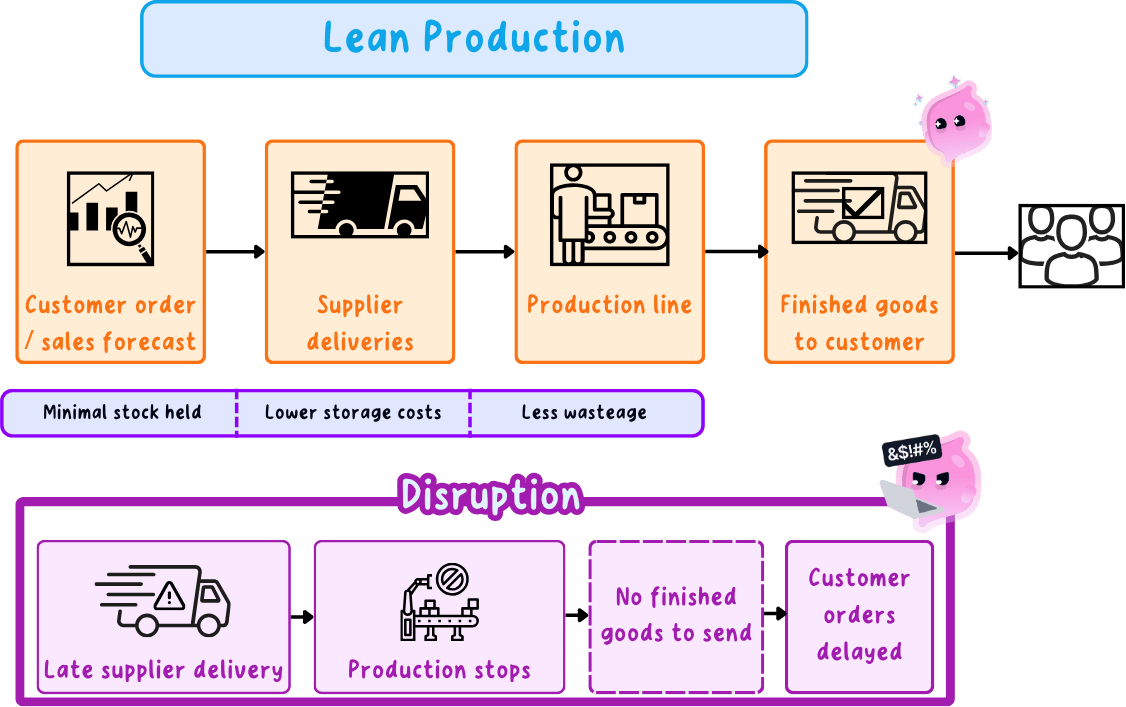
- Just in time: the business orders so that a delivery lands as the last one is being used up, which leaves the storeroom close to empty by design rather than by accident.
- Deliveries are small and frequent and timed against expected trade, so a sandwich shop takes bread each morning for that day rather than a week of loaves on a Monday.
- The alternative is to hold buffer stock, and the two systems pull in opposite directions across four things a business cares about.
| Just in time | Buffer stock (just in case) | |
|---|---|---|
| Cash tied up in stock | Very little | Large amount |
| Storage cost | Low | High |
| Risk of a stock-out | High | Low |
| Meeting a demand surge | Poor | Good |
Advantages of JIT: cash released, costs cut, waste avoided
- Cash released: stock is money standing still, so holding two days of it instead of a month frees cash for a delivery van, a marketing push or paying suppliers on time.
- Lower storage costs: less stock needs less space, so the business rents a smaller unit and pays less for heating, insurance, security and the staff time spent moving pallets.
- Less waste: fresh food, newspapers and anything with a use-by date lose their value on a fixed clock, so stock that arrives on the day it sells never has to be thrown away.
- Less risk of being stuck with it: tastes, technology and seasonal lines move on, so a business holding little stock is not forced to discount a stockroom of goods nobody now wants.
Example
- Greggs sells cheap hot food in high volume, and a sausage roll that does not sell today cannot be sold tomorrow.
- Ordering close to the trade a shop expects that day keeps waste down, which protects the thin profit on a product sold at a low price.
- The pull runs the other way for a builders' merchant in Hull, where cement and timber do not spoil and running out costs a customer a whole day on site.
Drawbacks of JIT, and what it needs to work
- Taking away the buffer takes away the safety net, and that creates four problems.
- No cover for a late delivery: one lorry stuck on the motorway or one fault on a supplier's line stops production or empties the shelf the same day, because there is nothing behind it.
- Total dependence on the supplier: the system holds only if the supplier sends the right quantity, on time, every time, and warns the business early when it cannot.
- Higher delivery costs: many small loads cost more in transport than a few large ones, and ordering in small amounts gives up the discount a supplier offers for bulk.
- No way to meet a surge: a heatwave, a viral post or a rival closing can lift demand overnight, and a business with nothing in reserve turns those customers away.
- JIT therefore needs reliable suppliers, accurate forecasting of demand and quick communication in both directions, which is why firms running it often buy from suppliers based nearby.
- Those conditions take years to build, so treat JIT as a system a business earns rather than one it can switch on next Monday.
Note
- Drawing stock levels, reorder levels and lead time on a bar gate stock graph belongs to the previous guide.
- How a firm builds the supplier relationships JIT rests on, and what its logistics choices cost, come in the two guides after this one.
Judging JIT: whether it suits a business depends on its suppliers and its market
- Whether a business should run JIT turns on four questions: how reliable its suppliers are, how predictable its demand is, how expensive storage is, and how much a stock-out would cost it.
- Where suppliers deliver daily and demand is steady, the risk column barely bites, so the cash freed and the storage saved arrive at almost no cost and JIT is the stronger system.
- Where an empty shelf sends the shopper to a rival on the same high street, the lost sale plus the lost repeat custom can outweigh a year of saved storage, so paying to hold a cushion is the cheaper mistake.
- On balance, JIT suits a business with dependable suppliers, steady demand and costly storage space, and it is dangerous for one whose customers go elsewhere the moment a shelf is empty.
Exam technique
- When the question says explain or analyse, carry the chain through: less stock is held, so less cash is tied up, so the owner can spend that cash on something that earns a return.
- Name the cost that falls rather than saying JIT saves money, because an unnamed saving is the assertion that keeps an answer in the bottom band.
- Application marks are gated on the context, so use the supplier reliability and demand pattern given in the case rather than a memorised point about supermarkets.
- When the question says justify or evaluate, decide, then say what the decision rests on: the cost of an empty shelf set against the cost of a full stockroom.
Self review
- What does just in time stock control mean?
- Give two ways JIT lowers a business's costs, and say how each one works.
- Why does one late delivery hurt a JIT business more than one holding buffer stock?
- Name two conditions a business needs in place before JIT can work.
- For which kind of business is JIT most dangerous, and why?
