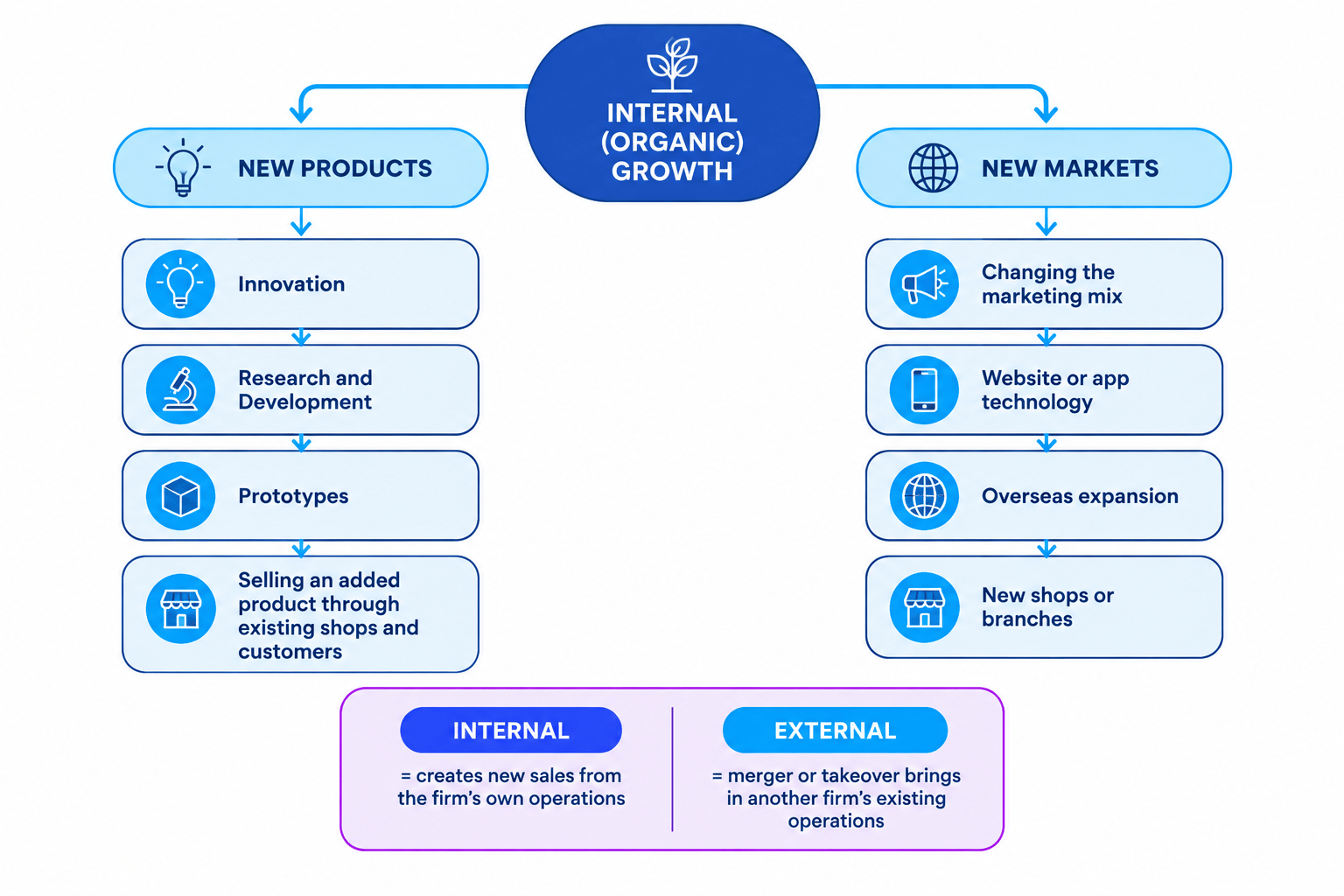
Internal growth: getting bigger out of the operations you already own
Definition
Internal (organic) growth: expanding by adding to the business's own operations, such as more products or more customers, rather than by buying or joining with another firm.
- Every extra pound of revenue under internal growth comes from capacity the business has built and paid for itself, so nothing is bought in ready-made from another company.
- Growth is measured by revenue, output, number of outlets, employees or share of the market, and internal growth lifts those figures one step at a time rather than in a single jump.
Common Mistake
- If a question asks how a business could grow internally, never suggest a merger or a takeover, because those bring in another firm's operations and count as external growth.
- Opening ten shops of your own is internal growth, while buying a rival that already owns ten shops is not.
- The test is whether the extra sales existed before, since internal growth creates new ones and external growth transfers somebody else's.
- Franchising is examined as a form of business ownership in 1.4.1, not as a method of internal growth here.
The two routes: new products and new markets
- A firm growing internally has two routes open to it, and each one raises revenue by a different mechanism.
- New products: adding a line the firm can sell through the shops, staff and customers it already has, so the same rent and wages are spread over more sales.
- Innovation turns an idea into something a customer will pay for, and research and development is the designing, prototyping and testing that gets it there, which is why Dyson worked through over 5,000 prototypes before the bagless vacuum cleaner reached a shop.
- Research and development is paid for long before the first sale, so a line that flops takes the money with it, which is why a firm often trials a new product in a handful of branches before a national launch.
- New markets: selling the range the firm already makes to a different group of buyers, reached by changing the marketing mix, by taking advantage of technology, or by expanding overseas.
- Changing the marketing mix: a smaller pack at a lower price, or promotion aimed at a different age group, puts the same product in front of buyers who would not have bought the original version.
- Taking advantage of technology: selling through a website or an app makes the market the whole country instead of the streets around the shop, at a fraction of the rent of another unit, and social media reaches those buyers without a national advert.
- Expanding overseas: selling in another country spreads risk, because a fall in UK spending no longer hits every sale, though the firm pays for transport, translation and any tariffs and may find local tastes differ.
- Opening a shop, branch or warehouse in another town is the same route in physical form, reaching customers who live too far from the existing site to use it.
- New markets are usually the cheaper route, because the product already exists and the spending goes on promotion and delivery rather than on years of development.
Example
- Greggs has grown internally by opening more shops on high streets and retail parks rather than by buying another bakery chain.
- Its vegan sausage roll is the new-product route, an extra line sold across counters that were already there.
- Gymshark reached a new market through technology, growing from screen-printing in a Birmingham garage in 2012 to selling online through fitness influencers.
- Neither firm needed to buy another company to get bigger.
Advantages: control kept, cost low, and a pace the business can absorb
- Control stays with the existing owners: no shares go to another firm's shareholders and no outside board arrives with different plans, so the way the founder runs the business survives the expansion.
- It costs less: the firm pays for one shop fit-out or one product launch at a time, perhaps £80,000 for a small unit, where buying a rival means paying for its entire premises, stock, staff and brand in one deal.
- Much of that bill can be met from retained profit, so there is no interest to pay and no new investor asking for a say in decisions.
- The pace is gradual: managers can train staff, settle supply problems and learn from a poor site before the next one opens, which means an early mistake stays small and can be corrected.
- There is no culture clash: new branches are staffed and run the firm's own way from the first day, rather than merging a workforce used to different pay, rules and habits.
Note
Where the money for growth comes from, internal sources such as retained profit set against external sources such as loans and share capital, is covered in the guide on financing growth.
Disadvantages: slow, capped by your own money, and still a strain
- It is slow: a new unit takes months to find, fit out and staff and a new product can take years to reach the shelf, while a takeover adds a whole trading chain on the day the deal completes.
- A rival can take the opportunity first: if a competitor opens in that town or launches the same idea while your version is still being built, the customers there are already loyal to them when you arrive.
- The pace is capped by what the firm can fund itself: retained profit only builds up as fast as the business earns it, so a firm making little profit grows slowly however good its plan is.
- Growth still stretches cash and management: an outlet is paid for months before it takes any money, and the owner who once watched a single site now supervises staff in several towns, so standards can slip.
Exam technique
- Name the route precisely, such as launching a new product, changing the marketing mix or selling overseas, because a vague "they should expand" gives the analysis nothing to build on.
- Then run the chain: a new product sells through counters the firm already staffs, so revenue rises faster than costs, so there is more retained profit to fund the next launch.
- Where the command word is explain or analyse, tie the route to what the firm in the source booklet actually sells, since application marks are gated on that context.
- Where it is justify or evaluate, weigh the control and low cost of internal growth against its slower pace, and say which matters more for a business of that size in that market.
Self review
- What makes growth internal rather than external?
- Name the two routes to internal growth and say what each one adds to the business.
- Give the three ways a business can reach a new market with the product it already sells.
- Give one reason internal growth costs less than a takeover.
- Give one drawback of funding growth only from retained profit.