External growth: buying a business instead of building one
Definition
External (inorganic) growth: expansion that comes from joining with or buying another business rather than from selling more yourself.
Merger: two businesses agreeing to join together to form one new, larger business.
Takeover: one business buying enough of another business, normally more than half its shares, to take control of it.
- Edexcel names two forms of external growth, and the sharp difference between them is consent.
- Merger: both sets of owners agree to combine, so the two firms become one new business, usually with a new name, a single board and one set of shareholders.
- Takeover, also called an acquisition: the buyer purchases enough shares to control the target, and because the target's directors do not have to agree, a takeover can be resisted.
Example
- A gym chain with 20 sites wants 40, so it buys a rival chain of 20 sites for £14 million.
- On completion day it owns 20 fitted-out buildings, the members who already train in them and the staff who run them.
- Building those 20 sites itself would mean finding premises, paying for the fit-out and waiting years for memberships to build.
- The £14 million buys time, which is the one thing organic growth cannot supply.
Advantages: what the buyer gets on the day the deal completes
- Growth is immediate, because the premises, equipment, customers and staff already exist and simply trade under new ownership from completion day, and speed is the real attraction of a takeover.
- Customers and market share: the target's buyers become your buyers at once, so revenue rises without waiting for a marketing campaign to take effect.
- Brand and reputation: a name shoppers already trust takes years of consistent trading to earn, so buying one is often quicker and cheaper than building one.
- Staff and expertise: trained people transfer with the business and bring knowledge the buyer lacks, such as how to run a warehouse network or a delivery app.
- Buying a rival also removes a competitor from the market, so the combined firm is under less pressure to undercut on price and keeps more of the customers it has just paid for.
- The larger firm orders stock in greater bulk, so suppliers charge it less per unit and its cost per item falls, which means it can either cut its prices or widen the gap between price and cost.
Disadvantages: the price of the deal and the trouble afterwards
- Buying a business is expensive, so the money usually comes from heavy borrowing, and the interest has to be paid every month whether the deal works or not.
- The problems that follow completion are as serious as the problem of paying for it.
- Culture clash: the two workforces arrive with different pay rates, shift patterns, software and habits, and staff who resent the new way of working leave or stop trying.
- Job cuts: two head offices and two accounts departments do the same work, so redundancies follow, and morale falls among the very employees the buyer wanted.
- Overpaying: the buyer judges the target from the outside, so worn-out equipment, lost contracts and unhappy customers only come to light once the money has gone.
- A combined business can also become too big to manage well, because decisions pass through more layers of managers, so a problem in one shop takes far longer to reach anyone able to fix it.
Judging organic against external growth: what it depends on
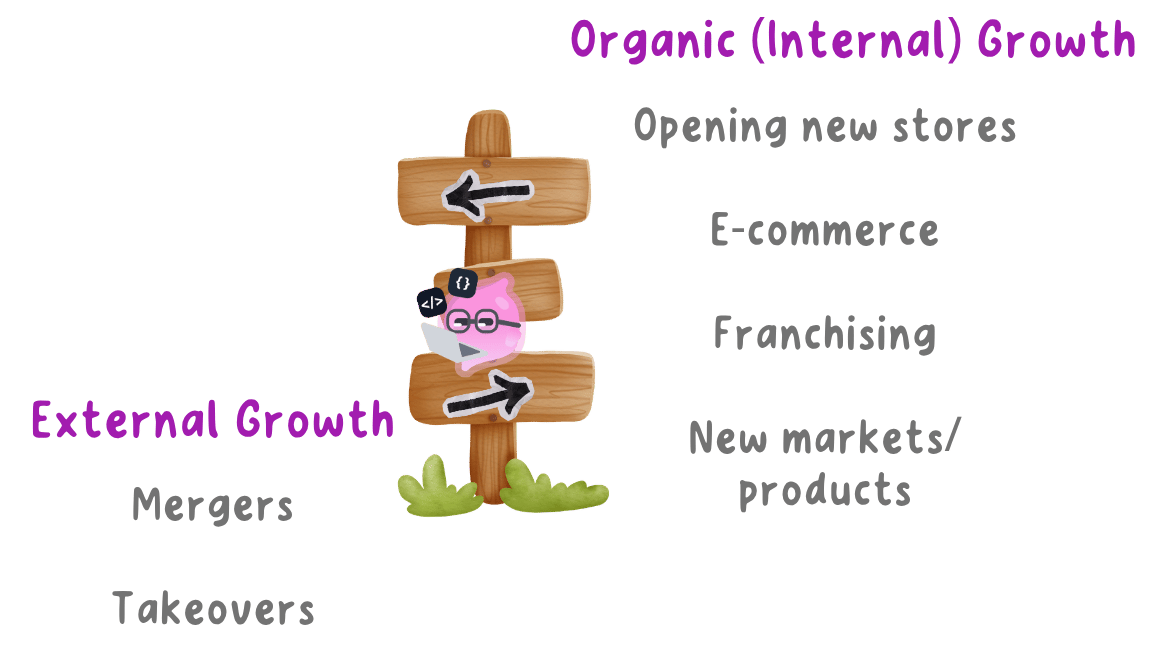
- External growth suits a business that needs speed and has the finance and management capacity to absorb another firm; organic growth suits one that values lower risk, control and a manageable pace.
- The key question is whether the target genuinely fits, because poor systems, culture or customers can turn the expected benefits into integration costs.
- Overall, external growth is strongest when speed matters enough to justify the higher financial and integration risk.
Exam technique
- Distinguish merger from takeover, then focus on the effect of gaining another firm's operations immediately.
- For analysis, link the immediate growth to customers, revenue, costs or expertise in the source-booklet business.
- For a judgement, weigh speed against finance and integration risk.
Self review
- What is the difference between a merger and a takeover?
- Roughly what proportion of a company's shares does a buyer normally need to control it?
- Give three things a buyer gains on the day a takeover completes.
- Give two reasons a takeover can leave the buyer worse off than before.
- Name two things that decide whether a firm should grow organically or externally.
