Remote and hybrid working: the job stops needing an office
Definition
Cloud storage: files kept online rather than on one office computer, so the same document can be opened and edited from any device with a connection.
Automation: using software or machines to carry out a task that a person used to do by hand, usually a repetitive one such as sending invoices or booking appointments.
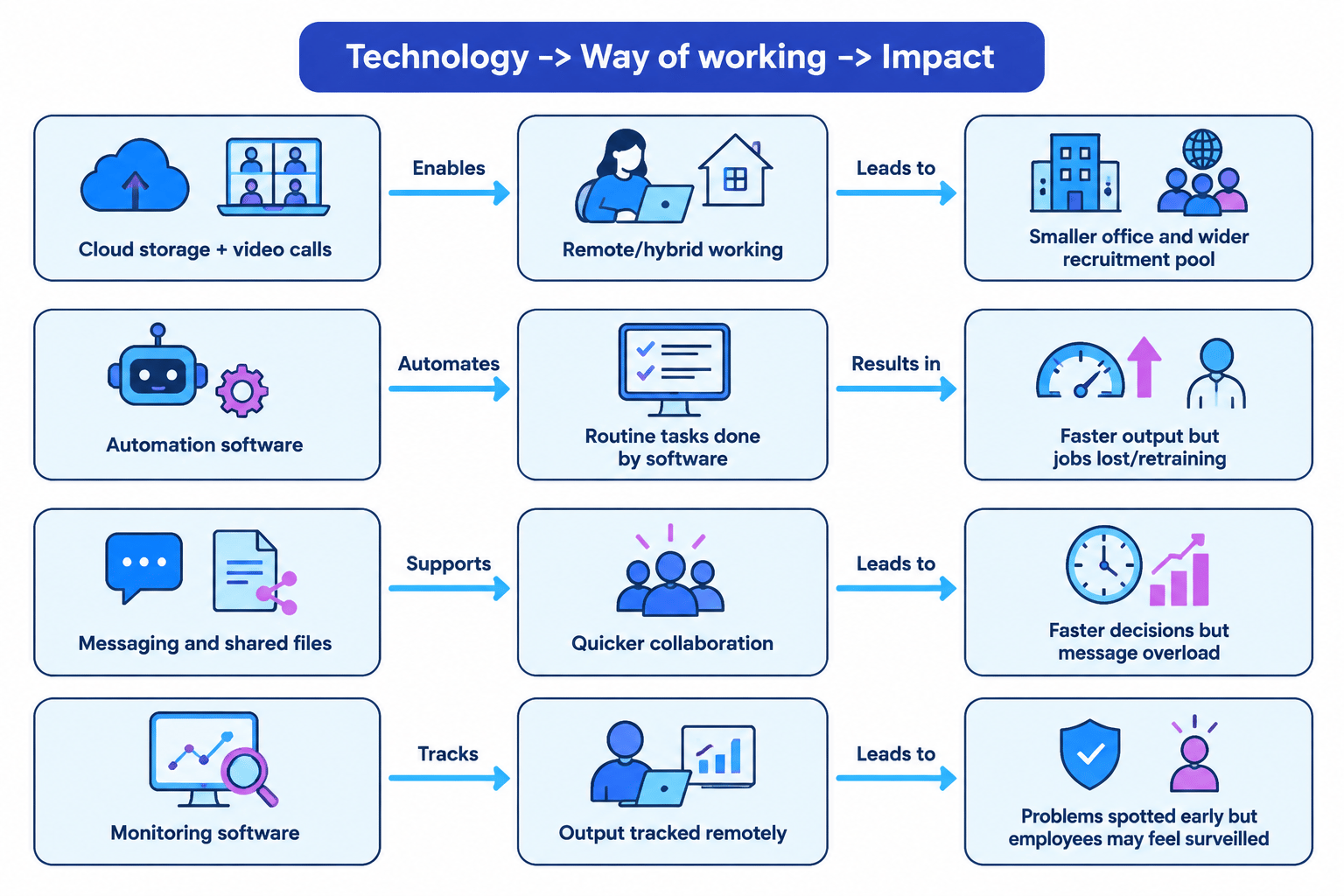
- Video calls, cloud storage and instant messaging mean the tasks of most office jobs can be done from any room with a connection, so the building stops being the thing that holds the work together.
- The business gains on two fronts when it lets staff work at home or split the week between home and office.
- Lower premises costs: if staff come in on alternate days the firm can rent a smaller office and share desks, so rent, heating and cleaning all fall, and those are fixed costs that had to be paid whether trade was good or not.
- A wider choice of staff: a vacancy can be filled by someone two hundred miles away, so the firm recruits from a national pool instead of one town, and experienced staff who value flexibility stay rather than leave.
- The same arrangement costs the business three things.
- Supervision is harder: a manager cannot see who is stuck, so a problem surfaces days later, and performance has to be judged on output rather than on hours visibly spent at a desk.
- A team is harder to build: a new employee at home picks up far less from overhearing experienced colleagues, so informal learning slows and loyalty to the team is weaker.
- Equipment and security must be provided: a laptop, a phone and a secure connection are needed in every home, and customer records now sit outside the office where they are easier to lose.
- For the employee the gain is concrete, because losing a commute returns an hour a day and the £5 or so it cost in fares or fuel, and the working day can bend around childcare or a college course.
- The cost to the same employee is isolation and a blurred line between work and home, since the laptop sits in the same room as the sofa and a message at nine in the evening is easy to answer and hard to ignore.
Flexible hours, automation, messaging and monitoring: a gain and a cost in each
- Flexible hours only became practical once technology stopped work having to happen in one place at one time, and three further changes follow the same pattern of a gain with a cost attached.
- Automation is the row with the sharpest split, because software takes the repetitive work and frees staff for tasks that need judgement, such as calming an angry customer, while some jobs disappear altogether and the staff who remain must be retrained on the new system.
- Monitoring is the row most likely to backfire, since tracking output lets a manager see a falling delivery rate in days rather than months, but staff who feel watched trust their employer less, and demotivated staff work slower, which eats the gain the tracking was bought for.
| Change | Gain | Cost to weigh |
|---|---|---|
| Flexible hours | Longer trading day covered | Handovers and cover gaps |
| Automation of routine tasks | Repetitive work done faster | Jobs lost, retraining needed |
| Messaging and shared files | Quicker decisions | Message overload, instant-reply pressure |
| Monitoring software | Problems spotted early | Feels like surveillance |
Example
- Deliveroo launched in London in 2013 and depends on smartphones, which connect the restaurant, the rider and the customer.
- The app is what makes the hours flexible, because a rider can log on when it suits them instead of turning up for a fixed shift.
- The same app is also the supervisor, since it hands out the orders and shows where the food is, so nobody has to stand in a depot counting riders in.
- Take that technology away and the business does not exist in a smaller form, it does not exist at all.
Technology changes who a business can employ, not only how
- The deepest change is to the labour market a business is fishing in, because a firm that allows remote working can hire someone hundreds of miles away and one that does not is limited to people within commuting distance.
- A small accountancy practice in Norwich that accepts home working can take on a bookkeeper in Glasgow, so it appoints on skill rather than on postcode and is less likely to be forced into a pay rise to tempt the only qualified applicant nearby.
- It cuts the other way for the employee, because a job that can be done from anywhere can also be done by anyone anywhere, so the competition for it is national rather than local.
What the technology costs to buy and to depend on
- None of these gains is free, because laptops and phones have to be bought, software is usually charged as a licence per user every month, and someone has to be paid to fix it when it stops.
- Training is the cost that is easiest to forget, since every hour a member of staff spends learning a new system is an hour they are paid for but not producing, and output usually dips before it improves.
- Dependence is the sharper risk, because a business that has moved its orders, files and payments online has no paper system to fall back on, so a broadband or server failure stops everybody at once rather than slowing one department.
- That is why the smaller the firm, the harder these costs bite, as a sole trader pays the same monthly licence fee as a large company but spreads it over far less revenue.
Exam technique
- Name the technology, then the way of working it changes, then the effect on the business: cloud files allow home working, so the firm rents a smaller office, so fixed costs fall.
- The link most often dropped is the last one, where an answer names a technology but never says what it does to costs, output or staff.
- Answer for the business in the source booklet, because remote working suits an insurance office and does nothing for a hairdresser or a bakery counter.
- When the question says discuss, justify or evaluate, set an employer gain against an employee cost rather than listing two gains.
Self review
- Define automation.
- Give one gain and one cost to a business of letting office staff work from home.
- Why does allowing remote working widen the pool of people a business can employ?
- State two costs a business faces when it introduces new technology for its staff.
- Why can monitoring software damage the relationship between a manager and their staff?