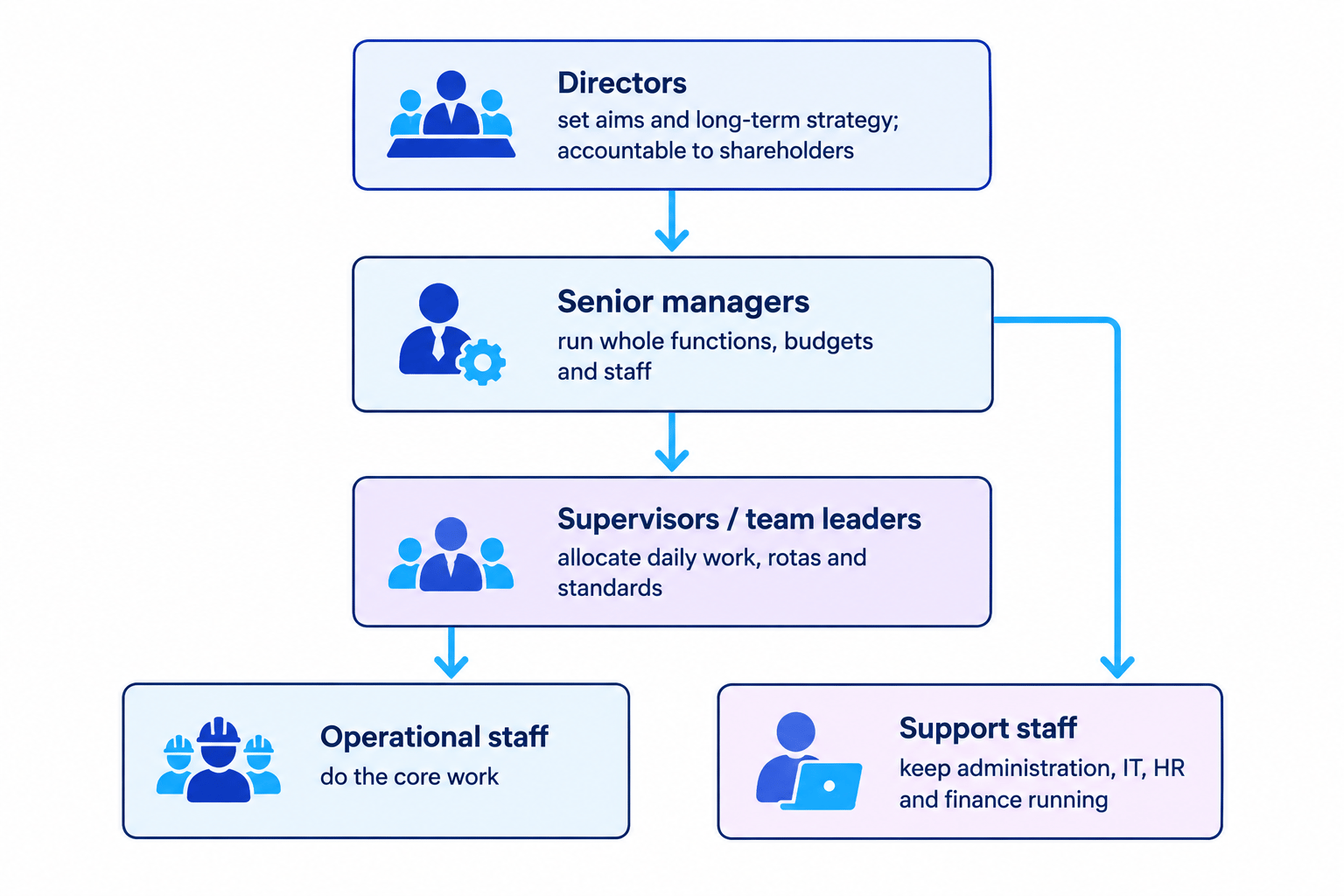
Directors and senior managers: setting the direction and running the functions
- Directors are appointed by the owners or shareholders and are accountable to them for the performance of the business as a whole.
- They set the overall aims and the long-term strategy, deciding the matters that commit the whole business, such as entering a new market or investing in a new site.
- Because they answer to the shareholders, a run of falling profit is a director's problem before it is anyone else's.
- Senior managers each run a whole function, such as marketing, finance, human resources or operations.
- Their job is to turn the directors' strategy into plans with targets, deadlines and the people to deliver them.
- They control that function's budget and staff, so they decide how the money allocated to their area is spent and who does what within it.
- They answer to the directors for their function's results, so it is the marketing manager who is asked why sales have fallen.
Example
- Greggs sells cheap hot food at high volume from shops on high streets and retail parks.
- Adding a new line such as the vegan sausage roll is a director-level call, because it commits every shop in the chain to new suppliers, new equipment and a national advertising spend.
- A senior manager in operations then works out which bakeries make it and how much each shop receives.
- The shop supervisor puts it on the rota and the counter staff sell it, and none of them chose to launch it.
Supervisors, team leaders and the staff who do the work
- Supervisors and team leaders run a team day to day and are the link between the managers above them and the staff doing the work.
- They allocate the work, set the rota, check it has been done to the required standard and pass any problem they cannot solve up the chain.
- Operational staff do the work the business exists to do, such as baking the bread, driving the delivery van or serving at the till.
- They are responsible for their own output and for following the procedures set above them, such as food hygiene rules or a safety check before a machine is used.
- They answer to their supervisor or team leader rather than to a director, so a problem with the work goes up one level first.
- Support staff keep the business running behind the front line, in administration, IT, human resources and finance.
- They bring in no sales directly, but if the payroll is wrong or the tills stop working the shop cannot trade, so what they are responsible for is keeping everyone else able to work.
- They answer to the senior manager of the function they sit in, such as the head of finance for the person who runs payroll.
Note
Tall and flat structures, span of control and chain of command belong to 2.5.1a, so here you need only place each role at the right level.
How the roles map onto the structure
The same jobs still have to be done whatever the size of the firm, as this comparison shows.
| Job to be done | Market stall | Supermarket chain |
|---|---|---|
| Setting the aims | The owner | The board of directors |
| Running a function | The owner | Senior managers |
| Allocating daily work | The owner | Supervisors and team leaders |
| Serving the customer | The owner | Operational staff |
| Payroll and IT | The owner, or a hired accountant | Support staff |
- On the market stall every one of those jobs is still done, but one person does all of them, so the roles exist as tasks rather than as job titles.
- As a business grows the jobs split off one at a time, supervision usually first, which is why the word manager can mean a department of two hundred in one firm and a shift of three in another.
Exam technique
- Name the role, then a responsibility, then the effect on the business, because a role named on its own earns nothing.
- Match the decision in the source booklet to the right level: opening a new site to a director, a departmental budget to a senior manager, next week's rota to a supervisor.
- Do not confuse a senior manager, who runs a whole function and its budget, with a supervisor, who runs one team's day.
- When the question says outline or explain, say who the role answers to as well as what it does, since that is the half most often left out.
Self review
- Who appoints the directors, and what are they accountable for?
- What does a senior manager control that a supervisor does not?
- Give two support staff roles and say why a shop cannot trade without them.
- Name the five job roles in the order they sit in the hierarchy.
- Who does a member of operational staff answer to day to day?