Market segments: one market, several groups of customers
Definition
Market segment: a group of customers inside a market who share characteristics and want similar things from the same type of product.
Target market: the segment or segments a business chooses to sell to and builds its product, price, promotion and place around.
- A market is rarely one single group, because people buying the same type of product want different things from it.
- Splitting the market into segments lets a business choose a target market and shape its offer around that group instead of guessing at an average customer.
The five bases: ways to split a market
- Edexcel names five bases you can use to divide a market, and each one describes the customers rather than the products.
- Location: grouping customers by where they live or work, which is why Greggs puts shops on high streets, in retail parks and near stations where people already walk past at lunchtime.
- Demographics: grouping customers by measurable personal facts such as gender, family size or occupation, which is why Tesco stocks family multipacks next to single portions.
- Lifestyle: grouping customers by how they spend their time and what they value, which is why Greggs launched a vegan sausage roll for shoppers cutting down on meat.
- Income: grouping customers by how much they have to spend, which is why Aldi and Lidl compete on price with a narrower range while Dyson sells on design and engineering at a premium.
- Age: grouping customers into bands such as children, teenagers, young adults and the over-60s, which is why Gymshark sells through fitness influencers on the social media young adults use.
- Most businesses use two or three bases at once, so Gymshark targets young adults (age) who train regularly (lifestyle) and buy online.
Note
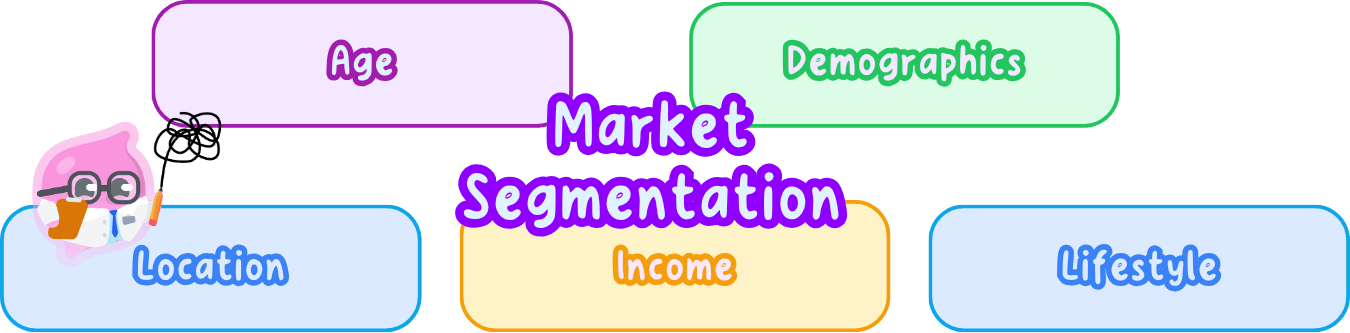
This diagram illustrates market segmentation generally. For GCSE Edexcel, use the five bases in this article: location, demographics, lifestyle, income and age.
Example
- The UK grocery market is served by several segments at the same time.
- Aldi and Lidl aim at shoppers who put price first, with low prices and a narrower product range.
- Tesco and Sainsbury's carry a wider range and offer click and collect for shoppers who value choice and convenience more than the lowest price.
- Both models work because each is built around one group rather than trying to please every shopper.
Why a business segments: targeting one group with every decision
- Knowing exactly who the customer is lets the business aim all four marketing decisions at the same people.
- Product: the business designs for one group's needs instead of compromising for everyone, so the product fits those customers better and more of them buy it.
- Promotion: the segment tells the business where those customers look, so the advert goes on that channel and less of the budget is spent reaching people who will never buy.
- Price: the segment's income shows what it will accept, so PureGym sets a low monthly membership for price-sensitive members while Dr Martens charges a premium to buyers who want boots that last.
- Place: the segment decides the channel, so a brand aimed at students sells through an app and a brand aimed at commuters takes a unit near the station.
- Because all four decisions pull in the same direction, a higher share of the people who see the product actually buy it, which raises revenue without raising the marketing spend.
- That focus is how a new firm competes with a large rival, by serving one group better than a business trying to serve the whole market can.
Note
- Once the segments are named, a business can plot them on a chart to see which groups nobody is serving well.
- That technique is market mapping, and the next guide covers it.
The limits: segment size and the customers you give up
- A segment is only worth serving if enough people are in it, because designing a separate product and running separate advertising costs the same whether ten customers buy or ten thousand.
- A bakery in Leeds selling only gluten-free birthday cakes might take too few orders a week to cover its rent, so it keeps a standard range alongside.
- Targeting one segment also means giving up sales to others, because the choices that attract one group put another off.
- PureGym wins price-sensitive members by having no staffed reception, and loses the members who want classes, a pool and someone on the desk.
- Depending on one segment concentrates risk, so if that group's spending falls the business has no other customers to fall back on.
Exam technique
- Name the base and describe the group, for example "by income, targeting shoppers on a tight budget", because a bare base name earns nothing.
- A segment is always a group of customers, never the product sold to them, so "our segment is trainers" loses the mark.
- Read the price, the packaging and the place of sale in the source booklet, since those details tell you which segment the firm has chosen.
- Carry the point through to the business: the segment is known, so promotion goes where those customers look, so less of the budget is wasted and more of the spend turns into sales.
Self review
- What is a market segment?
- Name the five bases of segmentation in the specification.
- Give one example of a UK business targeting a lifestyle segment.
- Explain how knowing the target market cuts wasted promotion spending.
- State one reason a segment might not be worth serving.
