Why conflict is built in: one pot of money, several claims on it
Definition
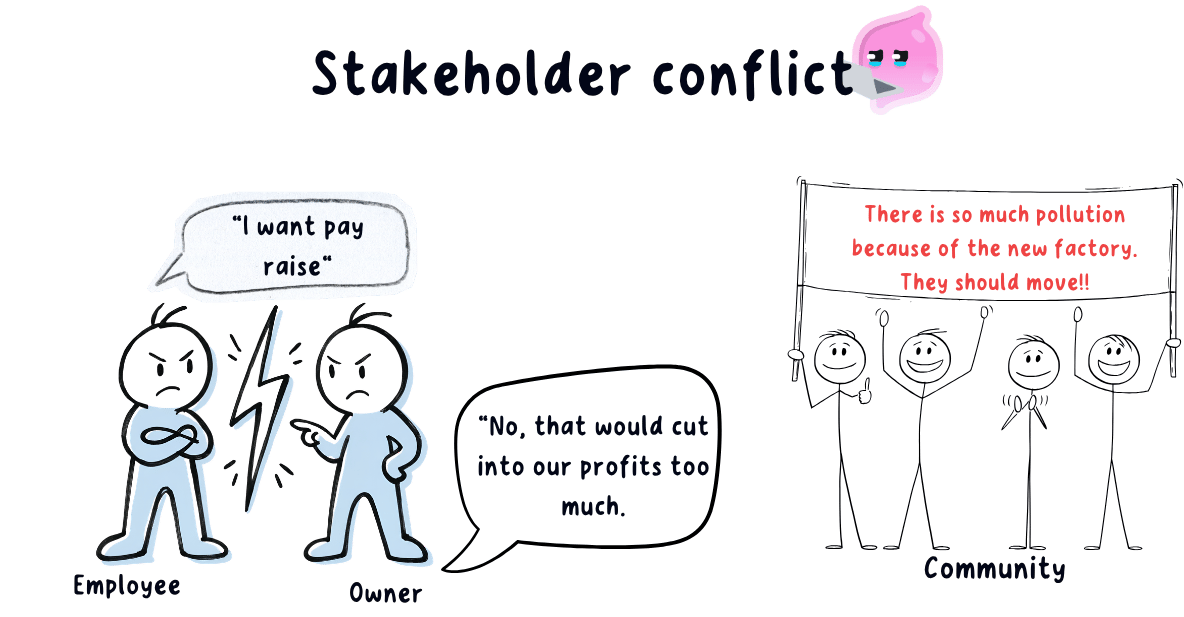
Stakeholder conflict: when giving one stakeholder group what it wants makes it harder to give another group what it wants.
- A business has one pot of money coming in from sales, and every stakeholder group has a claim on part of it.
- Money paid out in higher wages is money that is not paid out as profit, so satisfying employees costs the shareholders and satisfying the shareholders costs the employees.
The clashes that come up most, and the mechanism behind each
- Shareholders against employees: both claims land on the same wage bill.
- Shareholders want costs cut so profit and dividends rise, while employees want higher pay and secure jobs, so a 5% rise on a £200,000 wage bill takes £10,000 straight out of profit.
- Shareholders against customers: the price is the point where the money changes hands.
- Adding 50p to a £5 item raises profit on every sale, but customers get less for their money and some switch to a cheaper rival, so the extra profit is never guaranteed.
- The business against the local community: expansion buys sales and costs goodwill.
- Opening a larger site or trading until 11pm brings extra sales for the owners, but residents get more traffic, noise and litter, so objections can delay or block planning permission.
- Managers against shareholders: the argument is about timing rather than the amount.
- Managers often want profit reinvested in equipment and new branches that pay off in several years, while shareholders may want that same profit paid out as a dividend now.
- Suppliers against the business: both sides are protecting their own cash flow.
- The business wants a lower price and 60 days to pay, the supplier wants a higher price and payment in 30 days, and every extra day of credit the buyer gains is a day the supplier waits for cash.
- Pressure groups against the business: a greener method almost always costs more per unit.
- A campaign for recycled packaging or sustainably sourced materials raises the cost of making each item, so meeting it cuts profit unless customers will pay more for it.
Example
- Greggs sells cheap hot food in high volume, so each item earns only a small amount of profit.
- A rise in shop wages there has to be paid for either by a higher price for customers or by a smaller profit for the owners.
- Its vegan sausage roll worked the other way, because it answered customers who wanted a meat-free option and brought in new sales the owners gained from as well.
Where interests overlap: decisions that pay two groups at once
- Conflict is not always settled by picking a side, because some decisions pay two groups at the same time.
- Paying shop staff above the going rate raises the wage bill, but it cuts staff turnover, so the business spends less on recruiting and training replacements.
- Experienced staff also serve customers faster and make fewer mistakes, so repeat custom and sales rise and the shareholders end up better off from the decision the employees wanted.
Exam technique
- Name both groups, say what each one wants, then show why the same pound or the same decision cannot satisfy both.
- Check for an overlap before you assume a trade-off, because a decision such as better pay can raise sales as well as costs, and that point separates a top answer from a list.
- When the question says justify or evaluate, finish by saying which group should come first for this business and why, using its size, its cash position or its market.
- Do not write that a business can keep everyone happy, and do not claim every conflict can be fully resolved.
Self review
- Why does paying employees more usually reduce profit?
- State the conflict between shareholders and customers over the price charged.
- Why might managers and shareholders disagree about what to do with a year's profit?
- Give one decision that benefits employees and shareholders at the same time, and explain the link.
- Name two things that decide which stakeholder group a business should put first.
