Break-even output: the formula to recall and the contribution inside it
Definition
Contribution per unit: the amount a single sale leaves towards the fixed costs once its own variable cost has been paid.
Break-even output: the level of output at which total revenue equals total costs, so the business makes neither a profit nor a loss.
- Work through one business the whole way: it sells a product for £9, the variable cost of making one is £4, its fixed costs are £4,500 a month and it currently sells 1,200 units a month.
Example
- First find the contribution per unit:
- Each unit sold leaves £5 towards the fixed costs, and once the £4,500 is fully covered every further £5 is profit.
- Then find the break-even output:
- The business must take £8,100 in sales revenue before it covers all its costs, which is the figure to compare against a monthly sales target.
- Below 900 units the £5 contributions have not yet filled the £4,500 hole, so the business makes a loss, and at exactly 900 units it makes neither profit nor loss.
- Above 900 units the fixed costs are already paid, so every extra unit adds its whole £5 straight to profit.
Example
- Greggs sells cheap hot food at low prices, so the contribution on one sausage roll is small, which means a shop has to sell a very large number of items each day before its rent and staff costs are covered.
Margin of safety: the cushion between current sales and a loss
Definition
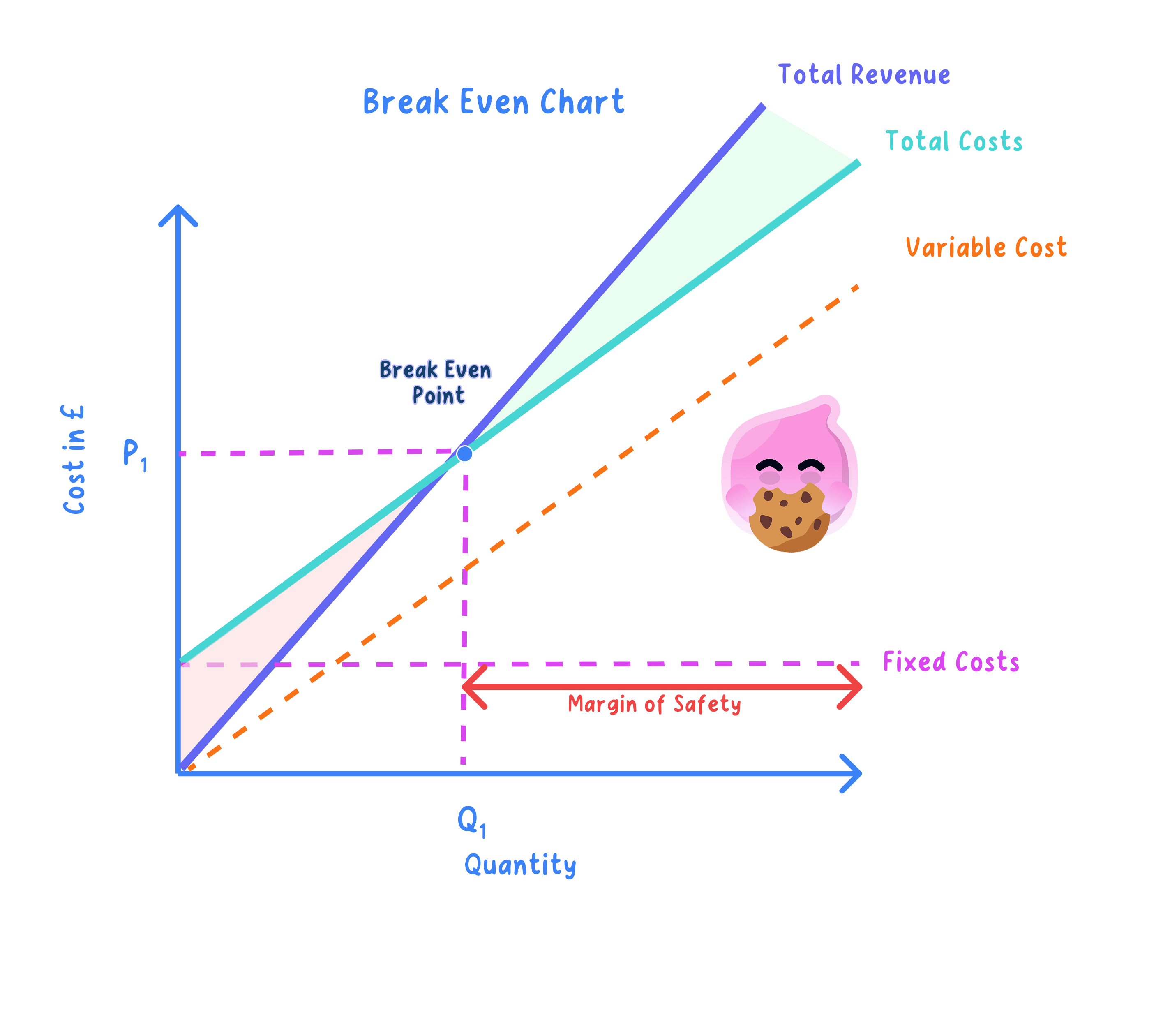
Margin of safety: the gap between actual or budgeted sales and break-even output, showing how far sales can fall before the business starts making a loss.
- A question may give a forecast or budgeted level of sales rather than an achieved one, and the method is the same either way.
Example
1,200−900=300 units
1{,}200 - 900 = 300\text{ units}
1,200−900=300 units
- Sales could fall by 300 units, a quarter of current sales, before the business starts losing money, and that cushion is what the owner is really buying with every extra sale.
- The same contribution figure gives the monthly profit:
- That £1,500 is simply the 300 units of margin multiplied by their £5 contribution, so the margin of safety and the monthly profit are the same fact told two ways.
What moves the break-even point, and the margin with it
Example
- Three changes shift the break-even output, and each one drags the margin of safety along with it.
- Fixed costs rise to £5,000
- The margin of safety falls from 300 units to 200.
- The price rises to £10
- Contribution becomes £6, so:
- The fixed costs are covered 150 units sooner.
- The variable cost per unit rises: contribution shrinks, so break-even output rises and the margin of safety narrows.
- A margin of only 200 units leaves the business one quiet month from a loss, so an owner facing a rent rise has to choose between raising the price, cutting the variable cost or accepting the extra risk.
Note
Both figures can also be read off a break-even chart, which is covered in 1.3.2c.
The limits of break-even
- Break-even assumes every unit made is sold, and all of it at the same price, which breaks down as soon as stock is left over or discounted in a sale.
- It assumes costs stay fixed at every level of output, yet a business that doubles output may need a second machine or overtime pay, which moves the break-even point again.
- The figures are forecasts that may be wrong, so break-even is a guide to a decision, not a guarantee.
Exam technique
- No formula sheet is given, so you have to recall all three: the break even point in units is fixed cost divided by sales price minus variable cost, the break-even point in revenue is break-even output multiplied by the selling price, and margin of safety is actual output minus break-even output.
- Do the subtraction on the bottom before you divide, because dividing the fixed costs by the selling price is the most common way marks are lost here.
- Break-even output and margin of safety are answered in units, while the break-even point in revenue is answered in pounds, so label each answer with the unit the question asked for.
- Show each step, then add one sentence saying what the number means for the business in the source booklet.
Self review
- State the formula for the break even point in units.
- Fixed costs are £3,000 and contribution per unit is £6, so what is the break-even output?
- Those same fixed costs of £3,000 go with a selling price of £10 and a variable cost per unit of £4, so what is the break-even point in revenue?
- A business breaks even at 900 units and sells 1,200, so what is its margin of safety?
- Why does a rise in the variable cost per unit push the break-even output up?
- Give one assumption that limits how far a break-even figure can be trusted.
