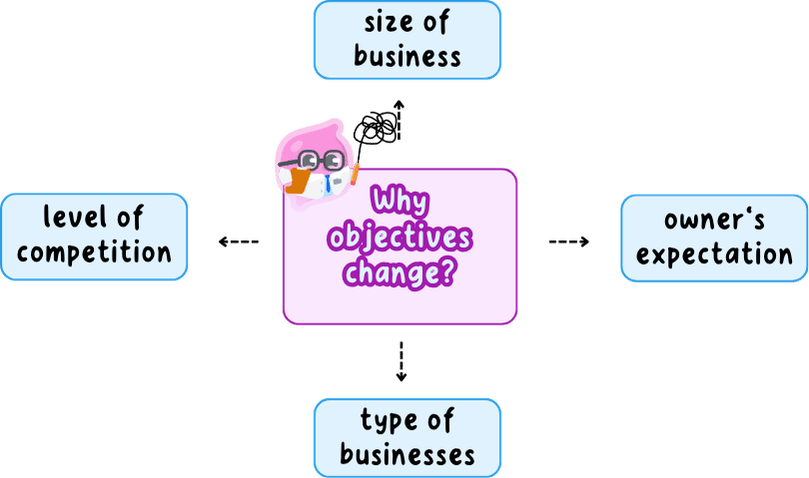
Why objectives differ between businesses
- The size of the business: a small business sets objectives around steady income and staying open, because it has little cash to fall back on if a target is missed.
- A large business has reserves, borrowing power and spare staff, so it can chase growth, market share and expansion overseas at the same time.
- The level of competition faced: in a crowded market the objective is to defend sales and hold market share, because a customer who is unhappy can switch to a rival the same day.
- Aldi and Tesco both set market share objectives because they compete for the same weekly shop, while a village post office with no local rival can concentrate on covering its costs.
- The type of business: a business owned by shareholders is pushed towards profit and shareholder value, while a not-for-profit organisation has no owners to pay.
- The National Trust sets objectives about conservation work and visitor numbers, and a social enterprise puts its surplus back into its social purpose.
- A public-sector body such as the NHS sets objectives about waiting times and patients treated, because it is funded to deliver a service rather than to return a profit.
- What the owner personally wants: one café owner sets a target of five branches, while the owner next door wants a reliable income and free weekends, so two identical businesses hold different objectives.
Note
- A not-for-profit organisation still needs enough income to cover its costs, but any surplus goes to the mission instead of to owners.
- The owner's own reasons for starting a business, such as wanting independence or following an interest, are covered in the topic on the role of the entrepreneur.
Start-ups compared with larger established businesses
- A start-up has to survive before it can attempt anything else. It has few customers, an unproven product and limited cash, so its objectives are about covering costs and building a base of regular buyers.
- An established business has the resources to set more ambitious objectives. It also has shareholders and lenders who expect those objectives, so standing still is not treated as acceptable.
- Four objectives only appear once a business is established: becoming the dominant business in its market, expanding internationally, increasing shareholder value, and setting formal ethical and environmental targets.
- Becoming dominant means holding a larger share of the market than anyone else, so rivals have to react to the prices you set and suppliers accept the terms you offer. Tesco holds that position in UK groceries, which is why a price cut there forces the other supermarkets to answer it.
- Greggs could target 150 new shops in a year only because it already had the cash, the bakeries and the brand to fill them, which a single-site baker does not.
- The scale of the ambition differs as well as the objective itself. Growth for a start-up means one extra site or a first large customer within its own town or region, while an established business writes its targets around the whole national market and then other countries.
- Ethical and environmental targets are informal in a start-up. The owner decides them as they go, whereas a larger established business publishes targets such as cutting packaging waste and is then judged on whether it met them.
Why objectives change as a business evolves
- Reaching one objective releases the next. A start-up that has traded for two years and built regular customers no longer needs survival as a target, so it moves on to profit or growth.
- Getting bigger changes what the business can attempt. More cash and more staff make international expansion or a market share target realistic when neither was possible before.
- A change of ownership rewrites the objectives. A sole trader who sells up to a larger company inherits that company's growth and shareholder value targets, whatever the original owner wanted.
- Objectives are reviewed on a cycle. Most businesses set targets a year at a time and revise them when the year ends, so no set of objectives stays in place for long.
Example
- A new restaurant spends year one aiming only to cover its rent, wages and food costs.
- Having survived, it targets £30,000 profit in year two and a second site by year four, so achieving one objective is what triggered a more ambitious one.
- A downturn then pushes it back to protecting cash, and the second site is shelved rather than cancelled.
Outside events that force objectives to change
- A recession pushes a business back towards survival. Customers spend less, revenue falls, and a firm that was chasing growth trims its product range, reduces staff and protects its cash instead.
- This happens to large established firms as readily as to small ones, so survival is not only a start-up objective.
- A strong new rival forces a switch to defending market share. As Aldi and Lidl expanded across the UK, the larger supermarkets moved from raising profit to cutting prices to hold on to their customers.
- New laws and new technology change what has to be targeted. A rise in the national living wage raises the wage bill, so a business sets a cost-cutting objective it did not need the year before.
- The threat of a takeover shifts the focus to shareholder value. Directors try to lift the share price so that shareholders keep faith in them and reject the offer.
- When conditions improve the objectives swing back. A business that returned to survival in a downturn moves back to growth once sales recover, and the cuts it made are reversed.
Exam technique
- Explain why this business's objectives might change is the usual wording, and the answer needs a trigger, then the new objective, then one action the business would now take.
- Read the case material for the age, size, type and competition of the business before you name any objective for it.
- The mistake to avoid is describing what an objective is, when the question asked why this particular business would change one.
Self review
- Name three reasons the objectives set by two businesses might differ.
- Why does a not-for-profit organisation not set profit maximisation as an objective?
- Give two objectives a larger established business might set that a start-up would not.
- How does a recession change the objectives of a business that was chasing growth?
- Why might the threat of a takeover shift a plc's focus to shareholder value?
