Judging success against the objective the business set
- Success is a comparison. You put the actual result next to the target the business set itself and see whether the target was reached.
- A café that targeted 500 customers a week and now serves 550 has succeeded against that objective.
- Without an objective there is nothing to judge against. A business with no target can report what it did but cannot say whether that was good or poor, because it never said what good would look like.
- The size of the figure is not the point. A large number that fell short of its target is a failure, and a small number that beat its target is a success.
Example
- A Greggs shop targets £8,000 of sales a week and takes £8,600, so against its own objective it has succeeded.
- A larger branch takes £12,000 a week but was targeting £15,000, so despite the bigger takings it has missed.
- Ranking the two shops by takings alone would give the wrong answer about which one performed.
Measuring success in ways other than profit
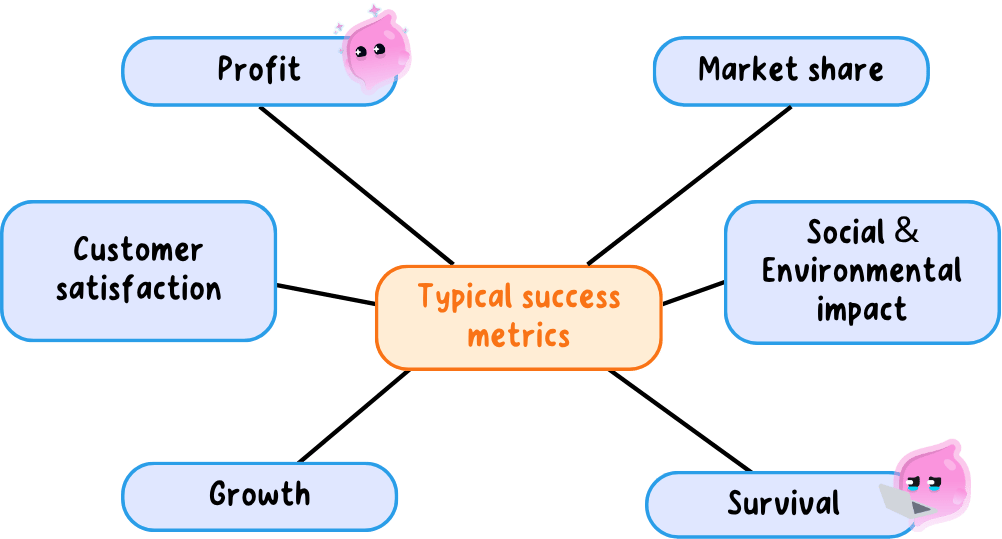
- Profit is the most common measure, and a business that set a profit target judges itself on whether that figure was reached.
- Customer satisfaction is measured by repeat custom, review scores and the number of complaints received, all of which can be counted month by month.
- Growth is measured by rising revenue, more outlets, more staff or more units sold than the year before.
- Survival is a measure in its own right, so a business still trading after three difficult years has succeeded against a survival objective even if it made no profit.
- Social and environmental impact is measured by figures such as tonnes of waste avoided, people helped or apprenticeships created.
- The National Trust judges itself on the buildings and land it has conserved and the visitors it has attracted, because those are the objectives it set.
- Market share shows performance against rivals, so a rising share means the business is winning customers its competitors have lost.
Example
- A business sells £4,200,000 in a year in a market where every firm together sells £30,000,000.
- A 14 per cent share means 14p of every £1 spent in that market is spent with this business.
- The objective has only been met if that percentage is higher than it was last year, so the owner should compare it with the previous figure before claiming success.
Common Mistake
- Do not treat profit as the only measure of success.
- The correct yardstick is whichever objective that particular business set for itself.
Reading the same performance against different objectives
- A profitable business can still have failed. A firm that set out to increase market share but lost share to a rival has missed its objective, whatever its profit figure shows.
- A loss-making business can still have succeeded. A start-up whose objective was to survive its first year and is still trading has done what it set out to do.
- Monzo grew its customer numbers for several years while still making a loss, and at that stage it was judged on customers won rather than on profit.
- The measure has to match the objective. Judging a charity by profit, or a six-month-old start-up by market share, produces a verdict that says nothing about whether it did what it was trying to do.
Note
- Different groups with an interest in the business also judge it by different measures, so an owner looks at profit while an employee looks at pay and job security.
- Those competing views are covered in the topic on stakeholders.
Deciding which measure to judge by
- Start with the objective the business itself set, because that is what its owners and managers were actually trying to achieve.
- Weigh the stage the business has reached. Survival is the fair measure for a first-year business, while a twenty-year-old plc should be judged on profit, market share and the return to its shareholders.
- Weigh the type of business. A charity or social enterprise has to be judged on its mission, because a profit for owners was never what it was set up to produce.
- Weigh the time period. A business can hit this year's profit target by cutting quality and then lose customers next year, so a single year's figure can point the wrong way.
- Use more than one measure where the evidence allows it. A business that grew revenue, held its market share and kept its review scores up has a stronger claim to success than one that only lifted profit.
Exam technique
- Do you think this business has been successful? Justify your answer is the wording here, and it wants a decision rather than a list of points on both sides.
- Name the objective the business set, take the target figure and the actual figure from the case material, then state plainly whether it was met.
- The mistake to avoid is judging every business by profit when the material has told you its objective was survival, growth or a social purpose.
Self review
- Against what should the success of a business be judged?
- Give three measures of success other than profit.
- How is market share calculated?
- Why can a business that made a loss still be judged a success?
- Why is one year's profit figure on its own a weak measure of success?
