5.4.1 Pricing methods
How a business chooses its price
- Price is the only part of the marketing mix that brings money into the business, because product, promotion and place all add to its costs.
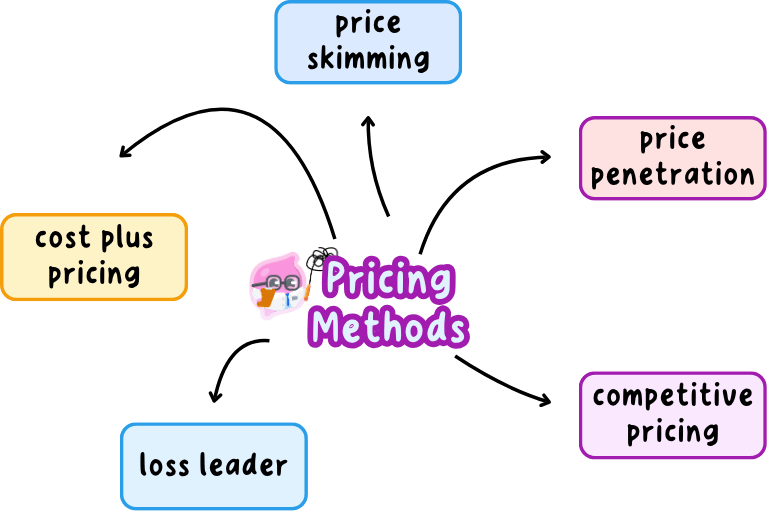
- The five pricing methods on the specification are price skimming, price penetration, competitive pricing, loss leader and cost-plus, and a business can use different methods for different products at the same time.
- The method a business picks changes the profit it makes on each sale, the number of units it sells and the image customers hold of the product.
The influences that push a business towards one method rather than another, its costs, its market, its rivals and the stage of the product life cycle, are taught in the article on factors influencing pricing decisions.
Price skimming
Price skimming: setting a high price for a new or unusual product at launch, then lowering it over time as rivals appear and the keenest customers have already bought.
- Skimming suits a product that is genuinely new, hard to copy quickly and facing few rivals, because the customers who want it first will pay a premium to have it first.
- Impact on the business: profit on every unit is high, so heavy development costs are recovered fast, but sales volume stays low and the wide margin advertises to competitors that the market is worth entering, which forces the price down later.
- Dyson prices each new cordless vacuum at the top of the market on release and keeps the previous model on sale for less once the newer one is out.
- A games console follows the same shape, priced high while keen gamers are queuing for it at launch and then discounted in bundles a year or two later.
Price penetration
Price penetration: setting a deliberately low price when a product enters a market, to win customers and market share quickly, then raising it once the product is established.
- Penetration suits a competitive market full of similar products, where customers switch easily and need a reason to try a name they do not know.
- Impact on the business: sales volume and market share grow quickly, but profit per unit is thin and the product may make a loss in its first months. Raising the price later is the hard part, because customers who came only for the cheap price may leave the moment it goes up.
Disney+ launched in the UK at £5.99 a month, well under the established streaming services, and lifted the price to £7.99 once it had built a large base of subscribers.
- Skimming starts high and comes down, while penetration starts low and goes up.
- Reversing that direction is the commonest error on this topic, so decide first whether the launch price sits above or below the rest of the market.
- Never recommend skimming for an ordinary product in a busy market, because customers will simply buy the cheaper rival.
Competitive pricing
Competitive pricing: setting a price at, or very close to, the price rival businesses charge for a similar product.
- It suits markets where the products are nearly identical and shoppers compare prices before buying, such as petrol, everyday groceries and car insurance.
- Impact on the business: sales volume is protected, because no customer walks away on price alone, but the profit margin on every sale is squeezed and a rival's price cut has to be matched. With price fixed by the market, the business has to win customers on quality, service, convenience or brand instead.
Sainsbury's runs an Aldi Price Match on hundreds of everyday items, holding those prices level with a cheaper rival so shoppers have no price reason to shop elsewhere.
Loss leader
Loss leader: a product priced deliberately at or below what it costs the business, to pull customers in so that they buy other, profitable products while they are there.
- Supermarkets choose staples such as milk and bread, because almost nobody drives to Tesco for one loaf and leaves with nothing else in the trolley.
- Impact on the business: more customers come through the door, and the loss taken on one line is covered many times over by the profit on the rest of their shopping.
- The risk is that some customers buy only the cheap item, and that a permanently low price teaches customers to think the product is worth very little.
IKEA's very cheap hot dogs and breakfasts earn the store almost nothing, but they bring families in and keep them there long enough to fill a trolley with furniture.
Cost-plus pricing
Cost-plus pricing: working out what one unit costs to make, then adding a set percentage of that cost on top to give the selling price.
- The formula is not supplied in the exam, so learn it and write it out before you substitute a figure.
- A bakery works out that one sausage roll costs £1.20 in ingredients, energy and labour and adds 40% on top, and when flour and energy later push the unit cost to £1.35 the same method raises the price automatically.
- At £1.68 each roll covers the £1.20 it cost and leaves 48p towards rent, wages and profit, so the owner knows no sale is made at a loss.
- At £1.89 the price has risen because the cost rose, not because customers were asked what they would pay, and it may now be more than they are willing to hand over for a sausage roll.
- Impact on the business: it is quick, needs no research and guarantees every unit's cost is covered, which is why small independent shops and tradespeople quoting for a job rely on it.
- Its weakness is that it looks only inwards, ignoring what rivals charge and what customers would accept, so the price can end up too high to sell or lower than it needed to be.
- Recommend a pricing method means choose one and stand behind it, so name it, define it in a sentence, then justify it using the business in front of you.
- Pull the deciding facts out of the scenario: how new or unusual the product is, how many rivals sell something similar, and whether the owner wants profit now or share first.
- Strengthen the choice by saying why the obvious alternative is worse, for example why penetration beats skimming when twenty firms already sell the same thing.
- Which method starts with a high launch price and lowers it over time?
- In what kind of market does price penetration make sense, and why?
- How can selling milk below cost still be profitable for a supermarket?
- Use cost-plus on a unit cost of £8 with 25% added, and state the selling price.
- Give one drawback of competitive pricing for a small business.
5.4.2 Factors influencing pricing decisions
Internal and external influences on price
- Every price sits between a floor and a ceiling: the business's costs set the lowest price it can survive on, and what customers are willing to pay sets the highest it can ask.
- Internal factors come from inside the business, mainly its costs of production and the stage its product has reached in the product life cycle.
- External factors come from outside it, mainly the nature of the market, the degree of competition and the level of demand.
- As a business grows and expands the pressures change, because it sells in more places and meets more rivals, while buying in bulk cuts its cost per unit and gives it room to price below a smaller competitor.
A factor is a pressure the business responds to; the five methods it can choose in response, including competitive pricing and cost-plus, are taught in the article on pricing methods.
Costs
- Over time the price has to cover the cost of making each unit, because a business selling below that cost loses money on every sale and eventually runs out of cash.
- The floor is found with average unit cost, and the formula is not supplied in the exam, so learn it.
- A furniture maker spends £180,000 to produce 15,000 stools.
- Any price under £12 loses money on every stool, so £12 is the floor and a price of £18 leaves £6 a stool towards profit, which tells the owner how much room there is before a discount becomes damaging.
- When a supplier raises its prices or wages rise, the unit cost rises with them, and the business must either put its price up or accept a thinner profit margin on each sale.
When ingredient and energy costs climbed sharply, Greggs raised the price of its sausage roll, because holding the old price would have left almost nothing on each sale.
The nature of the market
- In a mass market of millions of similar customers, price is the main weapon, so prices are low, margins are thin and the business relies on selling huge volumes.
- In a niche market a smaller group of customers wants something specific and will pay well above the average price to get it.
- Whether the product is an everyday essential or a luxury also shapes what feels acceptable, because customers judge a new price against the going rate they already expect.
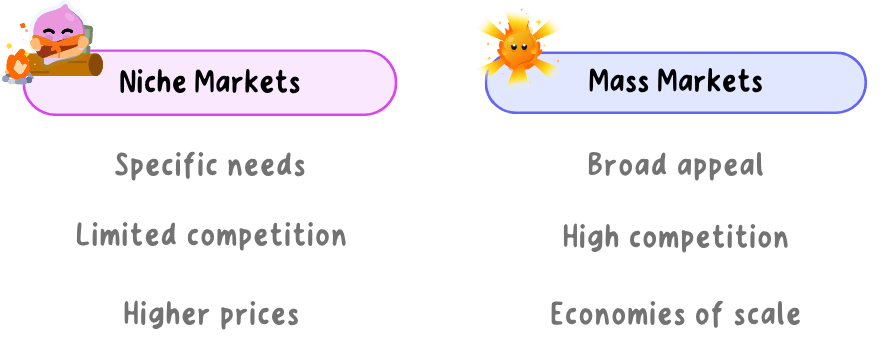
- Aldi sells to a mass market and builds its whole business around prices its customers can check against any rival.
- Brompton sells folding bikes built in London for well over £1,000, because commuters in its niche value a bike that folds small enough for a train.
The degree of competition
- The more rivals selling something similar, the less freedom a business has, because customers can compare prices in seconds and switch without losing anything.
- With few rivals, or with a product customers see as different from the rest, the business can hold a higher price and still keep its sales.
- This is why prices in a crowded market move together: when Tesco cuts the price of a staple and Asda does not follow, shoppers notice and move their weekly shop.
- The degree of competition is a factor, while competitive pricing is a method the business might choose because of it, so do not use the two words as if they were the same idea.
- Treating cost as the only influence is the other common slip, because a price that covers costs can still be far above what rivals charge or what customers will pay.
The stage of the product life cycle
- At introduction the launch price signals what the product is, so a genuinely new product can be priced high while a product entering a busy market is often priced low to win a first group of buyers.
- During growth rivals arrive, so the price is usually brought closer to theirs to protect the market share the product has won.
- At maturity price competition is at its hardest, with offers and multipacks used to defend sales against products that are much the same.
- In decline the price is usually cut to clear remaining stock and hold on to the customers who are left, which is why an out-of-date phone model is discounted rather than withdrawn immediately.
Price and demand
- The basic relationship is simple: as the price rises, demand is likely to fall, and as the price falls, demand is likely to rise.
- A higher price earns more on each sale but sells fewer units, so the business is always weighing the money per sale against the number of sales.
- How far demand falls depends on the product, so sales of essentials such as bread, and of strongly branded goods customers feel loyal to, drop less when the price goes up than sales of an unbranded treat.
- Demand itself moves over time, which is why easyJet charges far more for the same seat in the August school holidays than on a wet Tuesday in November.
- Analyse the factors that influence the price rewards a chain, so run each factor through to a consequence: the factor, the effect on the price, then the effect on sales or profit.
- Label each one internal or external if the question asks, since costs and the life cycle stage are internal while the market, rivals and demand are external.
- If a figure for total cost and output is given, work out the cost per unit and use it to show what the business cannot go below.
- Why do costs set a minimum price in the long run?
- Name two internal and two external factors that influence a pricing decision.
- State the basic relationship between price and demand.
- Why is price competition hardest when a product reaches maturity?
- Why can a niche business charge more than a mass market rival?
5.4.3 Developing new products
Benefits of developing new products
- Meeting changing needs: tastes, technology and lifestyles move on, so Warburtons added thins and wraps as customers began buying fewer standard sliced loaves.
- Growth in sales and revenue: a successful new product brings in customers the business did not have before, and can open a whole segment it was not selling to.
- Spreading risk: a wider range means the business is not depending on one product, so decline in an old line does not sink the whole firm.
- Staying competitive: a business that keeps selling the same thing loses customers to rivals offering something newer, so new products defend market share as well as building it.
- A stronger brand and a better price: a product that feels current and better than the old version can be sold at a higher price, and it keeps existing customers interested.
- Greggs developed a vegan sausage roll with Quorn and launched it in 2019, and it sold out in shops across the UK within days.
- The new product reached customers who had never thought of Greggs as a shop for them, so it added sales rather than simply moving them from the meat version.
Risks of developing new products
- The cost comes first. Research, prototypes, testing, new machinery and launch promotion are all paid for before a single unit is sold.
- Most new products fail. Dyson spent around £500 million developing an electric car and cancelled it in 2019 after deciding it could never be sold at a profit, and none of that spending came back.
- Cash leaves early. Money goes out months or years before any comes in, which can leave a small business short of cash even when the product eventually succeeds.
- Rivals copy success. Within months of the Greggs vegan roll selling out, other bakeries and supermarkets had their own version on sale, which shortens the advantage.
- Damage to what already sells: a poor new product harms the reputation of the whole range, and a good one can take sales from the business's own existing products rather than adding to them.
- Whether the risk is worth taking depends on the business, so a large firm with plenty of cash can absorb a failure that would close a sole trader.
- It also depends on the evidence, because thorough market research and small-scale testing cut the chance of failure but never remove it.
All of that spending on research, design and testing happens in the research and development stage of the product life cycle, when the business has no sales at all, which is covered in the article on the product life cycle.
Product design
- Good design has to get three things right at once, and pushing one too far usually damages another.
- Function: the product must do its job reliably and safely, because a kettle that boils slowly will not be bought twice however smart it looks.
- Appearance: how it looks and feels makes it stand out on a crowded shelf and tells customers at a glance what kind of product it is meant to be.
- Cost: it must be cheap enough to make that it can sell at a price the target market will accept and still leave a profit, so cheaper materials tempt a business even though they weaken function or appearance.
- Dyson designs its cordless vacuums around a motor small enough to sit in the handle, which is what makes them light to use and unlike a traditional vacuum to look at.
- That design costs a lot to make, so the machines are aimed at customers willing to pay a premium rather than at the cheapest end of the market.
Image and the needs of the target market
Target market: the particular group of customers a product is designed and sold to, described by things such as age, income, location and lifestyle.
- Design decisions start with who the product is for, because a product built to please everybody appeals strongly to nobody.
- Product image is the impression customers hold of a product, built from its design, name, packaging, price and promotion, and it is taken further alongside the unique selling point in the article on product differentiation.
- The image has to match what the segment expects, so plain recycled packaging and a higher price suit a brand sold on being ethical, while a product for young children needs bright colours and a name they can say.
- When design and image fit the target market, customers feel the product was made for them, and that is what turns a first purchase into a repeat one.
Gymshark designed its clothing, its website and its whole image around young gym-goers who follow fitness accounts online, which is how it grew into a major brand while selling mainly through the internet.
- Analyse the benefits and risks of launching a new product needs both sides and then a decision, so say clearly whether this business should go ahead and why.
- Base the decision on the firm's own position, such as how much cash it holds, how strong its research is and how quickly rivals could copy it.
- On design questions, name the target market first, then show how one design choice serves that group and what it does to sales.
- Give three benefits to a business of developing new products.
- Give three risks, and say which is the most serious for a small business.
- Why does developing a new product put pressure on a business's cash before it earns anything?
- What three things must good product design balance?
- Why should the design of a product start with its target market?
5.4.3b Product differentiation
What product differentiation means
Product differentiation: making a product stand out from those of rivals, so customers choose it for a reason other than a low price.
- In a competitive market, dozens of products do much the same job, so the customer picks on something, and differentiation decides what that something is.
- A product customers see as different is worth more to them, which means the business can charge a higher price and keep a wider profit margin on every sale.
- Differentiation also steadies sales, because a customer who wants this particular product will not swap it for whatever is cheapest that week.
A branded bottle of water such as Evian sells for several times the price of a supermarket own label, although both are safe and taste much the same, because customers are paying for the brand rather than the liquid.
The unique selling point
Unique selling point (USP): the one feature or benefit a product has that no competitor offers, giving customers a clear reason to choose it.
- A USP gives the marketing a single message that no rival can honestly repeat, which makes promotion cheaper and easier to remember.
- In a crowded market this is what stops the decision coming down to price, because a customer who wants that particular feature has nowhere else to get it.
- USPs wear out, because a good idea gets copied once rivals see it working, so a business has to keep developing the next one.
- Brompton's folding bikes fold small enough to carry onto a commuter train, which no ordinary bike can do, and are still built in London.
- Dyson's original USP was a vacuum that needed no bag, and once rivals launched bagless machines of their own Dyson had to differentiate again on power and cordless design.
Brand image
Brand image: the set of ideas and feelings customers hold about a brand, such as luxury, value, reliability or fun, before they have even tried the product.
- A good brand image builds brand loyalty, so customers buy again without comparing every alternative, and keeping a customer costs far less than winning a new one.
- It supports a higher price, because customers who trust the name accept that it costs more than an unfamiliar rival on the same shelf.
- It makes new products easier to launch, since a bar of chocolate sold under the Cadbury name starts with recognition and trust that a new business would spend years building.
- Image is built by every experience a customer has, from product quality and packaging to delivery and complaint handling, which is why one poor experience damages it faster than advertising repairs it.
Cadbury's purple wrapper is recognised across a shop before a single word is read, so the packaging alone tells shoppers what the product is and what to expect of it.
Other ways to stand out
- Design: a distinctive shape or look differentiates a product even when the function is ordinary, which is why a Mini is recognisable from across the street.
- Quality: better ingredients, materials or build justify a higher price, which is how Waitrose competes with Aldi without ever matching its prices.
- Customer service: John Lewis trains staff to advise and adds long guarantees on electricals, giving shoppers a reason not to buy the identical television cheaper elsewhere.
- How the product is made: Fairtrade cocoa, British sourcing or a repair service appeal to customers who care about those things more than about finding the lowest price.
- A brand is not just a logo, because the logo is only a shortcut for everything customers have come to expect from the business.
- Differentiation only works if customers notice it and value it, so a feature nobody asked for simply adds cost and cannot be charged for.
Competing without cutting the price
- Price cuts are the easiest thing for a rival to copy, so a price war leaves every business in the market selling the same amount for less money.
- Differentiation moves the competition onto ground rivals cannot copy by lunchtime, such as a patented design, a reputation or a trained workforce.
- The more crowded the market and the more alike the products, the more the business depends on a USP and a strong image to survive in it.
- Explain the benefit to the business of having a USP needs a chain, so go from the feature, to why customers want it, to the higher price or the repeat purchase it produces.
- The usual weak answer says a USP means more customers and stops there, when the point is that it removes price as the reason to buy.
- If asked about brand image, remember it costs time and money to build, so weigh that against the higher prices and loyalty it brings.
- Define product differentiation in one sentence.
- What is a USP, and why does it matter most in a competitive market?
- Give two benefits to a business of a good brand image.
- Name four ways other than price by which a product can be made to stand out.
- Why is competing on price alone dangerous for a business?
5.4.4 The product life cycle
The stages of the product life cycle
Product life cycle: the stages a product passes through from first being developed to being withdrawn from sale, shown as a curve of sales over time.
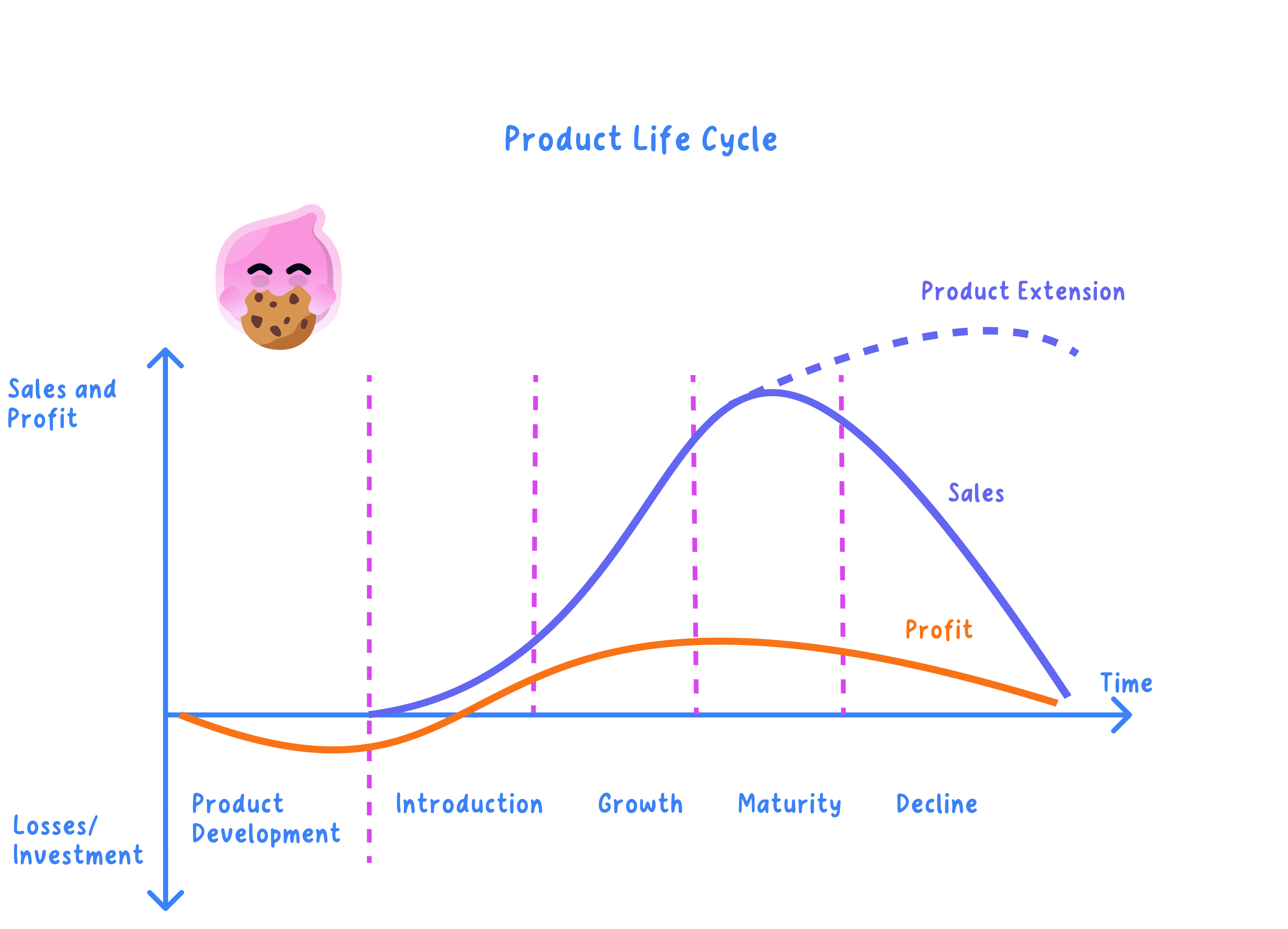
- The curve plots sales up the vertical axis against time along the horizontal axis, so the shape of the line is a picture of how demand for the product has changed: flat, then rising slowly, then steeply, then levelling off, then falling away. Most versions of the diagram add a second line for profit, which sits below zero while the product is still being developed.
- Research and development: the product is designed, built and tested before it goes on sale, so sales are zero. Diagrams sometimes label this stage product development. The business is spending on research, prototypes and machinery with nothing coming in, so cash flow is at its worst here.
- Introduction: the product is launched and sales begin, rising slowly because few customers know it exists. Heavy launch promotion means there is usually little or no profit yet, and many products fail at this point without ever growing.
- Growth: sales climb steeply as word spreads and more shops stock the product. Revenue rises fast and the product usually becomes profitable for the first time, which also attracts rivals into the market.
- Maturity: sales reach their peak and flatten out, because most customers who want the product already have it and competitors have filled the market. This is normally the most profitable stage, since development costs have been paid off and the product needs little introducing.
- Decline: sales fall as tastes change, technology moves on or a better rival arrives. The business then chooses between withdrawing the product and trying to extend its life.
- The stage a product has reached also drives the rest of the marketing mix, because price, promotion and place all shift as sales rise and fall, and the article on the integrated marketing mix follows those changes through.
- A games console is developed for years behind closed doors, launches at a high price to gamers who queue for it, then sells in huge numbers for two or three Christmases.
- Sales flatten once most fans own one, so bundles with games and price cuts appear, and decline arrives the moment the next generation is announced.
- Sales and profit are two separate lines, so the peak of the sales curve is not automatically the point at which the product earns the business most.
- Products move through the stages at wildly different speeds, since a fashion item can complete the whole curve in one summer while Heinz baked beans have sat in maturity for decades.
- Do not assume every product reaches every stage, because plenty never get past introduction.
Extension strategies
Extension strategy: an action taken to lift the sales of an existing product and delay its decline, so that its life in maturity is stretched out.
- Updating the packaging: a redesigned wrapper or bottle makes a familiar product look current and catches the eye again, which is why Cadbury has restyled the Dairy Milk wrapper repeatedly while the bar itself changed very little.
- Adding more or different features: new versions give existing owners a reason to buy again, so Nintendo added a bigger, brighter screen to the Switch four years after its launch.
- Changing the target market: aiming the same product at a different group reaches customers who never considered it, and it is the most powerful of the five because it finds a whole new source of demand.
- Advertising: a fresh campaign brings attention back to an ordinary product, which is how Warburtons keeps sliced bread in shoppers' minds with adverts built around well-known faces.
- Reducing the price: a lower price brings in customers who would not pay the old one, which is why Ford discounted the last Fiestas heavily before production ended in 2023, although every price cut takes profit off each sale.
- Timing decides how well any of them work, because an extension launched while the product is still selling well holds the curve up, whereas one launched after sales have collapsed is trying to revive a product customers have already left.
- Lucozade was sold for decades as a drink for people recovering from illness, and sales faded as fewer households kept it in the cupboard.
- Repositioning it as a sports energy drink, with new bottles and athletes in the advertising, changed the target market and sent sales climbing for years afterwards.
When an extension strategy works
- The curve is not destiny, because a well-judged extension bends maturity or early decline back upwards, which is how Dairy Milk has stayed a leading bar for more than a century.
- Extension is worth the money when the brand is still respected and the market still exists, since there is demand left to win back and the business avoids the cost and risk of developing a replacement.
- It fails when the whole market is disappearing, so no amount of new packaging would have saved DVD players once households moved to streaming, and HMV lost the shelf space anyway.
- Match the strategy to the cause of the fall: if customers find the product dated, new features help, but if a rival is simply cheaper, a price cut may start a fight the business cannot win.
- Extension delays decline rather than cancelling it, so a business that relies on it alone eventually has nothing new to sell, which is why the portfolio also needs products in growth.
- Identify the stage of the life cycle the product has reached is answered from the sales figures or the graph, so quote what sales are doing before you name the stage.
- Flattening sales are maturity and only falling sales are decline, so growth that has slowed down is not yet decline.
- Research and development sits before any sales exist, so it is the stage most often left out when the five are listed.
- List the five stages of the product life cycle in order.
- At which stage is cash flow at its worst, and why?
- What does the shape of the curve tell you about demand between introduction and decline?
- Name the five extension strategies and give a real product for one of them.
- When would you advise a business not to bother extending a product's life?
5.4.5 Product portfolio and the Boston Matrix
The product portfolio
Product portfolio: the full range of products a business sells, taken together rather than one at a time.
- Broadening the portfolio means adding products, which spreads risk, because a business selling one product has nothing left when that product reaches decline.
- Balancing the portfolio means holding products at different stages of their life rather than having everything bunched at the same stage.
- Because cash is limited, a business has to review the portfolio and decide which products deserve investment, which are left to earn quietly and which should be dropped.
Unilever's portfolio runs from Marmite and PG Tips to Dove and Ben & Jerry's, so a poor year for one brand barely touches the size of the business.
The Boston matrix
Boston matrix: a tool that places every product in a portfolio into one of four categories, using its market share and the growth of the market it sells in.
- The two measures are different things: market share is how big a slice of its market the product holds, while market growth is how fast the whole market is expanding.
- Stars: high market share in a fast-growing market, so they lead their market and sell strongly, but they swallow cash in advertising and extra capacity to keep up with the growth around them.
- Cash cows: high market share in a settled market that has stopped growing, and because they are well known and already paid for, they bring in far more cash than they need.
- Question marks, also called problem children: low market share in a fast-growing market, so they could become stars or could swallow money and never get there.
- Dogs: low market share in a market going nowhere, so they earn little and there is no growth left to win.
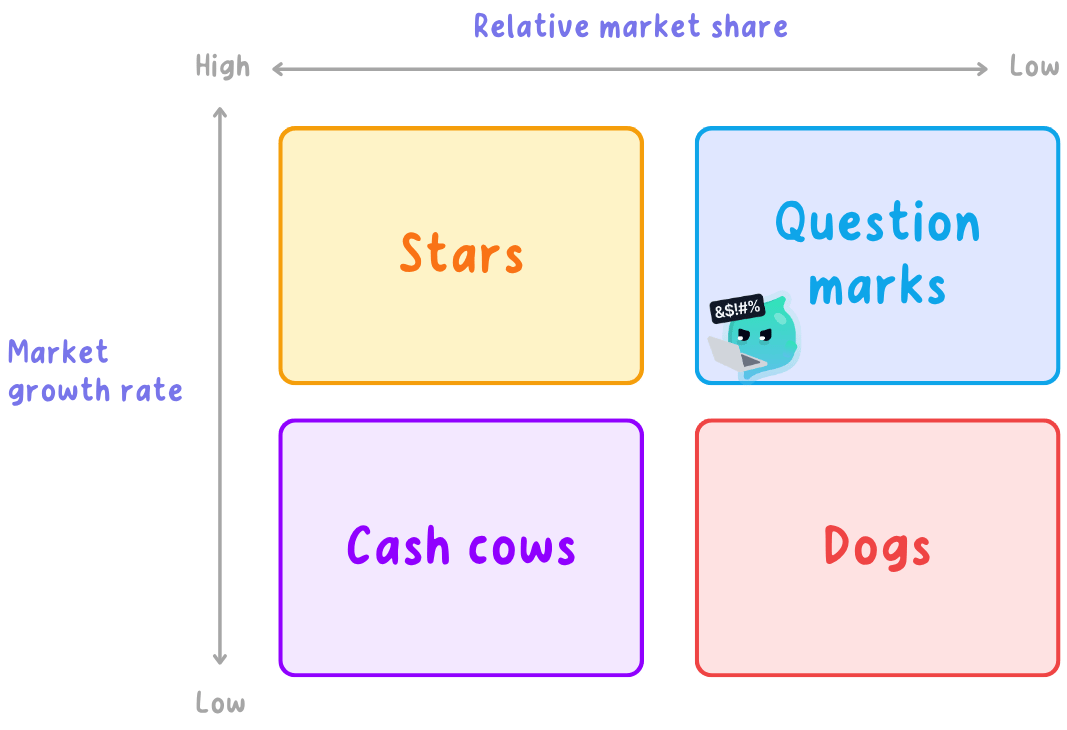
- Both stars and cash cows have a high share, and both question marks and dogs have a low share, so within each pair it is the growth of the market that separates them.
- On the diagram the share axis runs from high on the left to low on the right, the opposite way round to most graphs, so read the labels before you place a product in a box.
- A cash cow is not a product with falling sales, it is a market leader whose market has simply stopped expanding.
Working out market share
- Market share is the product's own sales expressed as a percentage of the sales of the whole market, and the formula is not given to you, so learn it.
- High and low are judged against the biggest rival rather than against a fixed figure, so a 20% share is high in a market split between many small brands and low in one where a rival holds 60%.
- A chocolate maker sells £48 million of its new plant-based bar in a market worth £600 million.
- An 8% slice is small, so with the plant-based market growing quickly this bar is a question mark, and the owners must decide whether to spend heavily on advertising and shelf space to build the share or drop it before more money goes in.
What a business does with each category
- Back the stars. Keep investing in promotion, distribution and capacity to hold the share while the market grows, because a star left alone loses its lead to a rival that is still spending.
- Milk the cash cows. Spend only what is needed to keep them selling, and use the cash they throw off to fund the stars and the question marks, which is what Cadbury's Dairy Milk does for the newer bars around it.
- Decide on the question marks. Either invest hard to build share while the market is still growing, or drop the product, because leaving it half-funded wastes money and wins nothing.
- Withdraw most dogs. Free up the shelf space, staff time and cash for something better, unless the product still covers its costs or completes a range customers expect to see.
Products move between the categories over time, so a question mark that wins share becomes a star, and a star becomes a cash cow once its market stops growing.
Why a balanced portfolio matters
- A balanced portfolio has cash cows earning today and stars or promising question marks ready to earn tomorrow, so the money is generated in the same business that needs to spend it.
- A portfolio of nothing but cash cows has no future, because every one of those markets will eventually shrink and there is no replacement coming through.
- A portfolio of nothing but question marks runs out of cash, because they all need funding at once and none of them is paying for itself yet.
- Treat the matrix as a snapshot rather than an instruction, since it says nothing directly about profit and a product it calls a dog may still make money for its owner.
- Identify and explain the four categories of the Boston matrix wants both halves, so name the category and then give its share and growth pairing in the same sentence.
- When you classify a product from an extract, quote the evidence twice, once for its share and once for how fast its market is growing.
- If sales figures and a market total are both given, calculate the share rather than guessing whether it counts as high or low.
- What is a product portfolio?
- Which two measures does the Boston matrix use?
- Give the share and growth pairing for each of the four categories.
- Why does a business use the cash from a cash cow rather than reinvesting it in that product?
- Explain one problem a business would face if its whole portfolio were question marks.
5.4.6 Advertising methods
Advertising and the advertising media
Advertising: communication about a product that a business pays to place in a chosen medium, to tell customers the product exists and persuade them to buy it.
Advertising media: the channels that carry the advert, such as newspapers, magazines, television, the internet, billboards, radio, cinema and leaflets.
- Because the space is bought, the business decides the exact wording, the pictures and where and when the advert appears.
- There are two questions to ask about any medium: who does it reach and what does it cost. The answers rarely point to the same medium, because the media that reach the most people are also the dearest.
- The cost of advertising is really two costs: producing the advert itself, and buying the space or airtime to show it.
Advertising is the paid part of promotion, so it is only one promotional method; sales promotion, public relations, sponsorship and social media are covered in the next guide.
Television, radio and cinema
- Television: one showing reaches millions of viewers at once, with sound, colour and movement to show the product being used, which is why Aldi and Warburtons build national campaigns around it.
- Filming the advert and buying peak-time airtime runs into hundreds of thousands of pounds, and most of those viewers are not in the target market, so a large slice of the spending reaches people who will never buy.
- Radio: airtime costs a small fraction of television, and a station covering one city reaches listeners in a defined area, which suits a single-branch garage or estate agent. There is nothing to look at, so the product cannot be shown, and drivers often treat adverts as background noise.
- Cinema: the advert fills a large screen in a dark room where nobody can look away, and the age certificate of the film tells the business roughly who is in the seats. Each screening reaches only a few hundred people, so building a large audience takes a long and costly run.
- Aldi runs its Christmas campaign on television because it needs every grocery shopper in the UK to see it in the same fortnight.
- A family-run garage spends far less on local radio and reaches only drivers within a few miles, which is exactly the audience it can serve.
Newspapers, magazines, leaflets and billboards
- Newspapers: a national title reaches millions of adult readers in a single day and a local paper covers one town cheaply, and print gives room for detail such as prices, addresses and opening hours, which is why Currys advertises offers this way. Readership is falling and is weighted towards older readers, and the paper is thrown away the same day.
- Magazines: readers choose a magazine by interest, so a walking title puts the National Trust in front of the people most likely to join, on glossy paper that is kept and read again. Each issue reaches a small number of readers and space is booked weeks ahead, so a magazine cannot carry an urgent message.
- Leaflets: printing and posting leaflets through chosen streets costs very little, which is why a new takeaway or gym uses them to reach nearby households. Most are binned unread, so thousands must be delivered to win a handful of customers.
- Billboards and posters: a site by a main road or in a station is seen again and again by the same commuters, and the cost for each person who passes is tiny. A passer-by has two seconds, so the advert can carry only a few words and one image, and it is seen by everyone rather than by a chosen group.
- A new Greggs opening in a town centre posts leaflets to the offices around it and takes a billboard site at the bus station, so the people who walk past every morning see it twice.
- Neither medium could carry the detail of a Currys price list, which is why the two businesses advertise in different places.
Advertising on the internet
- Search advertising: a paid listing appears when someone searches for that type of product, so the advert reaches a customer who is already looking to buy rather than interrupting one who is not.
- Targeted display and video adverts: adverts on websites, apps and video platforms can be set to appear only to chosen ages, areas and interests, so far less of the budget is spent on people outside the target market.
- Cost and flexibility: a small business can start on a few pounds a day, change the wording overnight and switch a campaign off, none of which is possible once television airtime is booked. Gymshark grew into a national brand on online promotion long before it had a shop.
- Measurement: the platform reports how many people saw the advert, clicked it and then bought, so the business can run two versions and keep the one that sells more.
- The internet is crowded, many users scroll past or block adverts, and a click is not a sale, so online advertising is cheap to start and easy to waste.
Paid adverts on social platforms belong here, while a business's own accounts, its influencers and the content customers share count as social media promotion rather than advertising.
Which media a given business is likely to use
- The audience: the medium has to be one the target customers actually use, so a brand aimed at sixteen-year-olds advertises on video platforms rather than in a local paper.
- The budget: a sole trader with £300 to spend is choosing between leaflets, a billboard site and online adverts, and television is simply not on the list.
- The product: a product that needs explaining, such as a Dyson vacuum cleaner, needs a medium that carries detail and shows it working, while a familiar chocolate bar needs only a reminder.
- The area served: a business that can only serve one town wants local media, because reach outside that town is wasted however cheap it looks.
- A national business such as Tesco runs several media at once so the same message reaches shoppers on television, in the press and online, while a single-site business concentrates its whole budget on the one or two media its customers use.
- Do not choose television just because it reaches the most people, because reach that falls outside the target market or outside the budget is worth nothing.
- Do not describe online advertising as free: the account costs nothing, but the adverts, the images and the staff time all cost money.
- When you are asked to recommend an advertising medium, pick one, name the customers it puts the advert in front of, and say why the alternative is worse for this business.
- Write what the medium does for this business, so "the billboard is seen by the commuters who walk past the shop" rather than "billboards reach a lot of people".
- The mistake to avoid is recommending an expensive national medium to a business whose customers all live in one town.
- What does it mean to say that advertising is paid for?
- Give one benefit and one drawback of television advertising.
- Why does a magazine advert suit a specialist product better than a national newspaper advert?
- Why can a billboard carry only a few words?
- Name two things a business should check before it books an advertising medium.
5.4.6b Sales promotion, PR, sponsorship and social media
Promotion beyond paid advertising
- Advertising is the promotional method a business buys space for. Alongside it sit four more methods: sales promotion, public relations, sponsorship and social media.
- They do different jobs. Sales promotion pushes customers to buy this week, while public relations, sponsorship and social media build how the business is seen over months and years.
Sales promotion: short-term incentives to buy
Sales promotion: a short-term incentive added to a product to encourage customers to buy it now.
- Point of sale displays: a stand, shelf-edge sign or basket by the till catches the shopper inside the shop and prompts an unplanned purchase, which is why Boots stacks small items at the queue. It costs the retailer selling space, and a shopper who has already decided what to buy walks straight past.
- Two-for-one offers: buy one get one free and similar multi-buys shift stock quickly and get customers to fill the cupboard with your brand rather than a rival's. Giving product away is expensive, and a customer who has bought two will not need any more for a fortnight.
- Repeating the same offer trains customers to wait for it, so the product starts to look worth only its offer price.
- Free gifts: a gift attached to the pack, such as a toy with a children's magazine, adds value without cutting the price, so the price the customer pays is protected. The gift has to be bought and packed, which raises the cost of every unit sold.
- Samples: handing out a free taste or trial size, as Lucozade does at stations, removes the risk of trying something new, which suits a launch. The business gives away product to people who may never come back, so the cost for each customer gained is high.
- Coupons and money off: a voucher or app code, such as the discounts Domino's sends its customers, cuts the price for the people who bother to use it and shows the business exactly how many responded. Every coupon redeemed comes straight off the profit on that sale.
- Competitions: an on-pack competition, of the kind Walkers has run for years, creates interest and gets customers to buy the pack to enter. The prize and the administration cost money, and some entrants buy once for the chance and never again.
Sales promotion lifts sales in the short term, so do not use it as the answer to a business that needs to change how customers see it.
Public relations
Public relations: the work a business does to earn favourable coverage and a good public image without paying for advertising space.
- The methods include press releases about a new product or shop, launch events, charity work, sponsoring a local school team and responding openly when something goes wrong.
- Coverage earned this way is cheap and it is believed, because the story reaches the customer through a newspaper or news programme rather than from the business itself.
- The business gives up control in exchange. It cannot dictate what is written, the story may never run, and bad news travels through the same channels just as fast.
- Greggs announced its vegan sausage roll with a short film sent to journalists, and the launch was reported free of charge across national news and radio.
- Buying that much national coverage as advertising would have cost millions, and the news reports carried more weight than an advert would have done.
Sponsorship
Sponsorship: paying a team, event, programme or person so that the business's name is associated with them.
- The business buys repeated exposure to a large audience that is watching willingly, on shirts, hoardings, tickets and every mention of the competition's name.
- It also borrows the image of whatever it sponsors, so a bank that backs a national competition looks established and trustworthy, and a sportswear brand that backs an athlete looks serious about sport.
- The drawbacks are the price, which puts major sponsorship out of reach of small businesses, and the risk that a losing season or a scandal involving the team or player rebounds onto the sponsor.
- Barclays pays to put its name on the Premier League, so millions of viewers in the UK and abroad see the brand every weekend of the season.
- A village plumber achieves the same effect for a few hundred pounds by paying for the shirts of the local under-11s team, seen every Sunday by exactly the parents who need a plumber.
Social media
Social media promotion: using platforms such as Instagram, TikTok, Facebook and X to promote a business through its own posts, through paid partners and through content that customers pass on.
- The business's own channels: posting photographs, videos and offers costs nothing but staff time, reaches followers who have chosen to follow, and lets the business answer questions and complaints in public. An account needs feeding constantly to stay worth following, and a complaint left unanswered sits there for every other customer to read.
- Influencers: paying someone with a large following to use and recommend the product borrows the trust their audience already gives them, which is how Gymshark built its customer base. The business cannot control what the influencer says or does next, and paid recommendations must be declared.
- Content customers share: a post funny or useful enough to be shared spreads at no extra cost, which is why Aldi keeps a playful voice online. Nothing guarantees that it spreads, and a complaint or a bad review spreads by exactly the same route.
- Social media suits a small budget and a young audience, but a business whose customers are older or offline still needs press, radio or leaflets to reach them.
- Name the exact technique, so "a free sample outside the station" or "a two for one offer on every pack", never "do a promotion".
- When the question says analyse the benefits of using sales promotion, follow the chain: the offer attracts shoppers, shoppers raise sales volume, and volume raises revenue even though the profit on each unit falls.
- Keep public relations and advertising apart in your answer: public relations earns coverage, advertising buys it.
- The mistake to avoid is offering a national sponsorship deal to a business the case study describes as a small start-up.
- What is sales promotion, and why is it described as short term?
- Name four sales promotion techniques and say what each is for.
- Why do customers often trust public relations coverage more than an advert?
- What does a business gain from sponsorship, and what is the risk it takes on?
- Give one reason a business cannot rely on social media alone.
5.4.7 Selecting the promotional mix
The promotional mix
Promotional mix: the particular combination of promotional methods a business chooses, from advertising, sales promotion, public relations, sponsorship and social media.
- No single method reaches everybody, so most businesses use two or three that cover each other's gaps, such as an advert to make customers aware and an offer to make them buy.
- Five things decide the mix: the finance available, what competitors are doing, the nature of the product or service, the nature of the market, and the target market.
The finance available
- The budget rules methods in and out before anything else is considered. A national television campaign costs hundreds of thousands of pounds, so a small independent is choosing between leaflets, a poster site, local press and social media.
- A small budget pushes a business towards methods with a low fixed cost: its own social media accounts, word of mouth, a search listing and a shirt sponsorship for the local team.
- Promotion is paid for before the extra sales arrive, so a business with weak cash flow may pick a cheap method now rather than the best method it cannot yet afford.
- A new independent coffee shop with £500 to spend uses leaflets to nearby offices, an Instagram account and a loyalty card.
- Costa, with a national budget, adds television, poster sites at stations and a phone app to the same list of methods.
- Both mixes suit the money available, which is why the cheap mix is not the wrong answer.
What competitors are doing
- If rivals promote heavily, a business that goes quiet is forgotten, so it may have to match them simply to stay visible on the same shelves.
- Matching a much larger rival pound for pound is impossible, so a smaller business often chooses a channel the rival ignores, where a small budget can dominate. A local gym cannot outspend PureGym, but it can own the town's social media feeds.
- Competitors also shape the message. Aldi's adverts compare its prices directly with Tesco's, because in that market the point customers care about is what the rival charges.
- When a rival launches a discount, the quickest reply is usually a sales promotion, because an offer can be in shops within days while an advertising campaign takes weeks to prepare.
The nature of the product or service
- An expensive or technical product has to be explained and demonstrated, so JCB sells diggers through trade magazines, exhibitions and salespeople rather than posters.
- A cheap everyday product that customers buy without thinking needs reminding and prompting instead, which is why Walkers uses television adverts and in-store offers.
- The product's image limits the methods. A premium brand avoids constant money-off deals because cutting the price repeatedly tells customers the product is not worth its price.
- How new the product is matters too. A launch needs methods that inform, such as samples and press coverage, while a product that everyone already knows needs methods that keep it front of mind.
The nature of the market and the target market
- Mass or niche: a mass market justifies wide, expensive methods because almost everybody who sees the advert is a possible customer. A niche market needs narrow methods, so a specialist cycling brand advertises in cycling magazines and nowhere else.
- Local or national: a business serving one town wants local radio, local press and leaflets, because reach beyond the delivery area is money spent on people it cannot serve.
- Selling to businesses or to the public: a business selling to other businesses uses trade press, exhibitions and direct contact, because its customers are counted in hundreds rather than millions.
- The target customers: their age, income and habits decide which methods will ever be seen, so a brand aimed at teenagers works through TikTok and influencers while one aimed at retired customers uses the local paper, radio and posted leaflets.
- Income matters as well as age, because customers on tight budgets respond strongly to coupons and multi-buys, while wealthier customers respond to quality and reputation.
- Gymshark reaches young gym users through influencers and social media, because that is where its customers spend their time and it costs a fraction of television.
- The National Trust reaches a much older membership through magazines, direct mail and leaflets left in the properties themselves.
Choosing the mix for a given business
- Work through the factors in order and most methods rule themselves out, which leaves a short list the business can actually afford and its customers will actually see.
- The methods chosen should say the same thing, so the prices, images and claims online match those in the shop and in print.
- The business then compares the cost of each method with the extra sales it brings in, and drops the ones that do not pay for themselves. Many businesses have moved spending out of print and into digital methods for exactly this reason.
- The dearest method is not the best one, because a cheap method aimed at the right people often brings in more sales for every pound spent.
- A small independent cannot buy television airtime at all, so recommending it ignores the finance available.
- Analyse the factors that influence this business's choice of promotional methods wants two or three factors taken from the case, each traced through to a method it rules in or out.
- If you are asked to recommend a mix, name two methods and justify each with a different factor, then say why you left the obvious expensive method out.
- The mistake to avoid is listing promotional methods with no link to this business's money, market or customers.
- What is the promotional mix?
- Name the five factors that influence which promotional methods a business selects.
- Why does a small budget push a business towards social media and leaflets?
- Give one way a competitor's actions can change a business's promotional mix.
- Why does a technical product need different promotion from a cheap everyday one?
5.4.7b Reasons for promotion
What promotion is for
Promotion: the part of the marketing mix that covers every way a business communicates with customers about a product.
- There are four reasons a business promotes: to inform or remind customers about the product, to persuade them to buy it, to create or change its image, and to create or increase sales.
- The reason comes first and the method follows, because the aim decides whether the business needs an advert, an offer, a press release or a sponsorship.
- Promotion does not mean only a discount or a special offer, and it is not another word for advertising.
- Advertising and sales promotion are two of the methods promotion uses, and the earlier guides in this chapter cover them.
To inform and remind customers
- Nobody buys a product they have never heard of, so a new product or a new shop needs promotion that carries the facts: what it is, what it costs, where to get it and when it opens.
- Informing also covers changes to something customers already know, such as a new recipe, a new size, longer opening hours or a move to a different site.
- Reminding keeps an established product in mind. Customers drift towards whatever brand they have seen most recently, so a business that stops promoting slowly disappears from the shopping list even though nothing about the product has changed.
- A new Aldi store leaflets the surrounding streets with its opening date, address and a list of prices, which is promotion to inform.
- Warburtons already sells bread in almost every supermarket, so its adverts tell shoppers nothing new and exist purely to remind them of the name at the bread shelf.
To persuade customers to buy
- Persuading means giving customers a reason to choose this product rather than a rival's, such as a lower price, better quality, faster delivery or a longer guarantee.
- This is why so much promotion makes a direct comparison. Aldi's adverts set its prices against Tesco's, and broadband providers advertise their speeds against each other, because the customer is choosing between them rather than deciding whether to buy at all.
- Persuasion matters most where the products are similar and switching is easy, such as insurance, mobile contracts and current accounts, because the message is almost the only thing separating one supplier from the next.
- Monzo promotes how quickly an account can be opened on a phone, because it is persuading customers to leave a bank they are already with.
- Currys promotes a price promise for the same reason: the television is available elsewhere, so the promotion has to remove the reason to shop around.
To create or change the image of the product
- A product's image is what customers assume about it before they buy, and promotion shapes that image through the words, pictures, people and events the business attaches to it.
- A business creates an image at launch and changes it later when it wants different customers, when it moves upmarket or downmarket, or when it has to recover from bad publicity.
- Image work is slow and it uses different methods from a sales push, because public relations and sponsorship change what customers believe while a discount only changes what they pay.
- Greggs was seen for years as a cheap bakery, and its playful social media voice and vegan launches turned it into a brand younger customers follow and talk about.
- The prices barely moved, so the change came from the promotion rather than from the product itself.
To create or increase sales
- The other three reasons all end here, because informing, persuading and building an image are worth paying for only if more customers buy.
- Selling more units raises revenue directly, so a business can put a figure on what a campaign has done for it.
- A café sells 200 coffees a week at £3, then leaflets the nearby offices and sells 240 a week.
- The promotion brought in £120 more revenue a week, so the owner should keep leafleting only if the leaflets and the extra milk, cups and coffee cost less than that.
- Promotion that raises sales by less than it costs makes the business worse off, which is why the extra revenue always has to be set against the cost of the campaign.
- Promotion is also used to defend sales rather than grow them, so a business facing a new rival promotes to hold on to the customers and the market share it already has.
Matching the reason to the situation
- A brand-new product needs promotion that informs, and a long-established one needs promotion that reminds, which is why two businesses in the same market can run completely different campaigns.
- A business losing customers to a rival promotes to persuade, and one entering a new segment or recovering from bad publicity promotes to change its image.
- When the question asks why this business promotes its products, name the reason precisely rather than writing "to increase sales" every time.
- To explain the effect, follow the chain: promotion raises awareness, awareness brings more customers, and more customers raise revenue.
- The mistake to avoid is treating image and sales as the same aim, since a business can sell more this month while damaging how customers see it.
- What are the four reasons a business promotes a product?
- What is the difference between promoting to inform and promoting to remind?
- Why does a well-known product still need promotion?
- Give one reason a business might want to change the image of a product.
- State the formula linking revenue to price and quantity sold, and explain why it matters to promotion.
5.4.8 Place: channels of distribution
Place and the channel of distribution
Channel of distribution: the route a product takes from the producer to the customer, either direct or through businesses in between.
- Place is the part of the marketing mix that decides how and where the customer gets hold of the product, and a business can only sell to customers its chosen route reaches.
- Every business that handles the product on the way, called an intermediary, does a job for the producer and takes a share of the final price for doing it, so the choice of channel is a choice between reach and the share of the price the producer keeps.
The channels a business can use
- Producer to customer: the producer sells straight to the customer, from its own shop, its own website, a factory outlet or over the telephone. A farm shop selling its own vegetables is the simplest version.
- Producer to retailer to customer: the producer sells in bulk to a shop, which sells single items to the public. Warburtons delivers bread straight to Tesco, which sells the loaves.
- Producer to wholesaler to retailer to customer: the producer sells lorry-loads to a wholesaler such as Booker, thousands of corner shops buy a few boxes each from the wholesaler, and customers buy single packets from the shops.
- One crisp manufacturer can use two channels at the same time, selling multipacks direct to the big supermarket chains and single bags through a wholesaler to corner shops.
- The supermarket buys enough to be worth a delivery of its own, while no manufacturer would send a lorry to a shop that wants two boxes.
What retailers and wholesalers add
Retailer: a business that sells goods in small quantities to the final customer, in a shop or online.
Wholesaler: a business that buys in bulk from producers and breaks that bulk into smaller quantities to sell on to retailers.
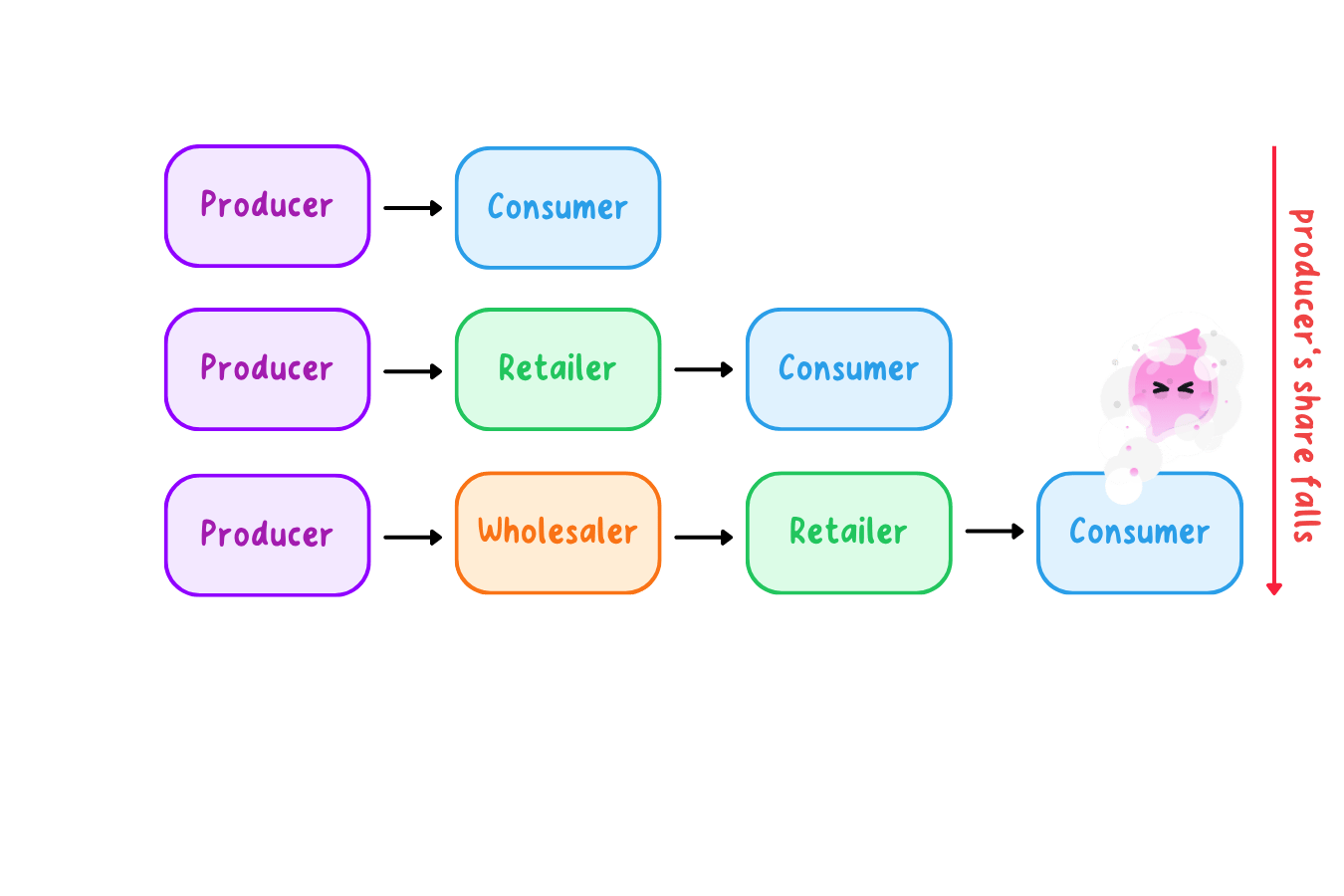
- A retailer brings customers. It provides high-street locations, opening hours, displays, staff who answer questions and the footfall of shoppers who came for something else, none of which the producer would have to build itself.
- A retailer also takes the stock off the producer's hands and pays for a large order, which brings cash in sooner and moves the risk of unsold stock down the chain.
- A wholesaler breaks bulk. A village shop can buy two boxes instead of a pallet, so small retailers can afford to stock the product at all, and the producer reaches thousands of tiny shops it could never deliver to.
- A wholesaler also stores the goods, delivers them and handles the paperwork, so the producer deals with a handful of large customers instead of thousands of small orders.
- A wholesaler sells to other businesses and a retailer sells to the public, and mixing the two up is the most common error on this topic.
- Do not write that intermediaries add cost for nothing, because both of them do work the producer would otherwise have to do.
Why a longer channel raises the price
- Each business in the chain sells for more than it paid, adding a margin to cover its own costs and its profit.
- A drinks producer sells a bottle to a wholesaler for £0.30, the wholesaler adds £0.15 and the corner shop adds £0.50.
- The producer receives £0.30 of the £0.95 the customer pays, and the other £0.65 buys storage, delivery and shop space.
- If that producer sold the same bottle from its own website at £0.70 it would keep far more of the price, but it would then have to find and serve every customer itself, so the shorter channel is only worth it if the extra promotion and delivery cost less than the margins it has saved.
Selling direct and by telesales
Telesales: selling to customers over the telephone, either by taking their calls or by ringing them, with no shop involved.
- Selling direct shortens the chain to nothing, so the producer keeps the whole price, controls how the product is presented and owns the relationship with the customer, which also means it collects the data on who is buying.
- The work does not disappear, it moves. The producer now pays for storage, packing, delivery, returns and all the promotion needed to make customers aware, and it reaches fewer people than a national retailer would.
- Telesales is one way of selling direct. It needs no premises on a high street, one team can cover the whole country, a trained seller can answer objections and suggest a more expensive option, and every call can be recorded and checked.
- Its drawbacks are that customers cannot see or handle the product, wages make each sale expensive, and unwanted sales calls annoy people and can damage the business's image. It works best for services and repeat orders, such as insurance renewals and business supplies, rather than for goods customers want to try.
Selling through a website or an app is the other main direct route, and the next guide covers e-commerce and m-commerce in full.
Choosing the channel for a given business
- The product decides a great deal. Fresh or fragile goods need short channels, cheap everyday goods sold in thousands of small shops need a wholesaler, and expensive goods that must be demonstrated, such as a JCB digger, are sold through specialist dealers.
- The market and the money decide the rest. A business selling nationally needs retailers, telesales or a website to reach that far, while a small producer with a strong local following can sell direct and keep the whole price. A premium brand also checks that the shops stocking it match the image it charges for.
- A long channel also hands power away. A small producer that sells almost everything through one supermarket has to accept the price it is offered and can be dropped at the end of the contract, which is why many producers keep their own website running alongside the retailers.
- Analyse whether this business should sell through retailers or direct to customers wants the gain and the sacrifice of each route, applied to the product in the case.
- Write the chain out in the right order, producer to wholesaler to retailer to customer, and say what each link does for this business.
- The mistake to avoid is claiming a business saves money by cutting out intermediaries without saying who now does their storing, delivering and selling.
- What is a channel of distribution?
- State the three main channels in order, from shortest to longest.
- What does breaking bulk mean, and which small businesses does it help?
- Why does a longer channel usually mean a higher price for the customer?
- Give one benefit and one drawback of selling by telesales.
5.4.9 E-commerce and m-commerce
E-commerce and m-commerce
E-commerce: buying and selling goods and services over the internet.
M-commerce: buying and selling through mobile devices such as smartphones and tablets, usually through an app.
- Selling online is a place decision, because a website or an app is another channel of distribution: the customer reaches the product through a screen instead of a shop.
- M-commerce is the part of e-commerce that happens on a phone, and it has grown fastest because the customer can buy on a bus or in a queue, in the moment they think of it, rather than waiting to get to a computer.
- An app also holds the customer's card details and address, so buying takes two taps, and it can send a notification straight to the customer's pocket when there is an offer.
- Both have grown year after year, so a business with no online channel now loses sales to rivals that have one. Next has closed high-street stores while its website has become the larger part of its business, and Tesco has grown its grocery deliveries alongside its aisles.
This guide covers e-commerce as a marketing decision; the wider effects of technology on how a business operates belong to the technology topic.
Reaching further, including international markets
- A shop can only sell to people who walk through the door, so its market is the town around it. A website removes that limit, and the market becomes everyone who can find the site and receive a parcel.
- The business can sell across the whole UK without opening a single extra branch, which means growth without the rent, fittings and staff that new shops would need.
- International markets open up in the same way. A small UK business can take an order from Germany or Australia from one warehouse, which spreads its risk across several countries and lets a niche product find enough customers worldwide even though there are few in any one town.
- Selling abroad brings extra work, because the site may need other languages and currencies, and delivery over long distances costs more and takes longer.
- The site is open at all hours, so orders arrive overnight and at weekends when every high-street rival is shut, and the business earns from those hours without paying anyone to stand behind a counter.
- ASOS built a national fashion business with no shops at all, shipping from a small number of warehouses to customers in the UK and abroad.
- Gymshark did the same for gym clothing, selling to customers in dozens of countries years before it opened a single store.
Lower costs and greater flexibility
- There is no high-street rent, no business rates on a prime site, no shop fittings and no team of shop assistants, so the fixed costs the business must cover each month are far lower than a chain of stores would carry.
- Stock sits in one warehouse instead of being spread across dozens of shops, so less has to be bought in the first place and less is left over to discount at the end of a season.
- Prices, photographs and the whole range can be changed in minutes, and the site records what every visitor looked at, so promotion can be aimed at the customers most likely to buy.
The drawbacks of selling online
- Delivery: every order has to be picked, packed and couriered, so postage and packaging are added to the cost of each sale, and a parcel that arrives late or damaged loses the customer even though the product was fine.
- Returns: customers who cannot try before they buy order two sizes and send one back, and the business pays for the return postage, the checking and the repacking on a sale it never made.
- A secure site: taking card details means paying to build and maintain a secure site, and a crash or a hack stops all sales at once and destroys the trust that made customers hand over their details.
- Easy price comparison: a rival's price is one tab away, so a business selling online competes with the whole country rather than the other shops in its town, which pushes prices and profit margins down.
- No physical browsing: customers cannot hold the product, smell the coffee or try the coat on, and there is no assistant to answer a question, so the site has to do that work with photographs, descriptions and reviews.
- Selling online is not cost-free: the shop rent is replaced by delivery, returns, the website and the promotion needed to be found at all.
- Wider reach is only a benefit if the extra customers exist, so a business that serves one town gains far less from it than a specialist selling nationwide.
Whether the online channel suits a given business
- The product has to survive the journey and be worth posting, so books, clothes and gym kit suit it while ice cream, a haircut and a fitted kitchen do not.
- The customers have to be willing to buy on a screen, so a business whose customers are older or rarely online still needs a shop, a telephone line or a catalogue alongside the site.
- Most established businesses now run both channels together. Currys lets customers order online and collect in store, and Tesco sells the same groceries in its aisles, on its website and through its app.
- A craft jeweller in a village sells a handful of pieces a week to passing trade, and a website turns the whole country into her market for products small enough to post in an envelope.
- The bakery next door gains almost nothing from the same website, because its cakes will not travel and its customers are the ones already walking past.
- If the case study mentions an app or shopping on phones, use the term m-commerce rather than settling for e-commerce.
- Analyse the benefits to this business of selling online wants a chain, so wider reach brings more orders, more orders raise revenue, and lower fixed costs mean more of that revenue is left as profit.
- The mistake to avoid is listing reach and low costs while ignoring delivery, returns and the fact that rivals' prices are one click away.
- Define e-commerce and m-commerce, and say how they differ.
- How does selling online let a small UK business reach international markets?
- Why are the fixed costs of a website lower than those of a chain of shops?
- State three costs or risks a business takes on when it starts selling online.
- Why does easy price comparison online squeeze a business's profit margin?
5.4.10 Integrated nature of the marketing mix
The four Ps as one decision
Marketing mix: the four Ps a business decides on together, product, price, promotion and place, to meet the needs of its target market.
- The mix is integrated when all four Ps point the same way and support each other, so the customer receives one clear message rather than four separate ones.
- Change one P and the others usually have to change too. Raising the price means the product has to justify it, the promotion has to look worth it and the shops stocking it have to match it.
- The mix is four musicians playing one song, and each can be excellent on their own.
- If one of them plays a different tune the audience does not hear three good players, it hears a mess.
How the four Ps support each other
- Take Hotel Chocolat, which sells chocolate as a gift to customers willing to pay for something special. Every P is built around that one decision.
- Product: a high cocoa content, unusual flavours and heavy boxed packaging that looks like a present before it is opened.
- Price: a premium price that covers those ingredients and that packaging, and that tells the buyer the gift is worth giving.
- Promotion: tasting events, food magazines and email to existing customers, rather than money-off coupons that would undercut the price it has just charged.
- Place: its own shops, department stores and its own website, so the surroundings match the price and no discount shelf sits alongside it.
- Aldi does the same job in the opposite direction. Its own-label range, low prices, price-comparison adverts and no-frills stores all say the same thing, and each P makes the others possible, because plain stores and short ranges are what keep the costs low enough for the prices.
When the mix contradicts itself
- Put a value-range biscuit on a shelf in a luxury department store and neither P works. The store's customers do not believe a cheap biscuit belongs there, and the shoppers who want it are in Aldi.
- A premium price with constant discounts contradicts itself just as badly, because customers who see the product cut every fortnight decide the low price is the real one and stop paying the high one.
- Promotion and place can contradict each other too. A business that advertises heavily on television before the product is in the shops sends customers looking for something they cannot buy, and it pays twice to bring them back.
Check any mix you recommend by imagining one customer meeting all four Ps at once, because a mix that reads well as a list can still contradict itself in a shop.
The mix changes over time
- A mix that fits today will not fit in three years, because the product ages, rivals copy it, customers' tastes move on and technology changes where they shop. The clearest pattern is the way the mix shifts across the product life cycle.
- At launch the product is new, promotion has to inform and explain, the price may be set high while the product is the only one of its kind, and place is often limited to a few stockists and the business's own website.
- In growth the product is proven, so promotion switches to building the brand, more retailers are added to keep up with demand, and the range widens with extra sizes and colours.
- In maturity rivals have caught up, so the price becomes competitive, promotion reminds rather than informs, sales promotions defend the shelf space, and the product itself may be refreshed to hold the customers it has.
- In decline promotion is cut back to save money, prices are lowered to clear the stock, and the product is dropped from the shops that sell least, until it is withdrawn.
- The mix is also pushed from outside the life cycle, because new technology moves customers on to their phones, incomes fall in a downturn and rivals copy whatever works, so a business has to review the four Ps even when the product itself has not changed.
- How a business should react depends on whether the change will last. A permanent shift, such as customers moving to buying on their phones, is worth rebuilding place and promotion around, while a short dip in sales is better met with a temporary offer, because changing all four Ps costs money and unsettles the customers who liked the old mix.
- A new Dyson vacuum launches at a high price, with adverts demonstrating what it does, sold through Dyson's own site and a small number of retailers such as Currys.
- Years later the same model is cheaper, stocked in supermarkets and discount sites, and promoted with offers rather than demonstrations, because all four Ps have moved together as it matured.
Using the mix to make a decision
- Start from the aim and the target market, because they decide what the mix has to achieve: a business trying to survive needs sales quickly, while one trying to move upmarket needs to change what customers believe.
- Then choose each P with the other three in front of you, and check the four together against the customer you named at the start.
- Finally check the business can deliver it, since a mix commits the rest of the business: production has to make the quality promised in the quantities promoted, and the money has to be there to pay for the promotion before the extra sales arrive.
A rival can copy one P in a week, but copying four that fit together takes years, which is why an integrated mix is what actually keeps customers.
- Recommend a marketing mix for this business wants a decision on each of the four Ps, with each one justified by the target market in the case.
- Show the links out loud, so "the premium price only works because the packaging and the department store back it up" rather than four unconnected paragraphs.
- If the question is about a product that has stopped selling, say which P has fallen out of step and what changing it forces on the other three.
- What are the four Ps of the marketing mix?
- What makes a mix integrated rather than four separate choices?
- Trace one aim, such as selling a product as a gift, through all four Ps.
- Give one example of a mix that contradicts itself, and explain why it fails.
- How should a business react differently to a permanent change in its market and to a short-term dip in sales?
