What sustainability means
Definition
Sustainability: meeting the needs of the present without damaging the ability of future generations to meet their own needs.
- It is a long-term test. A sustainable business asks whether it could keep operating in the same way for decades, rather than only whether it can afford this year's order.
- Two things make an activity unsustainable. Using up resources faster than they can be replaced, and releasing gases that warm the planet, both leave the future worse off than the present.
- It applies to the whole chain. The materials a firm buys, the energy it burns, the distance its goods travel and what happens to the product when the customer has finished with it all count.
Analogy
- A finite resource is like savings in a bank account: once spent, it is gone.
- A renewable resource is like a monthly wage, which keeps arriving as long as you do not spend it faster than it comes in.
Using scarce resources
Definition
Finite resources: resources such as oil, gas and metal ores that exist in limited quantities and cannot be replaced once they have been used.
- Some resources run down. North Sea oil and gas, the metals in a phone battery and the sand used in glass all come from stocks that shrink each time a business draws on them.
- Renewable resources can still be used up. Timber and fish replace themselves, but only if they are harvested slowly enough, which is why fishing quotas and replanted forests exist.
- Scarcity shows up as price. As a material becomes harder to obtain it costs more, so a firm that designs the material out of its product protects itself against future price rises.
- Supply itself is at risk. A furniture maker whose timber supplier clears forests without replanting will eventually have nothing to buy, so sustainability protects the business as well as the environment.
Example
- Drinks makers have redesigned plastic bottles to use thinner walls and lighter caps, so each bottle needs less plastic and a lorry carries less dead weight.
- UK supermarkets have removed shrink wrap from multipacks and cut plastic trays from fruit and vegetables, which uses less material and less waste collection.
- Furniture and paper firms buy timber certified as coming from replanted forests rather than from cleared woodland.
Global warming and what it means for a business
- Burning fossil fuels causes it. Gas boilers, factory furnaces, lorries and aircraft release greenhouse gases that trap heat in the atmosphere and raise average temperatures.
- A firm's contribution is its carbon footprint. This is the total greenhouse gas its activities produce, from the electricity in its offices to the delivery miles its goods travel.
- Extreme weather disrupts supply and premises. Floods close warehouses and shops, and a run of poor harvests raises the price of wheat, which pushes up costs for a bread maker such as Warburtons.
- Rules and taxes tighten as the problem grows. Governments respond with charges on emissions and deadlines for ending petrol and diesel sales, so a firm that ignores its footprint faces a forced change later.
Note
- Global warming reaches a business through its costs and its supply chain, which is why it appears in a business course rather than only in science.
- Local effects such as congestion, noise and waste disposal are covered in environmental considerations.
How a business can act more sustainably
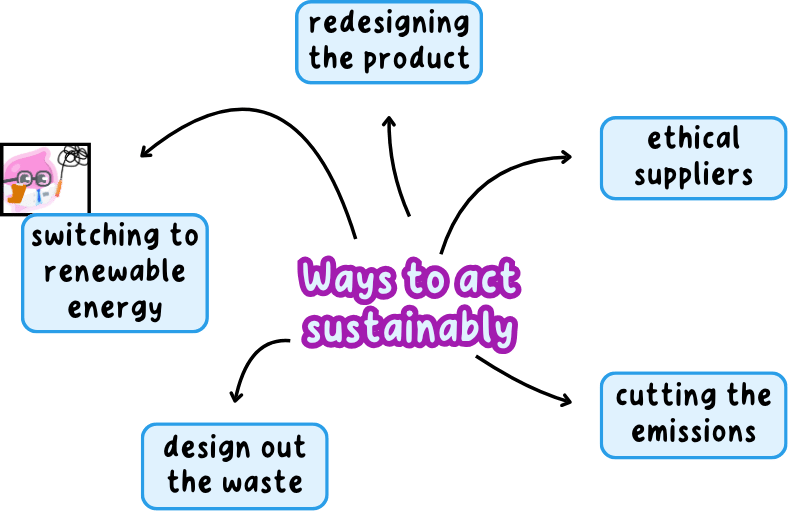
- Switch to renewable energy. Tesco buys the electricity for its UK stores from renewable sources, and a smaller firm can fit solar panels to a factory or warehouse roof.
- Redesign the product to use less. Making a bottle thinner, a box smaller or a component out of recycled metal cuts the resources consumed and the cost of every unit made.
- Buy from suppliers that replace what they take. Certified timber, responsibly caught fish and Fairtrade crops all come from sources managed so they will still exist in twenty years.
- Cut the emissions of moving goods. Electric delivery vans, fuller lorries and suppliers closer to the factory all reduce the fuel burned to get a product to the customer.
- Design out the waste. Refill stations, repairable products and take-back schemes keep materials in use instead of sending them to landfill after one life.
The trade-off between sustainability and profit
- The spending comes first and the gain comes later. Solar panels, electric vans and certified materials reduce profit in the year they are bought, and only repay the firm across the years that follow.
- Whether the market will pay decides the outcome. Customers of a premium brand may accept a higher price for a lower-impact product, while shoppers choosing on price alone will move to a rival that changed nothing.
- The firm's cash position limits the choice. A business with reserves can fund the change and wait for the savings, whereas one that is short of cash cannot spend £20,000 now however sensible it looks.
- Sometimes the two point the same way. Using less energy, less packaging and less fuel cuts costs immediately, so the conflict with profit is strongest where the change needs heavy investment.
Common Mistake
- Do not assume the trade-off always runs the same way, because the size of the up-front spending is what decides how much profit is sacrificed.
- A sustainable change customers never hear about carries the cost with none of the reputation gain.
Exam technique
- A question asking you to analyse the trade-off between sustainability and profit for this business wants one chain showing profit falling now and one showing it rising later, then a decision about which matters more to this firm.
- Use the timescale deliberately: say "in the first year" and "over the next five years", because the trade-off is really an argument about when.
- The slip students make is answering about litter and local pollution, which belongs to environmental considerations, instead of scarce resources and global warming.
Self review
- Define sustainability in one sentence.
- What is the difference between a finite resource and a renewable one?
- Give two ways global warming raises costs for a business.
- Name three ways a firm can act more sustainably.
- Explain the trade-off between sustainability and profit, and name one thing that decides which side wins.
