What an interest rate means for a business
Definition
Interest rate: the cost of borrowing money, and the reward for saving it, shown as a percentage of the amount each year.
- The Bank of England sets the UK base rate, and banks such as Barclays set the rates they charge borrowers and pay savers in line with it.
- A change in the rate reaches a business along two routes, and a good answer picks the one that fits the business in front of you.
- The cost route: what the business itself pays on the money it has borrowed.
- The demand route: what its customers have left to spend once their own borrowing has been paid for.
Analogy
- Interest works like rent on money: a borrower pays rent for using the bank's money, and a saver collects rent for letting the bank use theirs.
- When the rate rises, the rent on money goes up for everyone who is borrowing, businesses and households alike.
The effect of a rate rise on a business that borrows
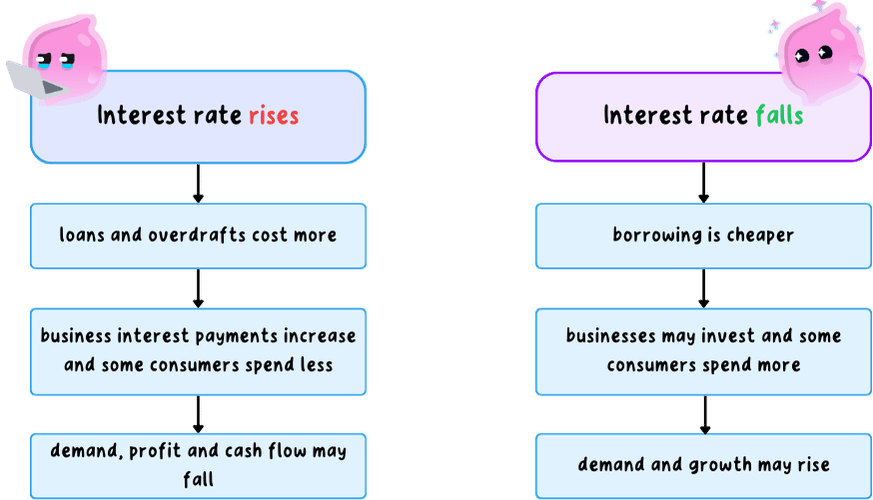
- An overdraft costs more. A business pays interest on however much it is overdrawn, so a rate rise increases that charge straight away.
- Loan and mortgage repayments rise. A business with a variable-rate loan or a commercial mortgage has to find more money each month for the same debt.
- Interest is a cost, so a bigger interest bill raises total costs and cuts profit even when sales have not changed at all.
- A business on a fixed-rate loan feels nothing until that deal ends, then borrows again at the new, higher rate.
- Borrowing to invest looks less attractive. A new shop, van or machine is only worth financing if the extra profit it earns beats the interest charged on the loan, so a rise turns borderline plans down.
- Postponed investment means the business grows more slowly, and the suppliers of that equipment lose the order.
Example
- An independent bakery with a £120,000 variable-rate loan from Barclays sees its monthly repayment rise after a rate increase, so its costs go up and its profit falls.
- The owner shelves the plan to borrow again for a second shop, because the interest on that second loan would now swallow most of the profit the shop was expected to make.
The effect of a rate rise on customer spending
- Customers with a mortgage or a credit card balance pay more interest each month, so they have less money left over.
- Consumer spending falls, so businesses selling to those households see demand and revenue drop.
- Businesses selling wants are hit hardest, because a television from Currys or a meal out at Nando's can be put off until money is easier, and items usually bought on credit are the first to be cancelled.
- Businesses selling needs hold up better, because customers still buy groceries from Tesco and bread from Warburtons whatever the rate does.
Common Mistake
- Do not mix up interest rates with inflation: interest is the cost of borrowing money, while inflation is a rise in the general level of prices.
- An answer that says shop prices have gone up is describing inflation, not the effect of a rate change.
When rates fall, and who gains from a rise
- A fall in the rate reverses both routes.
- Overdraft charges and variable loan repayments shrink, so costs fall and profit rises.
- Borrowing to expand becomes cheaper, so plans that were shelved go ahead.
- Customers with mortgages keep more of their pay, so demand recovers first for the wants they had cut.
- A rise is not bad news for every business. A business holding cash in the bank earns more interest on those savings, and a business with no borrowing avoids the cost route completely.
Note
Interest rates are one influence on what customers spend; the level of employment and the size of consumer incomes are the others, covered in 2.3.2.
Exam technique
- The usual wording is explain how an increase in interest rates might affect this business, so begin by deciding which route applies to it.
- If the case mentions a loan, mortgage or overdraft, develop the cost route: repayments rise, costs rise, profit falls.
- If the business sells wants such as furniture, electricals or meals out, develop the demand route: customers pay more interest, cut back, and sales fall.
Self review
- Which body sets the UK base rate?
- Why does a rate rise raise the costs of a business using an overdraft?
- Why does a business postpone buying new equipment when rates rise?
- Trace how a rate rise reaches the sales of a furniture retailer.
- Which business prefers a rate rise: one with a large loan, or one with cash in the bank?
