Rescheduling payments
Definition
Rescheduling payments: changing when money moves rather than how much moves, by agreeing to pay suppliers later or by getting customers to pay sooner.
- Paying suppliers later: the business asks a supplier to extend its credit terms from 30 days to 60, or to split a large invoice across two months. It fixes a shortage immediately and costs no interest, but it spends goodwill: the supplier may refuse, withdraw its early-payment discount, or insist on cash up front in future, and a firm that pays late repeatedly can lose the credit it depends on.
- Bargaining power decides who can do this. Tesco is large enough to agree long payment terms with its suppliers, so it sells most of its stock before it pays for it, while a single corner shop on 30-day terms has no such room and has to ask as a favour.
- Getting customers to pay sooner: the business invoices the day a job finishes, telephones overdue debtors, and shortens the credit it offers from 60 days to 30. It pulls forward cash the business has already earned, which is the cheapest cash available, but chasing hard annoys customers and tighter terms can send them to a rival who offers easier ones.
Example
- Thornbury Tools, a hardware shop in Bristol, forecasts February cash in of £12,000 and cash out of £19,800 on an opening balance of £6,500, which leaves a closing balance of -£1,300.
- Its supplier agrees to take £5,000 of the stock invoice in March instead, which cuts February's cash out to £14,800.
- February now ends with £3,700 in the bank instead of £1,300 short, so no overdraft is needed and no bill is missed.
- The £5,000 has not disappeared though, because March's cash out rises by that amount, so the shortage has been moved rather than removed, and it only works if March really does bring the £21,000 of takings the forecast predicts.
Reducing cash outflows
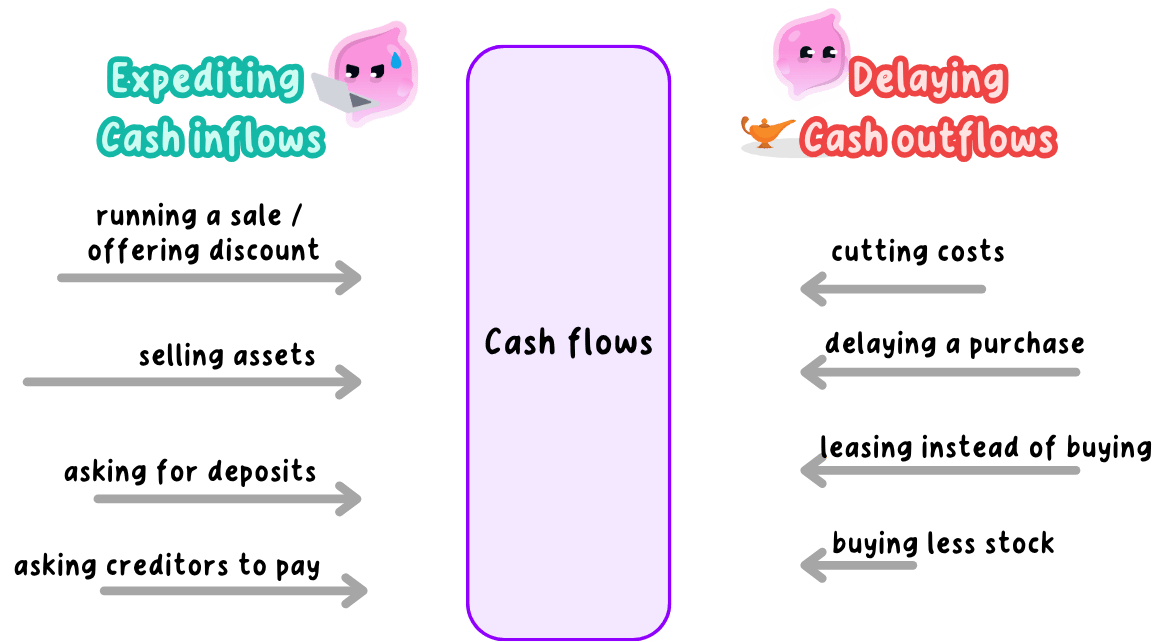
- Cutting costs: overtime, agency staff, advertising spend and any non-essential purchase can be stopped this month, which lowers outflows straight away and permanently rather than just delaying them. Cut into the wrong things and the damage lands later, because dropping advertising shrinks next quarter's sales and skipping maintenance turns a service into a breakdown.
- Delaying a purchase: a planned £8,000 van or shop refit can be postponed until the cash position recovers, which removes a large single outflow at no cost in interest. The business runs on older equipment for longer, so repair bills and downtime rise and any growth the purchase would have supported is put off.
- Leasing instead of buying: renting equipment for a monthly fee replaces one large payment with small predictable ones, so the business gets the machine without draining the bank. Over several years the total paid is higher than the purchase price and the business never owns the asset, so it cannot sell it later to raise cash.
- Buying stock in smaller batches: ordering weekly rather than monthly keeps cash in the account between deliveries instead of tied up on the shelves. Small orders lose the bulk discount, delivery charges rise, and a busy week can leave the shelves empty and the customer walking out.
Example
- Ashby Joinery in Leicester needs a second spray booth costing £12,000 but is short of cash for the next two months.
- It leases the booth for £320 a month instead, so the workshop takes on the extra orders without a £12,000 outflow it cannot afford.
Increasing cash inflows
- Running a sale: discounting slow-moving stock converts goods sitting in the stockroom into cash within days, which is faster than any other route. Each item sold now earns less profit, and regular discounting trains customers to wait for the next sale, so a business that does it too often damages its normal prices.
- Offering a discount for early payment: taking 2 per cent off an invoice settled within 10 days gives credit customers a reason to pay weeks earlier than they otherwise would. The discount is revenue given away on money the business was going to receive anyway, so it is only worth it if the cash is genuinely needed now.
- Selling an unused asset: a spare van, an idle machine or surplus land can be sold for a lump sum with no borrowing and no repayments. The asset is gone permanently, a quick sale usually fetches less than it is worth, and the business has to buy or hire one again if trade picks up.
- Asking for deposits: taking 30 per cent up front on made-to-order work brings cash in before the materials are bought, which is how many kitchen fitters fund each job. Customers may refuse, or choose a competitor who asks for nothing until the work is finished.
Common Mistake
- Do not offer "increase profit" or "sell more" as the solution to a cash flow problem, because bills are settled with cash and a sale on credit brings none in this month.
- Rapid growth can make cash flow worse before it makes it better, since the stock and wages for the extra orders are paid for weeks before the customers pay.
An overdraft or a new source of finance
Definition
Overdraft: an arrangement that lets a business spend more than it holds in its current account, up to an agreed limit, with interest charged only on the amount used.
- An overdraft is the natural fix for a short gap, because the business dips into it only on the days it is short and stops paying for it the moment customers' money lands. Nothing has to be cut, no supplier is upset and no customer notices.
- It is the dearest way to borrow per pound, there is usually an arrangement fee, and it is repayable on demand, so a bank that loses confidence can withdraw the facility exactly when the business needs it most.
- For a shortage lasting several months, a short-term bank loan, extra capital from the owners or money from family and friends is cheaper and more secure than sitting at an overdraft limit all year.
- Every borrowed pound becomes a future cash outflow with interest on top, so new finance buys time. A business that consistently pays out more cash than it collects has to fix its inflows or its outflows, because borrowing only postpones the day it runs out.
Choosing between the solutions
- Start by deciding whether the forecast shows one negative month between positive ones or a run of them, because a timing gap deserves an overdraft or a rescheduled invoice while a lasting shortage needs costs cut or prices raised.
- Check how fast each option delivers, since an overdraft can be arranged in days, a debtor can be chased this week, but selling premises or negotiating new terms takes months.
- Then ask which relationship the business can least afford to damage, because a firm with one specialist supplier should pay it on time and borrow instead, while a firm with a dozen interchangeable suppliers can negotiate harder.
- For Thornbury Tools the better answer is a small overdraft rather than delaying the supplier, because the gap is only £1,300 for a single month and March's takings repay it, so a few pounds of interest is a smaller price than risking the trade credit the shop relies on for the rest of the year.
Self review
- Give the two directions in which payments can be rescheduled.
- What does a business lose by delaying payments to its suppliers?
- Name three ways to reduce cash outflows and three ways to increase cash inflows.
- Why does an overdraft suit a one-month shortage better than a five-year loan?
- Why can new finance never cure a business that pays out more cash than it collects?
