Revenue: the money coming in
Revenue: the total money a business receives from selling its goods or services, before any costs are taken away.
Turnover: another name for the same figure, sometimes also called sales revenue.
- Revenue depends on two things only, the price charged and the number of units sold.
- Greggs earns revenue the same way, taking the price of each sausage roll, coffee and sandwich and multiplying it by the number sold, added up across every shop.
- Every figure in this article comes from one business, Craft and Crumb, an independent bakery in Leeds.
- Craft and Crumb sells sourdough loaves at £4.50 each, and in March it sold 2,000 of them.
- That £9,000 is everything customers handed over during March, and none of it is the owner's to keep yet, because every bill for the month still has to come out of it.
Fixed costs, variable costs and total costs
Fixed costs: costs that do not change when output changes, such as rent, insurance and salaries.
Variable costs: costs that rise and fall directly with output, such as raw materials and packaging.
Total costs: the fixed costs and the variable costs added together for a given level of output.
- To sort any cost into one group or the other, ask a single question: does this cost change when output changes?
- The fixed costs stay put. Craft and Crumb pays £1,800 rent, £200 insurance and a £1,000 manager's salary each month, so £3,000 is owed whether the bakery makes 2,000 loaves or none at all.
- The variable costs move with output. Each loaf swallows £1.20 of flour, yeast, packaging and oven energy, so this bill grows with every extra loaf baked.
- Variable costs are found per unit and then scaled up to the output, and the two groups of cost are then added together to give total costs.
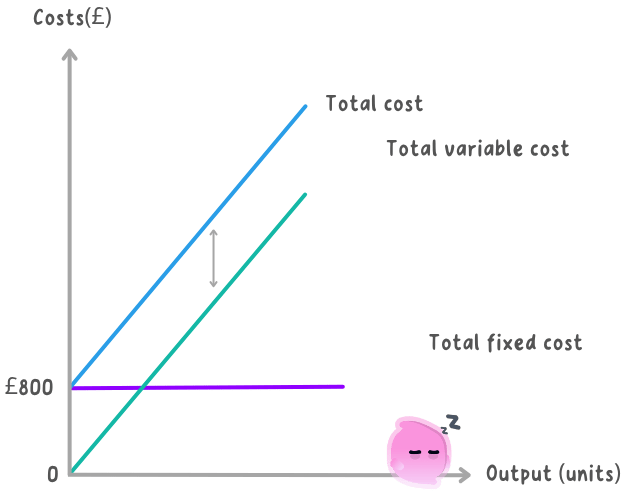
- In March, Craft and Crumb carried £3,000 of fixed costs and baked 2,000 loaves at a variable cost of £1.20 each.
- That £2,400 vanishes completely in a month with no baking, because every penny of it is attached to a loaf.
- Running the bakery in March cost £5,400, and because £3,000 of that is fixed, a quiet month is dangerous: the rent arrives even when the customers do not.
- Fixed does not mean permanent, because a landlord can raise the rent and Greggs takes on more rent every time it opens another shop.
- Fixed means only that the cost does not move when output moves.
Profit: what is left when the costs come out
Profit: the amount left when total costs are subtracted from revenue.
Loss: what a business makes when its total costs are greater than its revenue, so the subtraction gives a negative answer.
- Profit is the gap between two figures that have already been worked out, the revenue and the total costs, so both have to be found before the subtraction can be done.
- A positive answer is a profit, and it is the only money in the business the owner is free to take out, reinvest, or save for later.
- March gave Craft and Crumb revenue of £9,000 and total costs of £5,400.
- That £3,600 is what March actually earned the owner, and it is the money she can pay herself with, put towards a second oven, or hold back for a thinner month.
A month that makes a loss
- A loss appears whenever total costs are greater than revenue, so the same subtraction gives a negative answer.
- January was far quieter, with only 600 loaves sold, though the £4.50 price, the £3,000 of fixed costs and the £1.20 a loaf all stayed exactly where they were.
- January's 600 loaves have to be run through all three calculations again.
- The answer is negative, so January was a loss of £1,020.
- Nothing had gone wrong with the baking: sales fell while £3,000 of fixed costs stayed put, and the owner had to cover the gap from savings or an overdraft.
Write a negative answer up in words as a loss of £1,020, rather than leaving a minus sign to make the point for you.
Why revenue is not profit
- Revenue measures how much money came in, while profit measures what survives once total costs come back out, so the two figures answer different questions.
- Craft and Crumb took £9,000 in March and kept £3,600 of it, and in January it took £2,700 and kept nothing at all.
- A business can grow its revenue and still make a bigger loss, if its costs are growing faster than its sales.
- When a question asks how much a business made, decide whether it wants revenue or profit before you pick figures out of the data.
- Which two figures are multiplied together to find revenue?
- What single question tells you whether a cost is fixed or variable?
- A bakery has fixed costs of £3,000 and variable costs of £2,400: what are its total costs?
- Revenue is £2,700 and total costs are £3,720: what is the result, and what is it called?
- Why can a business with high revenue still make a loss?
