Unlimited liability
Definition
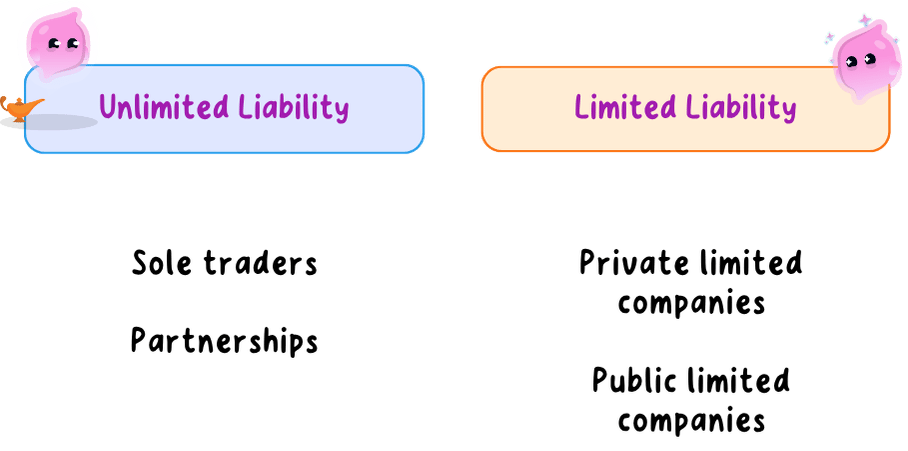
Unlimited liability: the owner is personally responsible for all the debts of the business, with no limit, so personal possessions can be sold to pay them.
- An unincorporated business has no legal identity of its own, so its debts are simply the owner's debts.
- If the business cannot pay, a court can order the owner's savings, car and even their home to be sold to settle what is owed.
- It applies to sole traders and partnerships, and in a partnership debts run up by one partner can be recovered from the others.
- The effect on behaviour is real, because an owner whose house is at stake turns down the risky contract and grows more slowly than they otherwise might.
Example
- A sole trader builder in Bristol buys £40,000 of materials on trade credit for a large extension.
- The customer runs out of money halfway through, so no final payment ever arrives.
- The £40,000 is still owed to the merchant, and because he has unlimited liability the debt is his personally.
- His savings can be taken to cover it, and if they fall short his house can be sold.
Limited liability
Definition
Limited liability: the owners of a company can only lose the money they invested in it, because the company is a separate legal person and the debts belong to the company.
- It applies to private limited companies and public limited companies, the two incorporated structures.
- Shareholders' personal possessions are protected, because they are not liable for the debts of the business.
- There is a guaranteed limit to their losses, since only the amount paid for the shares can be lost.
- Knowing the worst case in advance is what makes outside investment possible, because somebody will risk £5,000 on a stranger's business when they would never risk their house on it.
- The people who carry the risk instead are the suppliers and lenders, who may go unpaid when a limited company fails.
Common Mistake
- Limited liability does not mean the business has a limited amount of money.
- It means the shareholders' losses are limited to what they invested, and some of the largest companies in the UK have it.
- It also does not mean the debts disappear, because the company still owes the money and its own assets are still sold to pay what it can.
Choosing a structure for a new start-up
- Most new businesses start as sole traders, because it is quick, cheap, private and needs no accounts to be published.
- That suits a start-up whose risks and costs are small, such as a private tutor or a freelance designer, where the worst case is a few hundred pounds of unsold time.
- A partnership makes sense when the start-up needs more capital or skills than one person has, though joint unlimited liability means the partners must trust each other.
- Incorporating from day one is worth the extra cost when the business will borrow heavily or work in a sector where a single mistake is expensive, such as food manufacturing or construction.
- So for a start-up the decision turns on how much could go wrong and how much money is needed, not on how ambitious the owner feels.
Choosing a structure for a large established business
- A large business almost always needs limited liability, because the sums it owes at any moment are far beyond what any individual could cover.
- A private limited company suits an established firm that wants the protection and the extra finance while keeping decisions inside the family.
- A public limited company suits a firm that needs sums only the stock market can supply, and whose owners accept outside shareholders as the price.
- The drawbacks of floating are real, since the founders can be outvoted, a rival can mount a takeover, the accounts are public, and floating itself costs a large sum in fees.
Example
- Greggs shows the whole journey in one business.
- It began in 1939 as a small family bakery in Newcastle.
- It floated on the stock market in 1984, raising the finance to expand well beyond the North East.
- As a plc it now runs more than two thousand shops, a scale no family could have funded from profit alone.
- The trade-off is visible in every set of results, because the board now answers to thousands of shareholders rather than to one family.
Recommending a structure
- When you are asked to advise a business on changing structure, build the answer on four things rather than listing every feature you know.
- Control and decision making, because moving from sole trader to Ltd means sharing decisions that used to be one person's.
- Liability, because incorporating protects the owner's home and that protection is worth more the riskier the sector is.
- Finance and access to capital, because share capital does not have to be repaid whereas a loan does.
- Growth potential, because the structure has to fit where the business is trying to get to, not just where it is now.
- Then weigh the loss of control against the ability to raise finance that never has to be repaid, and commit to an answer rather than leaving both sides open.
Exam technique
- The short stem to have ready is explain one benefit to shareholders of limited liability, which has appeared word for word in more than one series.
- The answer wanted is the guaranteed limit to their losses, since only the amount the shareholder paid for their shares can be lost.
- The long one reads X is considering changing the legal structure from a sole trader to a private limited company, advise X whether this is a good idea, where the four headings above give you the shape of the answer.
Self review
- Define limited liability.
- Which two legal structures have unlimited liability?
- Explain one benefit to shareholders of limited liability.
- Give one reason a low-risk start-up might stay a sole trader.
- Name the four things to build a recommendation on legal structure around.
