The four factors of production
Definition
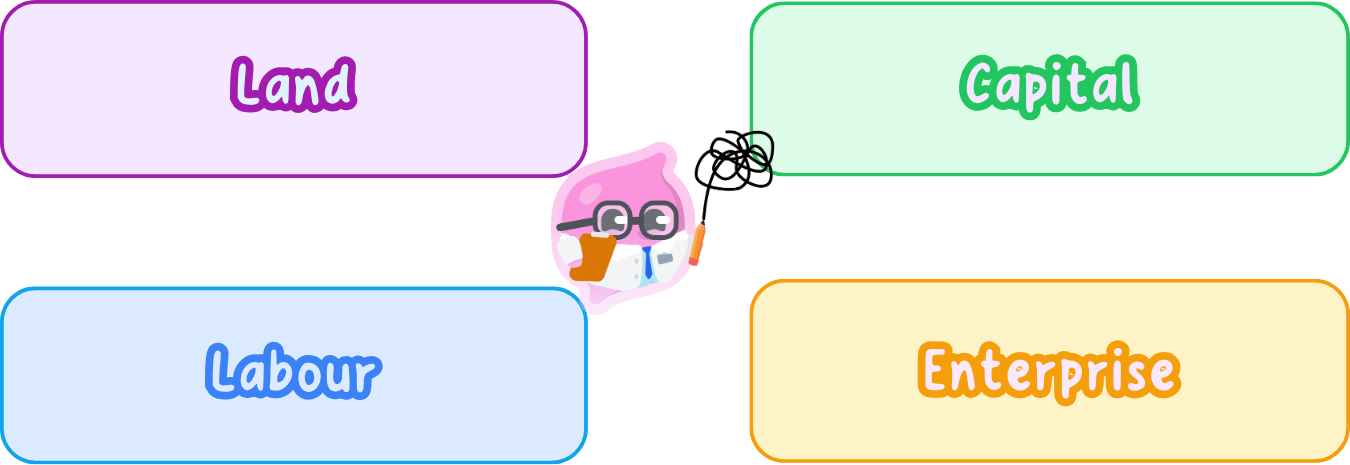
Factors of production: the four resources a business needs to produce anything, namely land, labour, capital and enterprise.
- Land is every natural resource the business uses, not just the ground it stands on.
- It includes the site of the shop or factory, farmland, fishing grounds, water, timber, oil and gas.
- Labour is the workforce needed to produce the product or service.
- It covers the bakers, drivers, shop assistants and managers, and its quality depends on skills and training.
- Capital is the equipment or machinery used to provide the goods or services.
- It includes ovens, delivery vans, tills, computers and the buildings themselves.
- Enterprise is organising the resources to take a risk and capitalise on a business opportunity.
- It is supplied by the entrepreneur, who decides what to produce and carries the loss if it goes wrong.
- All four are needed at once, so a bakery with a new oven but no baker sells nothing that morning, and the oven still has to be paid for.
Example
- An independent bakery in Stockport uses all four factors every day.
- Land: the shop unit it rents and the wheat grown by its flour supplier.
- Labour: the two bakers who start at 4am and the three staff who serve the queue.
- Capital: the £6,000 oven, the mixers and the display counter.
- Enterprise: the owner who put in her savings, chose the location and decided to open on Sundays.
Capital means equipment, never money
- Capital is the equipment, machinery, vehicles and buildings the business uses to produce.
- The money used to buy that equipment is finance, and it comes from savings, a bank loan or retained profit.
- Judge a resource by what it does, so a field is land, the tractor on it is capital, the farmer's work is labour, and the decision to open a farm shop is enterprise.
Common Mistake
- Never write that capital is the money a business has, because capital is the equipment or machinery used to produce the goods or services.
- A paid manager is labour, not enterprise, because they earn a wage and do not risk their own money.
Opportunity cost: the next best alternative given up
Definition
Opportunity cost: the next best alternative that is given up when a choice is made.
- A business has a limited amount of money, time and space, so choosing to use a resource one way rules out using it another way.
- Opportunity cost is not the money spent, and this is the most common error on this topic.
- It is the one option the business sacrificed, so there is only ever one opportunity cost per decision, not a list.
Example
- The Stockport bakery has £6,000 available and two realistic uses for it.
- Option A is a second oven, letting it bake around 20% more stock each morning.
- Option B is refitting the shopfront to pull in more passing trade.
- She buys the oven, so the opportunity cost is the shopfront refit, not the £6,000.
- The trade-off is real because she can only afford one, so the extra passing trade is the sacrifice she has made to raise output.
Opportunity cost at every size of business
- Opportunity cost applies at every size of business, because even Greggs has only a fixed budget for investment each year.
- If Greggs spends that budget opening new high street shops, the opportunity cost is the extra bakery and distribution capacity the same money would have bought, which would have lowered the cost of making each sausage roll.
Exam technique
- Factors of production come up as state two factors of production and as identify and explain two factors of production other than land.
- When the stem rules a factor out, check the ones you choose are not that factor in disguise, because the site of the shop is land even though it feels like part of the equipment.
- For opportunity cost, phrase your answer as the opportunity cost of X is Y, where Y is the named option that was sacrificed and never the sum of money.
Self review
- List the four factors of production.
- Explain what capital means, without using the word money.
- Is a delivery van land or capital, and why?
- Define opportunity cost in one sentence.
- A café spends £2,000 on new tables instead of a coffee machine. What is the opportunity cost?
